With the help of a ray diagram, show the formation of image of a point object due to refraction of light at a spherical surface separating two media of refractive indices $n_1$ and $n_2 (n_2 > n_1)$ respectively. Using this diagram, derive the relation.
$\frac{\text{n}_2}{\text{v}}-\frac{\text{n}_1}{\text{u}}=\frac{\text{n}_1-\text{n}_2}{\text{R}}$
Write the sign conventions used. What happens to the focal length of convex lens when it is immersed in water?
$\frac{\text{n}_2}{\text{v}}-\frac{\text{n}_1}{\text{u}}=\frac{\text{n}_1-\text{n}_2}{\text{R}}$
Write the sign conventions used. What happens to the focal length of convex lens when it is immersed in water?
Download our app for free and get started
Formula for Refraction at Spherical Surface Concave Spherical Surface:Let SPS′ be a spherical refracting surface, which separates media '1' and '2'. Medium '1' is rarer and medium '2' is denser. The refractive indices of media '1' and '2' are $n_1$ and $n_2$ respectively $(n_1 < n_2)$ Let P be the pole and C the centre of curvature and PC the principal axis of spherical refracting surface.
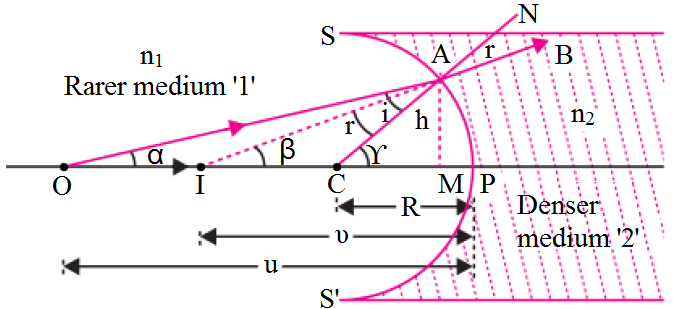
O is a point-object on the principal axis. An incident ray OA, after refraction at A on the spherical surface bends towards the normal CAN and moves along AB. Another incident ray OP falls on the surface normally and hence passes undeviated after refraction. These two rays, when produced backward meet at point I on principal axis. Thus I is the virtual image of O. Let angle of incidence of ray OA be i and angle of refraction be r i.e.
$\angle\text{OAC} = \text{i}\text{ and } \angle\text{NAB}= \text {r}$
Let $\angle\text{AOP}=\alpha,\angle\text{AIP}=\beta\text{ and }\angle\text{ACP}=\gamma$
In triangle OAC, $\gamma=\alpha+\text{i}\text{ or}\text{ i}=\gamma-\text{a}\dots(\text{i})$
In triangle AIC, $\gamma=\beta+\text{i}\text{ or}\text{ i}=\gamma-\text{a}\dots(\text{ii})$
From Snell's law $\frac{\sin\text{i}}{\sin\text{r}}=\frac{\text{n}_2}{\text{n}_1}\dots(\text{iii})$
If point A is very near to P, then angles $\text{i},\text{r},\alpha,\beta\ \gamma$ will be very small, therefore $\sin \text{i} = \text{i} \text{ and }\sin \text{r} =\text{r}$
Substituting values of i and r from (i) and (ii) we get
$\frac{\gamma-\alpha}{\gamma-\beta}=\frac{\text{n}_2}{\text{n}_1}\text{ or }\text{n}_1(\gamma-\alpha)=\text{n}_2(\gamma-\beta)\dots(\text{iv})$
The length of perpendicular AM dropped from A on the principal axis is h i.e. AM = h. As angles $\alpha,\ \beta\ \text{and}\ \gamma$ are very small, therefore
$\tan\alpha=\alpha,\tan \beta=\beta,\gamma=\gamma$
Substituting these values in equation (iv)
$\text{n}_1(\tan\gamma-\tan\alpha)=\text{n}_2(\tan\gamma-\tan\beta)\dots(\text{v})$
As point A is very close to P, point M is coincident with P
$\tan\alpha=\frac{\text{perpendicular}}{\text{Base}}=\frac{\text{AM}}{\text{MO}}=\frac{\text{h}}{\text{PO}}$
$\tan\beta=\frac{\text{AM}}{\text{MI}}=\frac{\text{h}}{\text{PI}},$
$\tan\gamma=\frac{\text{AM}}{\text{MC}}=\frac{\text{h}}{\text{PC}}$
Substituting this value in (v), we get
$\text{n}_1\Big(\frac{\text{h}}{\text{PC}}-\frac{\text{h}}{\text{PO}}\Big)=\text{n}_2\Big(\frac{\text{h}}{\text{PC}}-\frac{\text{h}}{\text{PI}}\Big)$
$\text{or }\frac{\text{n}_1}{\text{PC}}-\frac{\text{n}_1}{\text{PC}}=\frac{\text{n}_2}{\text{PC}}-\frac{\text{n}_2}{\text{PI}}$
Let u, v and R be the distances of object O, image I and centre of curvature C from pole P. By sign convention PO, PI and PC are negative, i.e. u = -PO, v = -PI and R = -PC
Substituting these values in (vi), we get
$\frac{\text{n}_1}{(-\text{R})}-\frac{\text{n}_1}{(-\text{u})}=\frac{\text{n}_2}{(-\text{R})}-\frac{\text{n}_2}{(-\text{v})}$
$\text{or }\frac{\text{n}_2}{\text{v}}-\frac{\text{n}_1}{\text{u}}=\frac{\text{n}_2-\text{n}_1}{\text{R}}$
Sign Conventions:
$\frac{1}{\text{f}}=(\text{n}-1)\big[\frac{1}{\text{R}_1}-\frac{1}{\text{R}_2}\big]$
When convex lens is immersed in water, refractive index n decreases and hence focal length will increase i.e., the focal length of a convex lens increases when it is immersed in water.
O is a point-object on the principal axis. An incident ray OA, after refraction at A on the spherical surface bends towards the normal CAN and moves along AB. Another incident ray OP falls on the surface normally and hence passes undeviated after refraction. These two rays, when produced backward meet at point I on principal axis. Thus I is the virtual image of O. Let angle of incidence of ray OA be i and angle of refraction be r i.e.
$\angle\text{OAC} = \text{i}\text{ and } \angle\text{NAB}= \text {r}$
Let $\angle\text{AOP}=\alpha,\angle\text{AIP}=\beta\text{ and }\angle\text{ACP}=\gamma$
In triangle OAC, $\gamma=\alpha+\text{i}\text{ or}\text{ i}=\gamma-\text{a}\dots(\text{i})$
In triangle AIC, $\gamma=\beta+\text{i}\text{ or}\text{ i}=\gamma-\text{a}\dots(\text{ii})$
From Snell's law $\frac{\sin\text{i}}{\sin\text{r}}=\frac{\text{n}_2}{\text{n}_1}\dots(\text{iii})$
If point A is very near to P, then angles $\text{i},\text{r},\alpha,\beta\ \gamma$ will be very small, therefore $\sin \text{i} = \text{i} \text{ and }\sin \text{r} =\text{r}$
Substituting values of i and r from (i) and (ii) we get
$\frac{\gamma-\alpha}{\gamma-\beta}=\frac{\text{n}_2}{\text{n}_1}\text{ or }\text{n}_1(\gamma-\alpha)=\text{n}_2(\gamma-\beta)\dots(\text{iv})$
The length of perpendicular AM dropped from A on the principal axis is h i.e. AM = h. As angles $\alpha,\ \beta\ \text{and}\ \gamma$ are very small, therefore
$\tan\alpha=\alpha,\tan \beta=\beta,\gamma=\gamma$
Substituting these values in equation (iv)
$\text{n}_1(\tan\gamma-\tan\alpha)=\text{n}_2(\tan\gamma-\tan\beta)\dots(\text{v})$
As point A is very close to P, point M is coincident with P
$\tan\alpha=\frac{\text{perpendicular}}{\text{Base}}=\frac{\text{AM}}{\text{MO}}=\frac{\text{h}}{\text{PO}}$
$\tan\beta=\frac{\text{AM}}{\text{MI}}=\frac{\text{h}}{\text{PI}},$
$\tan\gamma=\frac{\text{AM}}{\text{MC}}=\frac{\text{h}}{\text{PC}}$
Substituting this value in (v), we get
$\text{n}_1\Big(\frac{\text{h}}{\text{PC}}-\frac{\text{h}}{\text{PO}}\Big)=\text{n}_2\Big(\frac{\text{h}}{\text{PC}}-\frac{\text{h}}{\text{PI}}\Big)$
$\text{or }\frac{\text{n}_1}{\text{PC}}-\frac{\text{n}_1}{\text{PC}}=\frac{\text{n}_2}{\text{PC}}-\frac{\text{n}_2}{\text{PI}}$
Let u, v and R be the distances of object O, image I and centre of curvature C from pole P. By sign convention PO, PI and PC are negative, i.e. u = -PO, v = -PI and R = -PC
Substituting these values in (vi), we get
$\frac{\text{n}_1}{(-\text{R})}-\frac{\text{n}_1}{(-\text{u})}=\frac{\text{n}_2}{(-\text{R})}-\frac{\text{n}_2}{(-\text{v})}$
$\text{or }\frac{\text{n}_2}{\text{v}}-\frac{\text{n}_1}{\text{u}}=\frac{\text{n}_2-\text{n}_1}{\text{R}}$
Sign Conventions:
- All the distances are measured from optical centre (P) of the lens.
- Distances measured in the direction of incident ray of light are taken positive and vice-versa.
$\frac{1}{\text{f}}=(\text{n}-1)\big[\frac{1}{\text{R}_1}-\frac{1}{\text{R}_2}\big]$
When convex lens is immersed in water, refractive index n decreases and hence focal length will increase i.e., the focal length of a convex lens increases when it is immersed in water.

Download our appand get started for free
Experience the future of education. Simply download our apps or reach out to us for more information. Let's shape the future of learning together!No signup needed.*
Similar Questions
- 1View SolutionThe mixture a pure liquid and a solution in a long vertical column (i.e, horizontal dimensions < < vertical dimensions) produces diffusion of solute particles and hence a refractive index gradient along the vertical dimension. A ray of light entering the column at right angles to the vertical is deviated from its original path. Find the deviation in travelling a horizontal distance d < < h, the height of the column.
- 2View SolutionWhat is the focal length of a convex lens of focal length 30cm in contact with a concave lens of focal length 20 cm? Is the system a converging or a diverging lens? Ignore thickness of the lenses.
- 3View Solution
- Draw a labelled ray diagram showing the formation of image by a compound microscope in normal adjustment. Derive the expression for its magnifying power.
- How does the resolving power of a microscope change when.
- The diameter of the objective lens is decreased,
- The wavelength of the incident light is increased.
- 4View SolutionA lady uses +1.5D glasses to have normal vision from 25cm onwards. She uses a 20D lens as a simple microscope to see an object. Find the maximum magnifying power if she uses then microscope
- Together with her glass
- Without the glass. Do the answers suggest that an object can be more clearly seen through a microscope without using the correcting glasses?
- 5View SolutionA compound microscope consists of an objective lens of focal length 2.0 cm and an eyepiece of focal length 6.25 cm separated by a distance of 15 cm. How far from the objective should an object be placed in order to obtain the final image at (a) the least distance of distinct vision (25 cm), and (b) at infinity? What is the magnifying power of the microscope in each case?
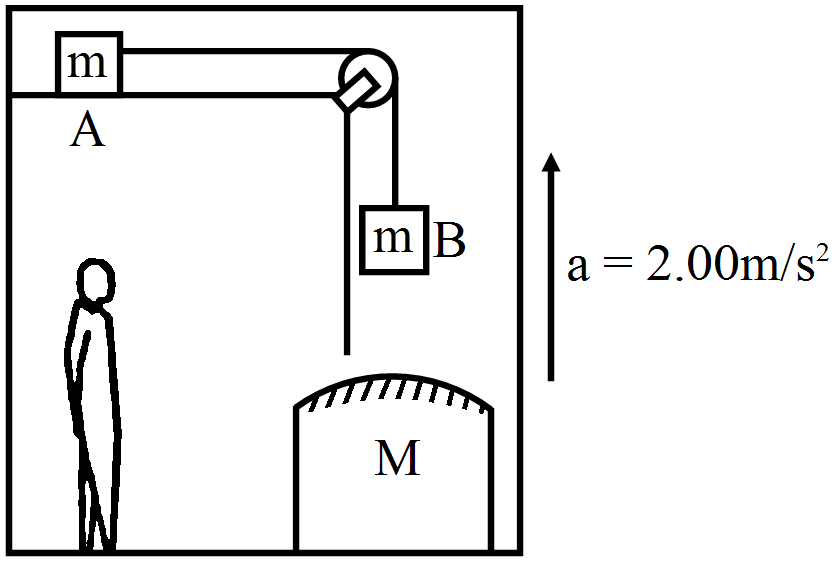
- 6Consider the situation shown in figure. The elevator is going up with an acceleration of $2.00m/s^2$ and the focal length of the mirror is 12.0cm. All the surfaces are smooth and the pulley is light. The mass-pulley system is released from rest (with respect to the elevator) at t = 0 when the distance of B from the mirror is 42.0cm. Find the distance between the image of the block B and the mirror at $t = 0.200s$. Take $g = 10m/s^2$.View Solution
- 7The refractive index of a material $M_1$ changes by 0.014 and that of another material $M_2$ changes by 0.024 as the colour of the light is changed from red to violet. Two thin prisms one made of $M_1(A = 5.3^\circ)$ and other made of $M_2(A = 3.7^\circ)$ are combined with their refracting angles oppositely directed.View Solution
- Find the angular dispersion produced by the combination.
- The prisms are now combined with their refracting angles similarly directed. Find the angular dispersion produced by the combination.
- 8View Solution
- With the help of a suitable ray diagram, derive the mirror formula for a concave mirror.
- The near point of a hypermetropic person is 50 cm from the eye. What is the power of the lens required to enable the person to read clearly a book held at 25 cm from the eye?
- 9View SolutionA man with normal near point (25 cm) reads a book with small print using a magnifying glass: a thin convex lens of focal length 5 cm.
- What is the closest and the farthest distance at which he should keep the lens from the page so that he can read the book when viewing through the magnifying glass?
- What is the maximum and the minimum angular magnification (magnifying power) possible using the above simple microscope?
- 10Light is incident from glass $(\mu=1.50)$ to water $(\mu=1.33).$ Find the range of the angle of deviation for which there are two angles of incidence.View Solution