Question
The current in series $LCR$ circuit will be maximum when $\omega$ is

Answer

(d) At resonant frequency current in series $LCR$ circuit is maximum.

Need a full question paper?

Generate a complete, print-ready paper with questions like this in minutes — across 16+ boards, with answer keys.

Start Generating Free

Similar questions

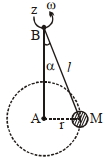
A mass $M$ hangs on a massless rod of length $l$ which rotates at a constant angular frequency. The mass $M$ moves with steady speed in a circular path of constant radius. Assume that the system is in steady circular motion with constant angular velocity $\omega .$ The angular momentum of $M$ about point $A$ is $L _{ A }$ which lies in the positive $z$ direction and the angular momentum of $M$ about $B$ is $L _{ B }$. The correct statement for this system is
In which of the following systems of unit, $Weber$ is the unit of magnetic flux
A person's near point is $50 \,cm$ and his far point is $3 \,m$. Power of the lenses he requires for

$(i)$ reading and

$(ii)$ for seeing distant stars are
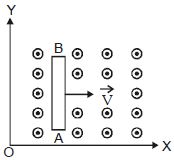
A conducting rod $AB$ moves parallel to $X-$ axis in a uniform magnetic field, pointing in the positive $X-$ direction. The end $A$ of the rod gets
If the angles of dip at two places are $30^o$ and $45^o$ respectively, then the ratio of horizontal components of earth's magnetic field at the two places will be
In an $LCR$ series $ac$ circuit, the voltage across each of the components, $L,\, C$  and $R$ is $50\,V$. the voltage across the $LC$ combination will be........$V$
The value of angle of dip is zero at the magnetic equator because on it
A cell can be balanced against $110\,\, cm$ and $100\,\, cm$ of potentiometer wire, respectively with and without being short circuited through a resistance of $10 \,\,\Omega$. Its internal resistance is ............... $\Omega$
An electron of mass $m$ and charge $q$ is travelling with a speed $v$ along a circular path of radius $r$ at right angles to a uniform of magnetic field $B$. If speed of the electron is doubled and the magnetic field is halved, then resulting path would have a radius of
A $10\, \mu F$ capacitor is fully charged to a potential difference of $50\, V$. After removing the source voltage it is connected to an uncharged capacitor in parallel. Now the potential difference across them becomes $20\, V$. The capacitance of the second capacitor is......$\mu F$