An electron of mass $m$ and charge $q$ is travelling with a speed $v$ along a circular path of radius $r$ at right angles to a uniform of magnetic field $B$. If speed of the electron is doubled and the magnetic field is halved, then resulting path would have a radius of
Medium


Download our appand get started for free
Experience the future of education. Simply download our apps or reach out to us for more information. Let's shape the future of learning together!No signup needed.*
Similar Questions
- 1A particle with charge to mass ratio, $\frac{q}{m} = \alpha $ is shot with a speed $v$ towards a wall at a distance $d$ perpendicular to the wall. The minimum value of $\vec B$ that exist in this region perpendicular to the projection of velocity for the particle not to hit the wall isView Solution
- 2A $10 \;eV$ electron is circulating in a plane at right angles to a uniform field at magnetic induction $10^{-4} \;W b / m^{2}(=1.0$ gauss), the orbital radius of electron is ........ $cm$View Solution
- 3In an ammeter $0.2\%$ of main current passes through the galvanometer. If resistance of galvanometer is $G,$ the resistance of ammeter will beView Solution
- 4A current of $3$ $amp$ is flowing in a plane circular coil of radius $4\, cm$ and number of turns $20$. The coil is placed in a uniform magnetic field of magnetic induction $0.5\, tesla$. Then, the dipole moment of the coil is.....$A-m^2$View Solution
- 5Two long parallel copper wires carry currents of $5\,A$ each in opposite directions. If the wires are separated by a distance of $0.5\,m$, then the force between the two wires isView Solution
- 6A straight section $PQ$ of a circuit lies along the $X$-axis from $x = - \frac{a}{2}$ to $x = \frac{a}{2}$ and carries a steady current $i$. The magnetic field due to the section $PQ$ at a point $X = + a$ will beView Solution
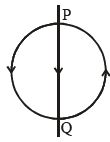
- 7A circular coil of wire carries a current. $PQ$ is a part of a very long wire carrying a current and passing close to the circular coil. If the directions of currents are those shown in figure, what is the direction of force acting on $PQ$ ?View Solution
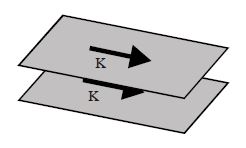
- 8View SolutionWhat are the directions of the magnetic field between and outside a pair of two parallel large sheets carrying currents in the same directions, as illustrated in Figure (from the side shown)?
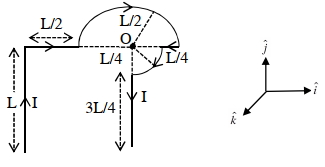
- 9Which one of the following options represents the magnetic field $\vec{B}$ at $O$ due to the current flowing in the given wire segments lying on the $x y$ plane?View Solution
- 10A straight section $PQ$ of a circuit lies along the $X$-axis from $x = - \frac{a}{2}$ to $x = \frac{a}{2}$ and carries a steady current $i$. The magnetic field due to the section $PQ$ at a point $X = + a$ will beView Solution