MCQ
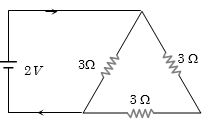
The current in the following circuit is ........... $A$
- A$\frac{1}{8}$
- B$\frac{2}{9}$
- C$\frac{2}{3}$
- ✓$1$
$\frac{1}{{{R_p}}} = \frac{1}{3} + \frac{1}{6} = \frac{{2 + 1}}{6} = \frac{3}{6}$
$ \Rightarrow $ ${R_p} = 2\,\Omega $
$ \Rightarrow $ $I = \frac{2}{2} = 1\,A$
Generate a complete, print-ready paper with questions like this in minutes — across 16+ boards, with answer keys.
$(A)$ $\beta_2>\beta_1$
$(B)$ $m_1>m_2$
$(C)$ From the central maximum, $3^{\text {rd }}$ maximum of $\lambda_2$ overlaps with $5^{\text {th }}$ minimum of $\lambda_1$
$(D)$ The angular separation of fringes for $\lambda_1$ is greater than $\lambda_2$
Assertion $A:$ Diffusion current in a $p-n$ junction is greater than the drift current in magnitude if the junction is forward biased.
Reason $R:$ Diffusion current in a $p-n$ junction is from the $n$-side to the $p$-side if the junction is forward biased.
In the light of the above statements, choose the most appropriate answer from the options given below
(Assume efficiency of the reactor is $50\%$)