MCQ
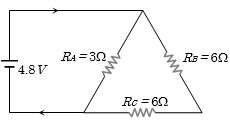
The current in the given circuit is ............ $A$
  • A
    $8.31$
  • B
    $6.82$
  • C
    $4.92$
  • $2$

Answer

Correct option: D.
$2$
d
$6$ $\Omega$ and $6\,\Omega$ are in series,

so effective resistance is $12$ $\Omega$

which is in parallel with $3$ $\Omega$,

so $\frac{1}{R} = \frac{1}{3} + \frac{1}{{12}} = \frac{{15}}{{36}}$

$ \Rightarrow $ $R = \frac{{36}}{{15}}$

$I = \frac{V}{R} = \frac{{4.8 \times 15}}{{36}} = 2\,A$

Need a full question paper?

Generate a complete, print-ready paper with questions like this in minutes — across 16+ boards, with answer keys.
Start Generating Free

Similar questions

In the figure, given that $V_{BB}$ supply can vary from $0$ to $5.0 \,V,\,\,V_{CC} = 5\,V,$ $\beta _{dc} = 200,\,\,R_B = 100,\,k\Omega ,$ $R_C = 1\,k\Omega  $ an $V_{BE} = 1.0\,V,$ The minimum base current and the input voltage at which the transistor will go to saturation, will be respectively
The voltage gain of the following amplifier is
Two point charges $Q$ and $-3Q$ are placed at some distance apart. If the electric field at the location of $Q$ is $E$ then at the locality of $ - 3Q$, it is
Consider the two idealised systems $(i)$ a parallel plate capacitor with large plates and small separation and $(ii)$ a long solenoid of length $L >> R$, radius of cross-section. In $(i)\, E$ ideally treated as a constant between plates and zero outside. In $(ii)$ magnetic field is constant inside the solenoid and zero outside. These idealised assumptions, however, contradict fundamental laws as below
Electric potential can be calculated in a:
A physical quantity is measured and the result is expressed as nu where u is the unit used and n is the numerical value. If the result is expressed in various units then:
A monochromatic point source of light is placed at a distance $d$ from a metal surface. Photo electrons are ejected at a rate $n$ per second, and with maximum kinetic energy $E$. If the source is brought nearer to distance $d / 2$, the rate and the maximum kinetic energy per photoelectron become nearly
According to corpuscular theory of light, the different colours of light are due to
An electron and a proton are at a distance of $1\,{\mathop A\limits^o }$. The moment of this dipole will be $(C × m)$
Huygens' concepts of secondary wavelets