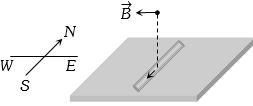
The current is flowing in south direction along a power line. The direction of magnetic field above the power line (neglecting earth's field) is
Easy


Download our appand get started for free
Experience the future of education. Simply download our apps or reach out to us for more information. Let's shape the future of learning together!No signup needed.*
Similar Questions
- 1The current in the windings on a toroid is $2.0\,A$. There are $400$ $turns$ and the mean circumferential length is $40\,cm$. If the inside magnetic field is $1.0\,T$, the relative permeability is near toView Solution
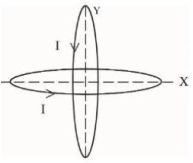
- 2Two identical circular wires of radius $20\,cm$ and carrying current $\sqrt{2}\,A$ are placed in perpendicular planes as shown in figure. The net magnetic field at the centre of the circular wire is $.............\times 10^{-8}\,T$. (Take $\pi=3.14$ )View Solution
- 3A galvanometer having a resistance of $9\, ohm$ is shunted by a wire of resistance $2\, ohm$. If the total current is $1\, amp$, the part of it passing through the shunt will be ............ $amp$View Solution
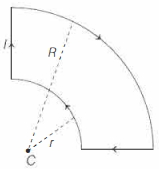
- 4An arrangement with a pair of quarter circular coils of radii $r$ and $R$ with a common centre $C$ and carrying a current $I$ is shown in the figure. The permeability of free space is $\mu_0$. The magnetic field at $C$ isView Solution
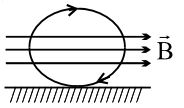
- 5A conducting ring of mass $2\,\, kg$ and radius $0.5\,\ m$ is placed on a smooth horizontal plane. The ring carries a current $i = 4A. A$ horizontal magnetic field $B = 10T$ is switched on at time $t = 0$ as shown in figure. The initial angular acceleration of the ring will beView Solution
- 6The magnetic moment of an electron $(e)$ revolving in an orbit around nucleus with an orbital angular momentum is given by :View Solution
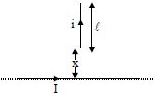
- 7View SolutionThe magnetic force between wires as shown in figure is :-
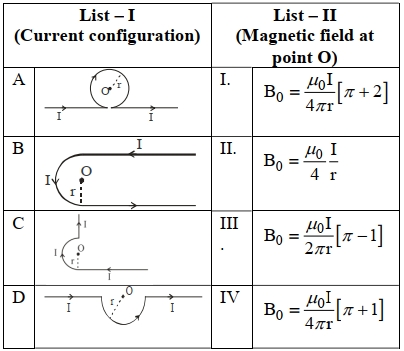
- 8Math List $I$ with List $II$View Solution
Choose the correct answer from the option given below:
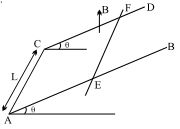
- 9$AB$ and $CD$ are smooth parallel rails, separated by a distance $l$, and inclined to the horizontal at an angle $\theta$ . $A$ uniform magnetic field of magnitude $B$, directed vertically upwards, exists in the region. $EF$ is a conductor of mass $m$, carrying a current $i$. For $EF$ to be in equilibrium,View Solution
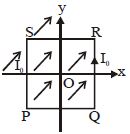
- 10A uniform, constant magnetic field $\vec B$ is directed at an angle of $45^o$ to the $x-$ axis in the $xy-$ plane, $PQRS$ is a rigid square wire frame carrying a steady current $I_0,$ with its centre at the origin $O.$ At time $t = 0,$ the frame is at rest in the position shown in the figure, with its sides parallel to the $x$ and $y$ axis. Each side of the frame is of mass $M$ and Length $L$View Solution