Question
The current−voltage characteristic of an ideal p-n junction diode is given by $\text{i}=\text{i}_0\Big(\text{e}^{\frac{\text{eV}}{\text{kT}}}-1\Big)$ where, the drift current $i_0$ equals $10\mu\text{A}.$ Take the temperature T to be 300K.
  1. Find the voltage $V_0$ for which $\text{e}^{\frac{\text{eV}}{\text{KT}}}=100.$ One can neglect the term 1 for voltages greater than this value.
  2. Find an expression for the dynamic resistance of the diode as a function of $V$ for $V > V_0$.
  3. Find the voltage for which the dynamic resistance is $0.2\Omega.$
Answer

 
  1. The current‒voltage relationship of a diode is given by $\text{i}=\text{i}_0\Big(\text{e}^{\frac{\text{eV}}{\text{kT}-1}}\Big)$
For a large value of voltage, 1 can be neglected.
$\text{i}\approx\text{i}_0\text{e}^{\frac{\text{eV}}{\text{KT}}}$
Again, we need to find the voltage at which
$\text{e}^{\frac{\text{eV}}{\text{KT}}}=100$
$\Rightarrow\frac{\text{eV}}{\text{kT}}=\text{In }100$
$\Rightarrow\text{V}=\frac{\text{In }100\times\text{kT}}{\text{e}}$
$\Rightarrow\text{V}=\frac{2.303\times\log\ 100\times8.62\times10^{-5}\times300}{\text{e}}$
$\Rightarrow\text{V}=0.12\text{V}$
  1. Given:
$\text{i}=\text{i}_0\Big(\text{e}^{\frac{\text{eV}}{\text{kT}-1}}\Big)\ ...(1)$
We know that the dynamic resistance of a diode is the rate of change of voltage w.r.t. current.
i.e. $\text{R}=\frac{\text{dV}}{\text{di}}$
As the exponential factor dominates the factor of 1, we can neglect this factor.
Now, on differentiating eq. (1) w.r.t. V, we get,
$\frac{\text{di}}{\text{dV}}=\text{i}_0\frac{\text{e}}{\text{kT}}\text{e}^{\frac{\text{eV}}{\text{kT}}}$
$\Rightarrow\frac{1}{\text{R}}=\frac{\text{ei}_0}{\text{kT}}\text{e}^{\frac{\text{eV}}{\text{kT}}}$
$\Rightarrow\text{R}=\frac{\text{kT}}{\text{ei}_0}\text{e}^{\frac{-\text{eV}}{\text{kT}}}\ ...(2)$
  1. Given,
$\text{R}=2\Omega$
On substituting this value in eq. (2), we get
$2=\frac{8.62\times10^{-5}\times300}{\text{e}\times10\times10^{-6}}\text{e}^{\frac{\text{-eV}}{8.62\times10^{-5}\times300}}$
$\Rightarrow\text{V}=0.25\text{V}.$

Need a full question paper?

Generate a complete, print-ready paper with questions like this in minutes — across 16+ boards, with answer keys.

Start Generating Free

Similar questions

The intensities due to two sources of sound are $I_0$ and $4I_0$. What is the intensity at a point where the phase difference between two waves is:
  1. $0^\circ$
  2. $\frac{\pi}{2}$
  3. $\pi?$
Define conservative and non$-$conservative forces. Give example and properties of conservative forces. A $5\ kg$ rifle fires a $58$ bullet with a speed of $500ms^{-1}$. What kinetic energy is acquired.
  1. By the bullet and.
  2. By the rifle?
  3. Find the the ratio of the distance which the rifle moves backward while the bullet is in the barrel to the distance the bullet moves forward.
A spring balance has a scale that reads from $0$ to $50kg$. The length of the scale is $20cm$. A body suspended from this balance, when displaced and released, oscillates with a period of $0.6s$. What is the weight of the body?
Explain by giving definition of Bulk Modulus of elasticity, Modulus of Rigidity and compressibility what are their units and dimensions? What is the relation between co-efficient of elasticity $Y , K$ and $\eta$ ?
A bucket full of water is placed in a room at $15^\circ C$ with initial relative humidity $40\%$. The volume of the room is $50m^3.$
  1. How much water will evaporate?
  2. lf the room temperature is increased by $5^\circ C, $ how much more water will evaporate? The saturation vapour pressure of water at $15^\circ C$ and $20^\circ C$ are $1.6$kPa and $2.4$kPa respectively.
A solid sphere of mass 0.50kg is kept on a horizontal surface. The coefficient of static friction between the surfaces in contact is $\frac{2}{7}.$ What maximum force can be applied at the highest point in the horizontal direction so that the sphere does not slip on the surface?
An incident wave and a reflected wave are represented by
$\xi_1=\text{a}\sin\frac{2\pi}{\lambda}(\nu\text{t}-\text{x})$
$\xi_2=\text{a}\sin\frac{2\pi}{\lambda}(\nu\text{t}+\text{x})$
Derive the equation of the stationary wave, and calculate the position of the nodes and antinodes.
Three moles of an ideal gas of $300K$ are isothermally expanded to five times its volume and heated at this constant volume so that the pressure is raised to its initial value before expansion. In the whole process $83.14\ kJ$ heat is required. Calculate the ratio $\frac{\text{C}_\text{P}}{\text{C}_\text{V}}$ of gas $(\log_\text{e}5=1.61).$
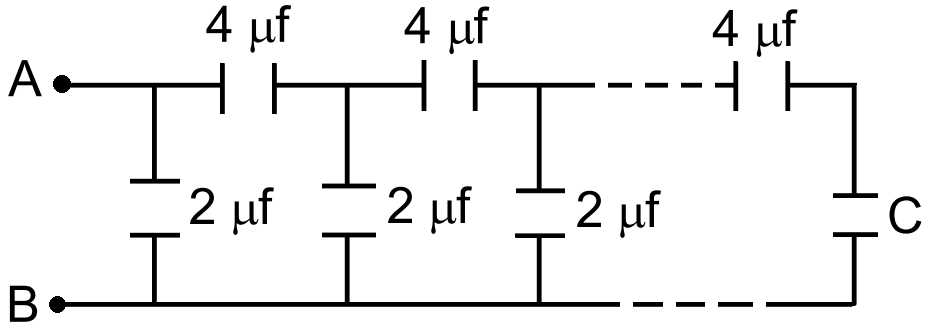
A finite ladder is constructed by connecting several sections of $2\mu\text{F},\ 4\mu\text{F}$ capacitor combinations as shown in figure. It is terminated by a capacitor of capacitance C. What value should be chosen for C, such that the equivalent capacitance of the ladder between the points A and B becomes independent of the number of sections in between?
Consider the situation of the previous problem. A charges of $-2.0 \times 10^{-4}C$ is moved from the point A to the point B. Find the change in electrical potential energy $U_B - U_A$ for the cases (a), (b) and (c).