The cyclotron frequency of an electron gyrating in a magnetic field of $1\, T$ is approximately
Medium
Download our app for free and get started
Cyclotron frequency,
${\mathrm{f}=\frac{\mathrm{q} \mathrm{B}}{2 \pi \mathrm{m}}=\frac{1.6 \times 10^{-19} \times 1}{2 \times 3.14 \times 9.1 \times 10^{-31}}} $
${=28 \times 10^{9} \mathrm{\,Hz}=28 \mathrm{\,GHz}}$

Download our appand get started for free
Experience the future of education. Simply download our apps or reach out to us for more information. Let's shape the future of learning together!No signup needed.*
Similar Questions
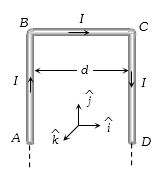
- 1$AB$ and $CD$ are long straight conductor, distance $d$ apart, carrying a current $I$. The magnetic field at the midpoint of $BC$ isView Solution
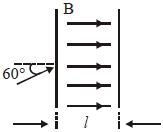
- 2The figure shows a region of length $'l'$ with a uniform magnetic field of $0.3\, T$ in it and a proton entering the region with velocity $4 \times 10^{5}\, ms ^{-1}$ making an angle $60^{\circ}$ with the field. If the proton completes $10$ revolution by the time it cross the region shown, $l$ is close to....... $m$View Solution
(mass of proton $=1.67 \times 10^{-27} \,kg ,$ charge of the proton $\left.=1.6 \times 10^{-19}\, C \right)$
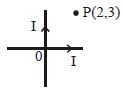
- 3Two mutually perpendicular insulated conducting wires carrying equal currents $I$, intersect at origin. Then the resultant magnetic induction at point $P(2m, 3m)$ will beView Solution
- 4If two protons are moving with speed $v=4.5 \times 10^{5} \,m / s$ parallel to each other then the ratio of electrostatic and magnetic force between themView Solution
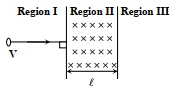
- 5A particle of mass $m$ and charge $\mathrm{q}$, moving with velocity $\mathrm{V}$ enters Region $II$ normal to the boundary as shown in the figure. Region $II$ has a uniform magnetic field B perpendicular to the plane of the paper. The length of the Region $II$ is $\ell$. Choose the correct choice$(s)$.View Solution
Figure: $Image$
$(A)$ The particle enters Region $III$ only if its velocity $V>\frac{q / B}{m}$
$(B)$ The particle enters Region $III$ only if its velocity $\mathrm{V}<\frac{\mathrm{q} / \mathrm{B}}{\mathrm{m}}$
$(C)$ Path length of the particle in Region $II$ is maximum when velocity $V=\frac{q / B}{m}$
$(D)$ Time spent in Region $II$ is same for any velocity $V$ as long as the particle returns to Region $I$
- 6View SolutionThe net charge in a current carrying wire is zero still magnetic field exerts a force on it, because a magnetic field exerts force on
- 7At a specific instant emission of radioactive compound is deflected in a magnetic field. The compound can emitView Solution
$(i)$ Electrons $(ii)$ Protons $(iii)$ $H{e^{2 + }}$ $(iv)$ Neutrons
The emission at the instant can be
- 8A current loop consists of two identical semicircular parts each of radius $R,$ one lying in the $x-y$ plane and the other in $x-z$ plane. If the current in the loop is $i.$ The resultant magnetic field due to the two semicircular parts at their common centre isView Solution
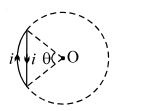
- 9Net magnetic field at the centre of the circle $O$ due to a current carrying loop as shown in figure is $(\theta < 180^o)$View Solution
- 10A wire of length $L$ is bent in the form of a circular coil and current $i$ is passed through it. If this coil is placed in a magnetic field then the torque acting on the coil will be maximum when the number of turns isView Solution