A current loop consists of two identical semicircular parts each of radius $R,$ one lying in the $x-y$ plane and the other in $x-z$ plane. If the current in the loop is $i.$ The resultant magnetic field due to the two semicircular parts at their common centre is
AIPMT 2010, Medium
Download our app for free and get started
The loop mentioned in the question must look like one as shown in the figure.
Magnetic field at the centre due to semicircular loop lying in $x-y$ plane, $B_{x y}=\frac{1}{2}\left(\frac{\mu_{0} i}{2 R}\right) \quad$ negative $z$ direction.
Similarly field due to loop in $x-z$ plane,
$B_{x z}=\frac{1}{2}\left(\frac{\mu_{0} i}{2 R}\right)$ in negative $y$ direction.
$\therefore$ Magnitude of resultant magnetic field,
$B =\sqrt{B_{x y}^{2}+B_{x z}^{2}}=\sqrt{\left(\frac{\mu_{0} i}{4 R}\right)^{2}+\left(\frac{\mu_{0} i}{4 R}\right)^{2}}$
$=\frac{\mu_{0} i}{4 R} \sqrt{2}=\frac{\mu_{0} i}{2 \sqrt{2} R}$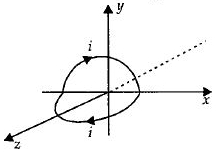

Download our appand get started for free
Experience the future of education. Simply download our apps or reach out to us for more information. Let's shape the future of learning together!No signup needed.*
Similar Questions
- 1A long wire carries a steady current. It is bent into a circle of one turn and the magnetic field at the centre of the coil is $B$. It is then bent into a circular loop of $n$ $turns$. The magnetic field at the centre of the coil will beView Solution
- 2A uniform beam of positively charged particles is moving with a constant velocity parallel to another beam of negatively charged particles moving with the same velocity in opposite direction separated by a distance $d.$ The variation of magnetic field $B$ along a perpendicular line draw between the two beams is best represented byView Solution
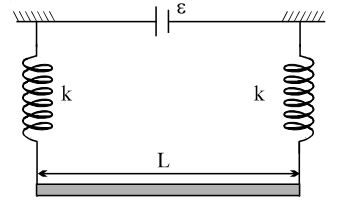
- 3A straight rod of mass $m$ and length $L$ is suspended from the identical spring as shown in the figure. The spring stretched by a distance of $x_0$ due to the weight of the wire. The circuit has total resistance $R\Omega$ . When the magnetic field perpendicular to the plane of the paper is switched on, springs are observed to extend further by the same distance. The magnetic field strength isView Solution
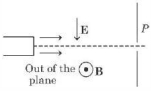
- 4A collimated beam of charged and uncharged particles is directed towards a hole marked $P$ on a screen as shown below. If the electric and magnetic fields as indicated below are turned $ON$View Solution
- 5View SolutionAssertion : If the current in a solenoid is reversed in direction while keeping the same magnitude, the magnetic field energy stored in the solenoid decreases.
Reason : Magnetic field energy density is proportional to square of current.
- 6${10^{ - 3}}amp$ is flowing through a resistance of $1000\,\Omega $. To measure the correct potential difference, the voltmeter is to be used of which the resistance should beView Solution
- 7Consider two identical galvanometers and two identical resistors with resistance $R$. If the internal resistance of the galvanometers $R_{ C } < R / 2$View Solution
($A$) The maximum voltage range is obtained when all the components are connected in series
($B$) The maximum voltage range is obtained when the two resistors and one galvanometer are connected in series, and the second galvanometer is connected in parallel to the first galvanometer
($C$) The maximum current range is obtained when all the components are connected in parallel
($D$) The maximum current range is obtained when the two galvanometers are connected in series and the combination is connected in parallel with both the resistors
- 8A solenoid of $N$ turn, $'l'$ length and $'r'$ radius of cross - section. If current $i$ flow in solenoid then magnetic field at axial mid point will be (where $l\, \simeq \,\,r$ )View Solution
- 9View SolutionAn electron and a proton have equal kinetic energies. They enter in a magnetic field perpendicularly, Then
- 10Work done by magnetic field of $1\,tesla$ on a particle of chargs $1\,C$ moving with speed $5\,m/s$ in one second........$J$View Solution