MCQ
The de Broglie wavelength $\lambda$ associated with a proton increases by $25 \%$, if its momentum is decreased by $p_0$. The initial momentum was
  • A
    $4 p_0$
  • B
    $\frac{p_0}{4}$
  • $5 p_0$
  • D
    $\frac{p_0}{5}$

Answer

Correct option: C.
$5 p_0$
c
(c)

$\frac{\lambda_2-\lambda_1}{\lambda_1}=\frac{25}{100}$

$\frac{\lambda_2}{\lambda_1}=\frac{5}{4} \Rightarrow \frac{P_1}{P_2}=\frac{5}{4}$

$P_2-P_1=-P_0$

$\frac{4 P_1}{5}-P_1=-P_0$

$P_1=5 P_0$

Need a full question paper?

Generate a complete, print-ready paper with questions like this in minutes — across 16+ boards, with answer keys.

Start Generating Free

Similar questions

A $2 \,m$ long rod of radius $1 \,cm$ which is fixed from one end is given a twist of $0.8$ radians. The shear strain developed will be
A vessel of volume $0.02 \,\,m^3$ contains a mixture of hydrogen and helium at $20\,^oC$ and $2$ atmospheric pressure. The mass of mixture is $5\,\, gms$. Find the ratio of mass of hydrogen to that of helium in the mixture.
A block of mass $m$ moving at a speed $v$ compresses a spring through a distance $x$ before its speed becomes one fourth. Find the spring constant of the spring
Column $I$ describe some situations in which a small object moves. Column $II$ describes some characteristics of these motions. Match the situation in Column $I$ with the characteristics in Column $II$ and indicate your answer by darkening appropriate bubbles in the $4 \times 4$ matrix given in the $ORS$.
Column $I$ Column $II$
$(A)$ The object moves on the $\mathrm{x}$-axis under a conservative force in such a way that its "speed" and "position" satisfy $v=c_1 \sqrt{c_2-x^2}$, where $\mathrm{c}_1$ and $\mathrm{c}_2$ are positive constants. $(p)$ The object executes a simple harmonic motion.
$(B)$ The object moves on the $\mathrm{x}$-axis in such a way that its velocity and its displacement from the origin satisfy $\mathrm{v}=-\mathrm{kx}$, where $\mathrm{k}$ is a positive constant. $(q)$ The object does not change its direction.
$(C)$ The object is attached to one end of a massless spring of a given spring constant. The other end of the spring is attached to the ceiling of an elevator. Initially everything is at rest. The elevator starts going upwards with a constant acceleration a. The motion of the object is observed from the elevator during the period it maintains this acceleration. $(r)$ The kinetic energy of the object keeps on decreasing.
$(D)$ The object is projected from the earth's surface vertically upwards with a speed $2 \sqrt{\mathrm{GM}_e / R_e}$, where, $M_e$ is the mass of the earth and $R_e$ is the radius of the earth. Neglect forces from objects other than the earth. $(s)$ The object can change its direction only once.
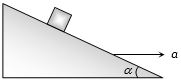
A block is kept on a frictionless inclined surface with angle of inclination '$\alpha$'. The incline is given an acceleration $ 'a'$ to keep the block stationary. Then a is equal to
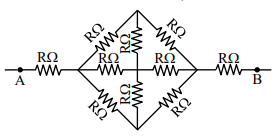
The effective resistance between $A$ and $B$, if resistance of each resistor is $R$, will be
  Image 
A stress of $1.5\,kg.wt/mm^2$ is applied to a wire of Young's modulus $5 \times 10^{11}\,N/m^2$ . The percentage increase in its length is
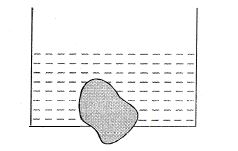
An object is fitted in a hole at base of a container as shown in figure, the force due to liquid on object is (Assume no leakage of water, volume of object inside container is $V$ and density of liquid is $\rho $ )
An electric dipole has a fixed dipole moment $\vec P$ which makes angle $\theta $ with respect to $x-$axis. When subjected to an electric field $\overrightarrow {{E_1}} $ $=E$$\hat i$ it experiences a torque $\overrightarrow {{T_1}} $ =$\;\tau \hat k$ When subjected to another electric field $\overrightarrow {{E_2}}  = \sqrt 3 {E_1}\hat j$ it experiences torque $\overrightarrow {{T_2}} $ = $ - \overrightarrow {{T_1}} $ The angle $\theta \;$ is.......$^o$
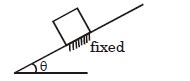
Assume that a block of very low shear modulus is fixed on an inclined plane as shown. Due to elastic forces it will deform. What will be the shape of the block ?