MCQ
The deflection in a moving coil galvanometer is
  • A
    Directly proportional to the torsional constant
  • Directly proportional to the number of turns in the coil
  • C
    Inversely proportional to the area of the coil
  • D
    Inversely proportional to the current flowing
Answer

Correct option: B.
Directly proportional to the number of turns in the coil
b
(b)$\theta = \frac{{NiAB}}{C} \Rightarrow \theta \propto N$ (Number of turns)

Need a full question paper?

Generate a complete, print-ready paper with questions like this in minutes — across 16+ boards, with answer keys.

Start Generating Free

Similar questions

Identify the physical quantity that cannot be measured using spherometer :
A frog can be deviated in a magnetic field produced by a current in a vertical solenoid placed below the frog. This is possible because the body of the frog behaves as
A proton (mass $ = 1.67 \times {10^{ - 27}}\,kg$ and charge $ = 1.6 \times {10^{ - 19}}\,C)$ enters perpendicular to a magnetic field of intensity $2$ $weber/{m^2}$ with a velocity $3.4 \times {10^7}\,m/\sec $. The acceleration of the proton should be
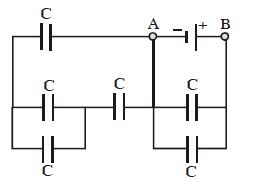
Find equivalent capacitance between $A$ and $B$
A resistance of $20$ ohms is connected to a source of an alternating potential $V = 220\,sin\,(100\,\pi t)$. The time taken by the current to change from its peak value to r.m.s value is
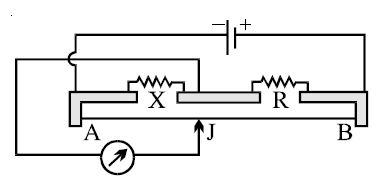
The figure shows a meter-bridge circuit, with $AB = 100\, cm$,$ X = 12\,\Omega$ and $R = 18\,\Omega$ , and the jockey $J$ in the position of balance. If $R$ is now made $8\,\Omega$ , through what distance will $J$ have to be moved to obtain balance? .............. $cm$
Stopping potential for photoelectrons
Which of the following statements about the behaviour of light is not correct?
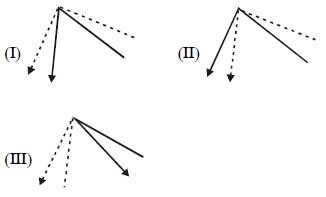
Each of these diagrams is supposed to show two different rays being reflected from the same point on the same plane mirror. Which one of the following is correct ?
An electron of mass $m$ and charge $q$ is travelling with a speed $v$ along a circular path of radius $r$ at right angles to a uniform of magnetic field $B$. If speed of the electron is doubled and the magnetic field is halved, then resulting path would have a radius of