Question
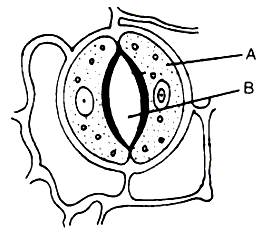
The diagram alongside represents a structure found in a leaf. Study the same and answer the questions that follow:
(i) Name the parts labeled A and B.
(ii) What is the biological term for the above structure?
(iii) What is the function of the part labeled A?
(iv) Mention two structural features of A, which help in the function mentioned in (iii) above?
(v) Where is this structure likely to be found in a leaf?
(vi) The structure (fig.5.22) helps in the process of transpiration. Explain the term transpiration.
(vii) How many other cells are found surrounding this structure as seen in the diagram?
Answer

(i) A = Guard cell
B = Stomatal aperture
(ii) Stomata
(iii) The function of the guard cells are that they help to regulate the rate of transpiration by opening and closing the stomata thus preventing excessive water loss.
(iv) The two structural features of guard cells are :
1.The guard cells have thin outer wall and thick inner wall.
2. Guard cells contain chloroplast in their cytoplasm.
(v) These are present on the lower surface of the dorsiventral leaf.
(vi) Transpiration is the loss of water in the form of water vapour from aerial parts of the plant.
(vii) Five

Need a full question paper?

Generate a complete, print-ready paper with questions like this in minutes — across 16+ boards, with answer keys.

Start Generating Free

Similar questions

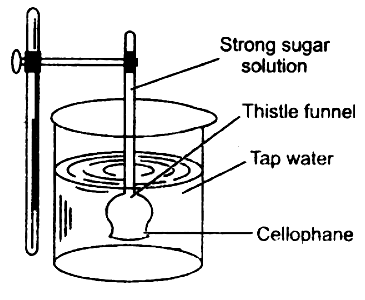
The diagram below represents an experimental set up to demonstrate a vital process. Study the same and then answer the questions that follow:


(i) Name the process.
(ii) Define the above named process.
(iii) What would you observe in the experimental setup after an hour or so?
(iv) What control experiment can be set up for the above experiment?
(v) Keeping in mind the root hair cell and its surrounding name the part that corresponds to (1) Concentrated sugar solution, (2) Parchment paper, (3) Water in the beaker.
(vi) Name any other substance that can be used instead of parchment paper in the above experiment.
(vii) Mention two advantages of this process to the plant.
What are the functions of the nervous system?
The diagram given below represents a certain phenomenon which occurs during meiosis. Name and explain the phenomenon by using the terms – homologous chromosomes, chromatids, crossing over.
Draw labeled diagram of different steps of mitosis.
With well labelled diagrams explain meiosis.
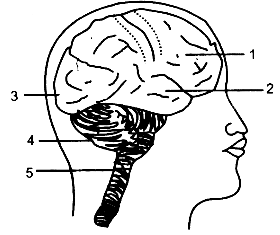
The following diagram is that of a human brain. Guidelines 1 to 5 indicate different parts of the surface of the brain and these are as follows:
1. The frontal lobe of the cerebrum
2. The temporal lobe of the cerebrum
3. The occipital lobe of the cerebrum
4. Cerebellum
5. Medulla oblongata
Study the diagram and answer the following questions:
(i) What handicaps would result from:
(a) Damage toçart numbered 3.
(b) Damage to part numbered 4.
(ii) Mention one main function of each of the parts numbered 1,2, and 5.
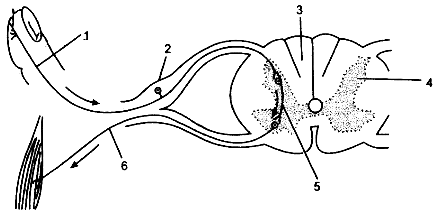
The diagram given below is a representation of a certain phenomenon pertaining to the nervous system. Study the diagram and answer the following questions:

(i) Name the phenomenon which is being depicted.
(ii) Give the technical term for the point of contact between the two nerve cells.
(iii) Name the parts 1, 2, 3, and 4.
(iv) Write the functions of parts 5 and 6
(v) How does the arrangement of neurons in the spinal cord differ from that of the brain?
Differentiate between:
Red blood cells and White blood cells
The response of plants to gravity is known as geotropism. How are plant parts sensitive to gravity? Describe with the help of a diagram.
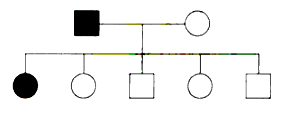
A family consists of two parents and their five children and the pedigree chart below shows the inheritance of the trait colour blindness .

(i) Who is colour blind in parents - Father or Mother?
(ii) How many daughters and sons have beeen born in the family?
(iii) What does the child 1 indicate about this trait?
(iv) Complete the depiction of all probabilities of the trait among the children 2-5 in the chart.
(v) On which chromosome is the gene of this trait located?
(vi) Name one other trait in humans which follows the similar mode of inheritance.