Question
The diagram below represents an experimental set up to demonstrate a vital process. Study the same and then answer the questions that follow:
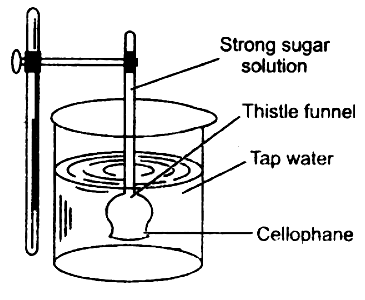

(i) Name the process.
(ii) Define the above named process.
(iii) What would you observe in the experimental setup after an hour or so?
(iv) What control experiment can be set up for the above experiment?
(v) Keeping in mind the root hair cell and its surrounding name the part that corresponds to (1) Concentrated sugar solution, (2) Parchment paper, (3) Water in the beaker.
(vi) Name any other substance that can be used instead of parchment paper in the above experiment.
(vii) Mention two advantages of this process to the plant.
Answer

(i) Osmosis.
(ii) Transfer of water or solvent molecules from a solution of lower concentration to a solution of higher concentration through a semi-permeable membrane is called osmosis.
(iii) The level of sugar solution rises in the stem of thistle funnel, whereas the water level in the beaker falls.
(iv) A non-permeable membrane can be used in place of parchment paper for a control experiment.
(v) (1) Root hair cell sap corresponds to concentrated sugar solution.
(2) Cell membrane of root hair cell corresponds to parchment paper.
(3) Soil solution corresponds to water in the beaker.
(vi) Goat’s bladder or pig’s bladder.
(vii) (1) Helps in water absorption.
(2) Helps in stomatal opening and closing thus facilitating gaseous exchange.

Need a full question paper?

Generate a complete, print-ready paper with questions like this in minutes — across 16+ boards, with answer keys.

Start Generating Free

Similar questions

Describe an experiment to prove that transpiration occurs more from the lower surface of a leaf.
Some great author has said that a population explosion is far more dangerous than an atomic explosion. Justify his statement?
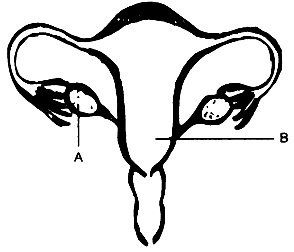
Study the diagram given below and then answer the questions that follow:

(i) Name the part labeled A. Name any two hormones produced by the part labeled A.
(ii) What happens to the part labeled B.
(1) if fertilization takes place?
(2) If fertilization does not take place?
(iii) Where does fertilization occur?
(iv) Draw a neat diagram of the human sperm as seen under high magnification and label the following parts.
(1) Acrosome
(2) Mitochondria
Differentiate between:
Red blood cells and White blood cells
How would you demonstrate that green plants release oxygen when exposed to light?
Given below is a table designed to give the names of the glands, the hormones produced, their chief functions, the effects of over secretion and under secretion in respect of thyroid, pituitary and pancreas. Fill up the blanks 1-13
Sl. No.Source Gland cellsHormone producedChief functionEffect of over secretionEffect of under secretion
1(1) ……….thyroxine (2) ………. (3) ……….(4) ……….
2Beta cells of Islets of Langerhans(5) …… Promotes glucose utilization by the body cells(6) ……….(7) ……….
3(8) ………. Growth hormone (9) ………(10) ……….Dwarfism
4(11) …… Vasopressin Increases reabsorption of water from kidney tubule(12) ……….(13) ……….
Distinguish between the following:
Osmosis and diffusion
Name the three types of transpiration.
Draw labeled diagram of different steps of mitosis.
What is circulatory system? Describe the circulatory system of humans.