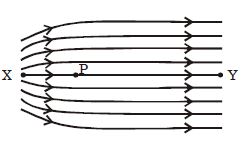
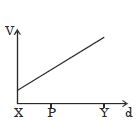
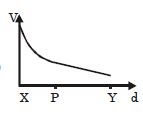
The diagram below shows electric field lines in a region of space. Which of the following diagrams best shows the variation with distance $d$ of the potential $V$ along the line $XY$ as we move from $X$ to $Y$ ?
- A
- B
- C
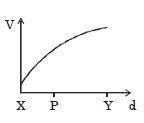
- D
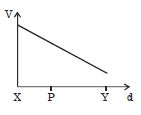
Medium


Download our appand get started for free
Experience the future of education. Simply download our apps or reach out to us for more information. Let's shape the future of learning together!No signup needed.*
Similar Questions
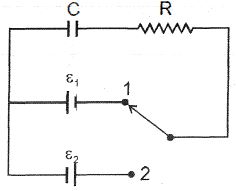
- 1Intially, switch $S$ is connected to position $1$ for a long time shown in figure. The net amount of heat generated in the circuit after it is shifted to position $2$ isView Solution
- 2Electric potential at a point $P$ due to a point charge of $5 \times 10^{-9}\; C$ is $50 \;V$. The distance of $P$ from the point charge is ......... $cm$View Solution
(Assume, $\frac{1}{4 \pi \varepsilon_0}=9 \times 10^{+9}\; Nm ^2 C ^{-2}$)
- 3A molecule of a substance has permanent dipole moment $p$. A mole of this substance is polarised by applying a strong electrostatic field $E$. The direction of the field is suddenly changed by an angle of $60^{\circ} .$ If $N$ is the Avogadro's number the amount of work done by the field isView Solution
- 4In the given circuit if point $C$ is connected to the earth and a potential of $ + \,2000\,V$ is given to the point $A$, the potential at $B$ is.....$V$View Solution
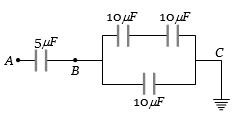
- 5Find equivalent capacitance between $A$ and $B$View Solution
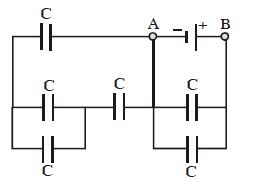
- 6Two capacitors of capacitances $C$ and $2\, C$ are charged to potential differences $V$ and $2\, V$, respectively. These are then connected in parallel in such a manner that the positive terminal of one is connected to the negative terminal of the other. The final energy of this configuration is$.....CV^2$View Solution
- 7Charges $Q, 2Q$ and $-Q$ are given to three concentric conducting shells $A, B$ and $C$ respectively as shown the ratio of charges on inner and outer surfaces of shell $C$ will beView Solution
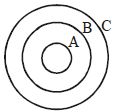
- 8The capacitance of a metallic sphere will be $1\,\mu F$, if its radius is nearlyView Solution
- 9Four capacitors of capacitance $10\,mF$ and a battery of $200\,V$ are arranged as shown. How much charge will flow through $AB$ after the switch $S$ is closed .....$\mu C$View Solution
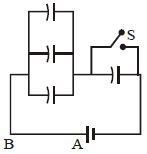
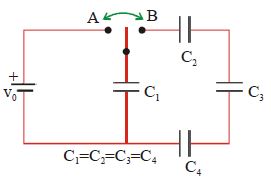
- 10The four identical capacitors in the circuit shown below are initially uncharged. The switch is then thrown first to position $A$, and then to position $B$. After this is done:View Solution
Note: $V_{1,2,3,4}$ are the potential differences across $C_{1,2,3,4}$ and $Q_{1,2,3,4}$ are the final charges stored in $C_{1,2,3,4}$ respectively.