Question
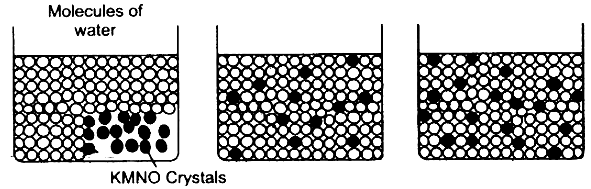
The diagram given below represents an experimental set – up to demonstrate a certain process. Study the same and answer the questions that follow:
Image

Mention two advantages of the process to the plants.

Answer

(i) The roots of plants absorb water and minerals from surrounding soil due to osmosis. (ii) Osmosis allows plants to absorb water from the soil which helps plants to keep cells alive in roots, stems and leaves. (iii) Osmosis is also important in the opening and closing of stomata which is an important feature for the processes like transpiration and photosynthesis.

Need a full question paper?

Generate a complete, print-ready paper with questions like this in minutes — across 16+ boards, with answer keys.

Start Generating Free

Similar questions

Explain the following in brief:
Effects of ethylene hormone on plants.
Differentiate between the following:
Antiseptic and Antibiotics
Give suitable explanation for the following:
More transpiration occurs from the lower surface of a dorsiventral leaf.
Explain briefly the relation between poverty and population.
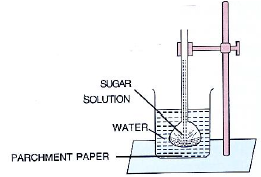
Given below is an experimental demonstration.

(i) Which phenomenon has been demonstrated in the given figure?
(ii) What is the solute and what is solvent in the above experiment?
(iii) Define the phenomenon in Q. (i) above.
(iv) Give one example from your daily life experiences based on this principle.
Differentiate between the following pair:
Bulbo-urethral gland and prostate gland
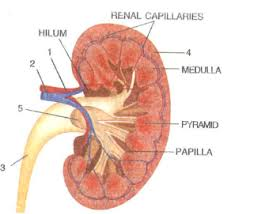
Look at the figure given below. It is a section of human kidney as seen from the front.Image
Which area/part (give its name and number given on the diagram) which contains the following:
(i) Malpighian capsule
(ii) The pyramids
(iii) Freshly collected urine
A few RBC’s were kept in three test tubes containing isotonic, hypotonic and hypertonic solutions. What will be the expected observations after a few hours? Explain.
In an experiment, two sets of apparatus were set up as shown below:
In A there is a concentrated sugar solution inside the thistle funnel and red ink in the water outside the funnel. In B there is a concentrated glucose solution with red ink inside the thistle funnel and water outside the thistle funnel.
In both A and B the level of liquid inside the funnels rises up the tubes. In A the sugar solution turns red and in B, the water turns red.
Study the given observations and answer these questions:
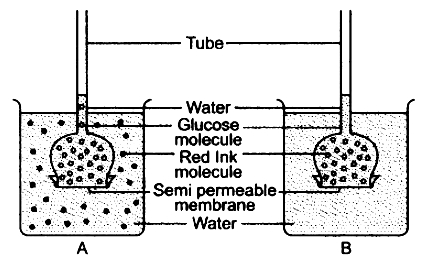
Name the process by which red ink moves in A and B.
Which type of pressure forces the water molecules to move towards thistle funnels and cause a rise in the water level?
Where does this process occur in plants and animals?
What material could be used as a semi-permeable membrane?
What is the difference between transpiration and guttation?