Questions

[2 Mark Question Answer]

🎯

Test yourself on this topic

20 questions · timed · auto-graded

Question 12 Marks
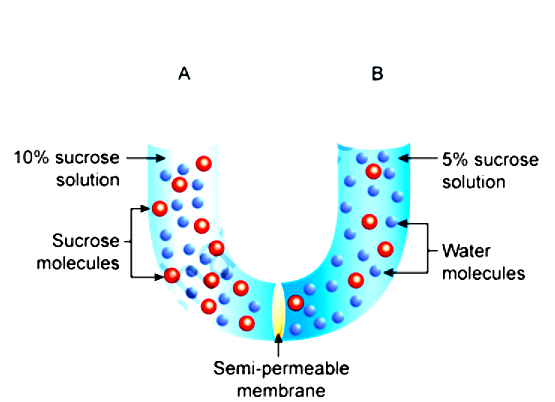
Study the experimental setup in the figure and then answer the question that follow.
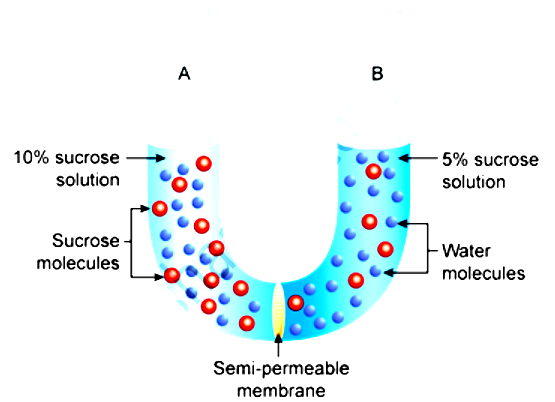
What will you observe in the setup after about half an hour? Give reasons for your answer.
Answer
Water molecules will continue to pass from 5% sucrose solution to 10% sucrose solution through the semipermeable membrane due to osmosis. This will continue till the concentration of water molecules becomes the same in both ends of the setup.
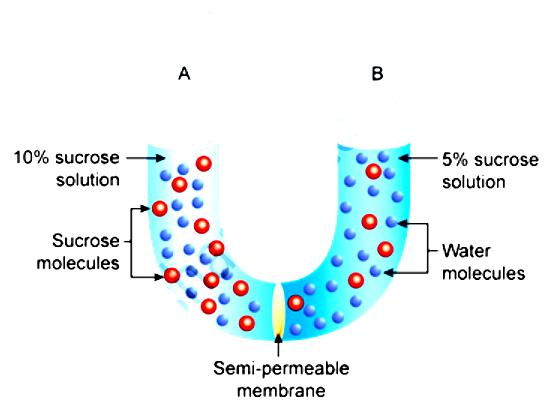
View full question & answer
Question 22 Marks
Study the experimental setup in the figure and then answer the question that follow.
What is meant by 'semipermeable membrane'?
Answer
A semipermeable membrane is a membrane which allows the passage of molecules selectively. It allows a solvent such as water molecules to pass through it freely but prevents the passage of the solute (sugar or salt molecules in solution).
View full question & answer
Question 32 Marks
Study the experimental setup in the figure and then answer the question that follow.

Explain the phenomenon mention in question 8.1 .
Answer
Osmosis is the movement of water molecules from their region of higher concentration (dilute solution) to their region of lower concentration (concentrated solution) through a semipermeable membrane.
View full question & answer
Question 42 Marks
Two potato cubes each 1 cm3 in size, were placed separately in two containers (A and B), the container A having water and the other (B) containing concentrated sugar solution. After 24 hours when the cubes were examined, those placed in water were found to be firm and had increased slightly in size and those placed in concentrated sugar solution were found to be soft and somewhat decreased in size. Use the above information to answer the questions that follow: Name and define the physical process being investigated in this experiment.
Answer
The process being investigated is osmosis. Osmosis is the diffusion of water molecules across a semi-permeable membrane from a more dilute solution (with a lower solute concentration) to a less dilute solution (with a higher solute concentration).
View full question & answer
Question 52 Marks
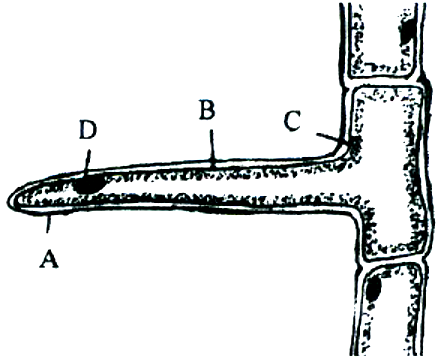
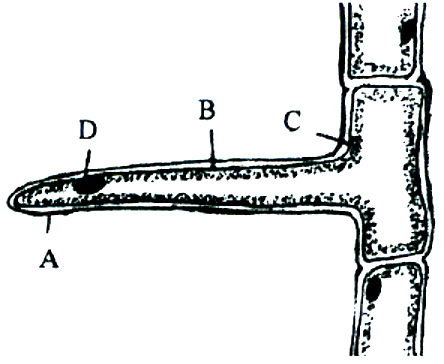
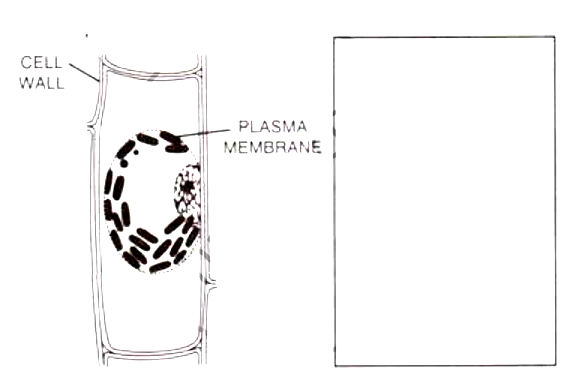
The diagram below represents a layer of epidermal cells showing a fully grown root hair. Study the diagram and answer the questions that follow:
Mention one distinct difference between the parts labelled A and B.
Answer
Cell wallCell membrane
The cell wall of a root hair is freely permeable and allows both salt and water to pass through.The cell membrane of a root hair is semi-permeable and does not allow large dissolved salt molecules to pass through.
View full question & answer
Question 62 Marks
The diagram below represents a layer of epidermal cells showing a fully grown root hair. Study the diagram and answer the questions that follow:
The root hair cell is in a turgid state. Name and explain the process that caused this state.
Answer
A root hair gets turgid because of the absorption of water from the surrounding. Absorption of water by root hair is achieved by the process of osmosis. The concentration of water in the surrounding is more than that of the interior of the cell; this causes the water from the surrounding to move in because of endosmosis.
View full question & answer
Question 72 Marks
The diagram below represents a layer of epidermal cells showing a fully grown root hair. Study the diagram and answer the questions that follow:
Name the parts labelled A, B, C and D.
Answer
A - Cell wall
B - Cell membrane
C - Cytoplasm
D - Nucleus
View full question & answer
Question 82 Marks
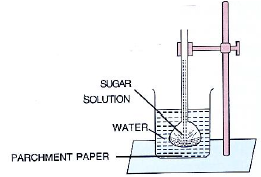
The diagram given below represents an experimental set – up to demonstrate a certain process. Study the same and answer the questions that follow:
Image

Mention two advantages of the process to the plants.
Answer
(i) The roots of plants absorb water and minerals from surrounding soil due to osmosis. (ii) Osmosis allows plants to absorb water from the soil which helps plants to keep cells alive in roots, stems and leaves. (iii) Osmosis is also important in the opening and closing of stomata which is an important feature for the processes like transpiration and photosynthesis.
View full question & answer
Question 92 Marks
The diagram given below represents an experimental set – up to demonstrate a certain process. Study the same and answer the questions that follow:
Image
Keeping in mind the root- hair, cell and its surroundings, name the parts that correspond to
(1) concentrated sugar solution
(2) parchment paper and
(3) water in the beaker.
Answer
(1) concentrated sugar solution Cell sap (of higher concentration than that of the surrounding water) within the root hair. (2) parchment paper cell membrane of root hair. (3) water in the beaker water in soil.
View full question & answer
Question 102 Marks
The diagram given below represents an experimental set – up to demonstrate a certain process. Study the same and answer the questions that follow:
Image
what control experiment can be set up for comparison?
Answer
For control experiment, the beaker will contain the water. At the same time, instead of the sugar solution; the thistle funnel with the cellophane paper tied on its mouth and inverted in the beaker will also contain water.
View full question & answer
Question 112 Marks
The diagram given below represents an experimental set – up to demonstrate a certain process. Study the same and answer the questions that follow:
Image
Define the above named process.
Answer
Osmosis is the diffusion of water molecules across a semi-permeable membrane from a more dilute solution (with a lower solute concentration) to a less dilute solution (with a higher solute concentration).
View full question & answer
Question 122 Marks
A leaf cell of a water plant was placed in a liquid other than pond water. After sometime, it assumed a shape as shown below:
Redraw in the space provided, the diagram of the cell if it is soon placed in ordinary water for some time.
View full question & answer
Question 132 Marks
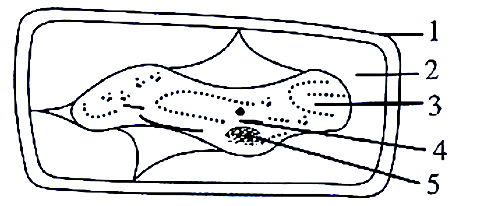
The following diagram represents a plant cell after being placed in a strong sugar solution.

Guidelines 1 to 5 indicate the following (1)Cell wall, (2) Strong sugar solution, (3) Protoplasm (4) Large vacuole, (5) Nucleus (1)What is the state of the cell shown in the cell shown in the diagram? (2)Name the structure which acts as a selectively permeable membrane. (3)If the cell had been placed in distilled water instead of strong sugar solution, which feature would not have been seen? (4)Name any one feature of this plant cell which is not present in an animal cell.
Answer
(1)The cell is flaccid i.e. it is plasmolyse
(2)Plasma Membrane
(3)Plasmolysis would not occur and flaccidity would not be seen i.e. the protoplasm would not have shrunken away from the cell wall
(4)Cell Wall is absent in animal cell.
View full question & answer
Question 142 Marks
Potato cubes when placed in water become firm and increase in size.
Answer
Potato cubes contain excess of salts and sugars as compared to the water in which the cubes are placed. Hence, due to endosmosis, water from the surrounding enters the potato cubes making them firm and increasing their size.
View full question & answer
Question 152 Marks
If you uproot a plant from the soil, its leaves soon wilt.
Answer
If a plant is uprooted, the leaves continue losing water by transpiration, but there is no more water absorbed the roots. This does not allow the compensation for the loss of water by transpiration; hence the leaves of the uprooted plant wilt soon
View full question & answer
Question 162 Marks
If you sprinkle some common salt on grass growing on a lawn, it is killed at that spot.
Answer
Common salt when sprinkled on the grass causes the Plasmolysis of grass cell ultimately leading them to death. Hence, if we sprinkle some common salt on grass growing on a lawn, it is killed at the spot.
View full question & answer
Question 172 Marks
Differentiate between the following : Turgidity and Flaccidity
Answer
Turgidity Flaccidity
1It is the state of a cell in which the cell cannot accommodate any more water and it is fully distended.1It is the condition in which the cell content is shrunken and the cell is not tight.
View full question & answer
Question 182 Marks
Distinguish between the following: Hypotonic and hypertonic solutions
Answer
Hypotonic solutions hypertonic solutions
In this condition , the solution outside the cell has lower solute concentration than the cell sap .In this condition , the solution outside the cell has higher solute concentration than the cells sap .
View full question & answer
Question 192 Marks
Differentiate between the following
Turgor pressure and wall pressure
Answer
Turgor pressure Wall pressure
1Turgor pressure is the pressure of the cell contents on the cell wall.1Wall pressure is the pressure exerted by the cell wall on the cell content.
View full question & answer
Question 202 Marks
Explain how soaked seeds swell up and burst their seed coats.
Answer
When soaked in water, the seeds swell up due to imbibition and endosmosis. During these two processes water enters the cell. Due to endosmosis, at some point, the seed coat is unable to bear the turgor pressure and hence, the seed coat bursts.
View full question & answer