A $6\,\mu F$ capacitor is charged from $10\;volts$ to $20\;volts$. Increase in energy will be
Easy
Download our app for free and get started
(b) $\Delta E = {E_{Final}} - {E_{Initial}} = \frac{1}{2}C(V_{Final}^2 - V_{Initial}^2)$
$ = \frac{1}{2} \times 6 \times ({20^2} - {10^2}) \times {10^{ - 6}}$
$ = 3 \times (400 - 100) \times {10^{ - 6}} = 3 \times 300 \times {10^{ - 6}} = 9 \times {10^{ - 4}}\,J$
$ = \frac{1}{2} \times 6 \times ({20^2} - {10^2}) \times {10^{ - 6}}$
$ = 3 \times (400 - 100) \times {10^{ - 6}} = 3 \times 300 \times {10^{ - 6}} = 9 \times {10^{ - 4}}\,J$

Download our appand get started for free
Experience the future of education. Simply download our apps or reach out to us for more information. Let's shape the future of learning together!No signup needed.*
Similar Questions
- 1The election field in a region is given by $\vec E = (Ax + B)\hat i$ where $E$ is in $N\,C^{-1}$ and $x$ in meters. The values of constants are $A = 20\, SI\, unit$ and $B = 10\, SI\, unit$. If the potential at $x =1$ is $V_1$ and that at $x = -5$ is $V_2$ then $V_1 -V_2$ is.....$V$View Solution
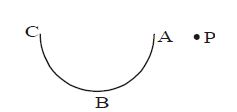
- 2In the following diagram the work done in moving a point charge from point $P$ to point $A, B$ and $C$ is respectively as $W_A,\, W_B$ and $W_C$, then (there is no charge nearby)View Solution
- 3Capacitance of an isolated conducting sphere of radius $R_{1}$ becomes $n$ times when it is enclosed by a concentric conducting sphere of radius $R_{2}$ connected to earth. The ratio of their radii $\left(\frac{ R _{2}}{ R _{1}}\right)$ is:View Solution
- 4Three capacitors $2,\, 3$ and $6\ \mu F$ are joined in series with each other. What is the minimum effective capacitance......$\mu \,F$View Solution
- 5With the rise in temperature, the dielectric constant $K$ of a liquidView Solution
- 6A capacitor of $10\,\mu F$ charged up to $250\, volts$ is connected in parallel with another capacitor of $5\,\mu F$ charged up to $100\, volts$. The common potential is.....$V$View Solution
- 7Two identical parallel plate capacitors are connected in series to a battery of $100\,V$. A dielectric slab of dielectric constant $4.0$ is inserted between the plates of second capacitor. The potential difference across the capacitors will now be respectivelyView Solution
- 8A $4\, \,\mu F$ condenser is charged to $400\, V$ and then its plates are joined through a resistance. The heat produced in the resistance is.......$J$View Solution
- 9A $10\, \mu F$ capacitor is fully charged to a potential difference of $50\, V$. After removing the source voltage it is connected to an uncharged capacitor in parallel. Now the potential difference across them becomes $20\, V$. The capacitance of the second capacitor is......$\mu F$View Solution
- 10$0.2\, F$ capacitor is charged to $600\, V$ by a battery. On removing the battery. It is connected with another parallel plate condenser of $1\, F$. The potential decreases to....$V$View Solution