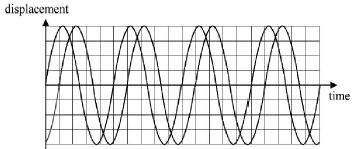
The diagram shows two oscillations. What is the phase difference between the oscillations?
Medium


Download our appand get started for free
Experience the future of education. Simply download our apps or reach out to us for more information. Let's shape the future of learning together!No signup needed.*
Similar Questions
- 1View SolutionThe value of maximum possible amplitude in the case of forced oscillations when driving frequency is close to natural frequency is
- 2If the length of a clock pendulum increases by $0.2 \%$ due to atmospheric temperature rise, then the loss in time of clock per day is ........... $s$View Solution
- 3A spring is stretched by $5 \,\mathrm{~cm}$ by a force $10 \,\mathrm{~N}$. The time period of the oscillations when a mass of $2 \,\mathrm{~kg}$ is suspended by it is :(in $s$)View Solution
- 4Four simple harmonic vibrations:View Solution
${y_1} = 8\,\cos\, \omega t;\,{y_2} = 4\,\cos \,\left( {\omega t + \frac{\pi }{2}} \right)$ ;
${y_3} = 2\cos \,\left( {\omega t + \pi } \right);\,{y_4} = \,\cos \,\left( {\omega t + \frac{{3\pi }}{2}} \right)$ ,
are superposed on each other. The resulting amplitude and phase are respectively;
- 5A simple pendulum is hanging from a peg inserted in a vertical wall. Its bob is stretched in horizontal position from the wall and is left free to move. The bob hits on the wall the coefficient of restitution is $\frac{2}{{\sqrt 5 }}$. After how many collisions the amplitude of vibration will become less than $60°$View Solution
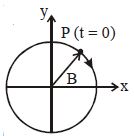
- 6Figure shows the circular motion of a particle. The radius of the circle, the period, sense of revolution and the initial position are indicated on the figure. The simple harmonic motion of the $x-$ projection of the radius vector of the rotating particle $P$ isView Solution
- 7The acceleration due to gravity at a place is ${\pi ^2}\,m/se{c^2}$. Then the time period of a simple pendulum of length one metre isView Solution
- 8Two masses $m_1$ and $m_2$ connected by a spring of spring constant $k$ rest on a frictionless surface. If the masses are pulled apart and let go, the time period of oscillation isView Solution
- 9A particle excutes $SHM$ on a straight line path. The amplitude of oscillation is $2\,cm$. When the displacement of the particle from the mean position is $1\,cm$, the numerical value of magnitude of acceleration is equal to the numerical value of magnitude of velocity. The frequency of $SHM$ is (in $second^{-1}$)View Solution
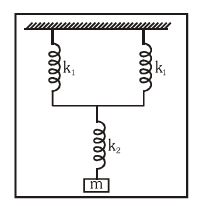
- 10View SolutionThe total spring constant of the system as shown in the figure will be