Question
The difference between two numbers is 14 and the difference between their squares is 448. Find the numbers.

Answer

Let the numbers be x and y respectively.
According to the question:
$x - y = 14 ...(1)$
$x^2 - y^2 = 448 ...(2)$
From (1), we get:
$x = 14 + y ...(3)$
Putting x = 14 + y in (2), we get
$(14 + y)^2 - y^2 = 448$
$196 + y^2 + 28y - y^2 = 448$
$196 + 28y = 448$
$28y = 448 - 196$
$\text{y}=\frac{252}{28}$
y = 9
Putting y = 9 in (1), we get
x - 9 = 14
⇒ x = 14 + 9
⇒ x = 23
Hence, the required numbers are 23 and 9.

Need a full question paper?

Generate a complete, print-ready paper with questions like this in minutes — across 16+ boards, with answer keys.

Start Generating Free

Similar questions

Two years ago, a man was five times as old as his son. Two years later, his age will be 8 more than three times the ago of the son. Find their present ages.

Form the pair of linear equations in the problem, and find its solution graphically:
5 pencils and 7 pens together cost ₹ 50 whereas 7 pencils and 5 pens together cost ₹ 46. Find the cost of one pencil and that of one pen.
If $\sin\theta+\cos\theta=\text{p and }\sec\theta+\text{cosec}\theta=\text{q},$ then prove that $\text{q}(\text{p}^2-1)=2\text{p}.$
Two pipes running together can fill a tank in $11\frac{1}{9}$ minutes. If one pipe takes 5 minutes more than the other to fill the tank separately, find the time in which each pipe would fill the tank separately.
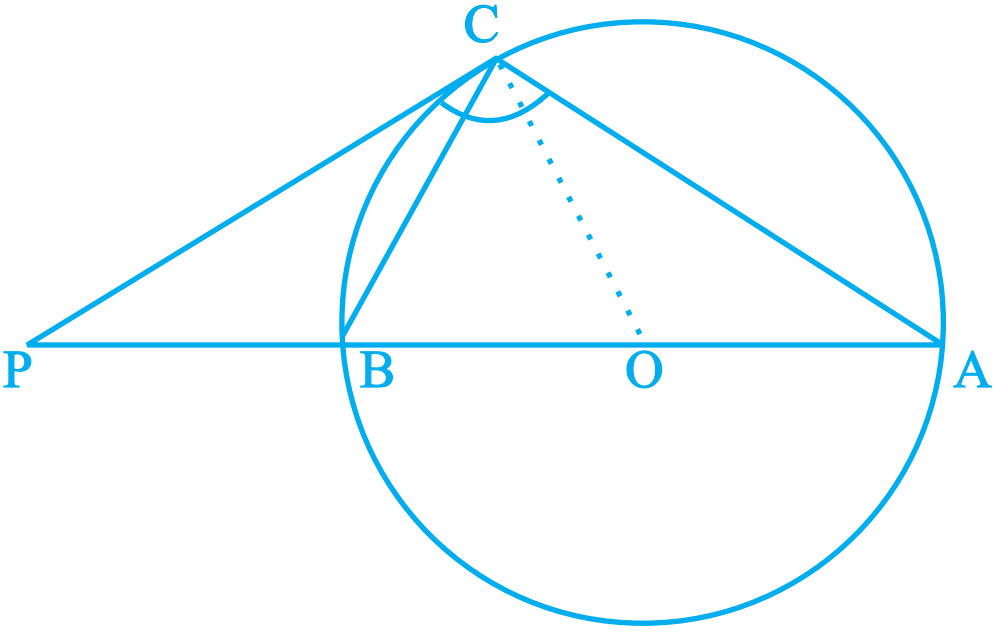
The tangent at a point C of a circle and a diameter AB when extended intersect at P. If $\angle\text{PCA}=110^\circ,$ find $\angle\text{CBA}.$
[Hint: Join C with centre O.]
In a right triangle ABC in which $\angle\text{B}=90^{\circ},$ a circle is drawn with AB as diameter intersecting the hypotenuse AC at P. Prove that the tangent to the circle at P bisects
BC.
In $\triangle\text{ABC},$ P and Q are points on sides AB and AC respectively such that PQ || BC. If AP = 4cm, PB = 6cm and PQ = 3cm, determine BC.
Solve the following quadratic equation:
$\frac{1}{\text{2a}+\text{b}+\text{2x}}=\frac{1}{\text{2a}}+\frac{1}{\text{b}}+\frac{1}{\text{2x}}$
If $\text{a}\neq\text{b}\neq\text{c},$ prove that the points $(a, a^2), (b, b^2), (c, c^2)$ can never be collinear.
Find the mean of the following data, using step-deviation method.
Class
5-15
15-25
25-35
35-45
45-55
55-65
65-75
Frequency
6
10
16
15
24
8
7