MCQ
The dimensions of $\frac{\alpha}{\beta}$ in the equation $F=\frac{\alpha-t^2}{\beta v^2}$, where $F$ is the force, $v$ is velocity and $t$ is time, is ..........
  • A
    $\left[ MLT ^{-1}\right]$
  • B
    $\left[ ML ^{-1} T ^{-2}\right]$
  • $\left[M L^3 T^{-4}\right]$
  • D
    $\left[ ML ^2 T ^{-4}\right]$

Answer

Correct option: C.
$\left[M L^3 T^{-4}\right]$
c
(c)

$F=\frac{\alpha-t^2}{\beta v^2}$

Dimensionally, $\alpha=\left[ T ^2\right]$

$\left[M L T^{-2}\right]=\frac{\left[ T ^2\right]}{\beta\left[L^2 T^{-2}\right]}$

$\beta=\frac{ T ^2}{\left[ MLT ^{-2} \cdot L ^2 T ^{-2}\right]}$

$\Rightarrow \beta=\left[ M ^{-1} L ^{-3} T ^6\right]$

Dimensions of $\frac{\alpha}{\beta}=\frac{ T ^2}{ M ^{-1} L ^{-3} T ^6}=\left[ ML ^3 T ^{-4}\right]$

Need a full question paper?

Generate a complete, print-ready paper with questions like this in minutes — across 16+ boards, with answer keys.

Start Generating Free

Similar questions

No other thermometer is as suitable as a platinum resistance thermometer to measure temperature in the entire range of
stone is tied to one end of a string $50\, cm$ long is whirled in a horizontal circle with a constant speed. If the stone makes $10$ revolutions in $20\, s$, what is the magnitude of acceleration of the stone ......... $cm/s^2$
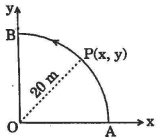
A point $P$ moves in counter-clockwise direction on a circular path as shown in the figure. The movement of '$P$' is such that it sweeps out a length  $s = t^3+5$, where s is in metres and $t$ is in seconds. The radius of the path is $20\ m$. The acceleration of '$P$' when $t = 2\ s$ is nearly ..........  $m/s^2$
Which of the following are true?
A person travelling on a straight line moves with a uniform velocity $\text{v}_1$ for a distance $x$ and with a uniform velocity $\text{v}_2$ for the next equal distance. The average velocity $v$ is given by:
If the magnitude of sum of two vectors is equal to the magnitude of difference of the two vectors, the angle between these vectors is ........ $^o$
A soap bubble is blown to a diameter of $7 \mathrm{~cm}$. $36960 \mathrm{erg}$ of work is done in blowing it further. If surface tension of soap solution is $40 \mathrm{dyne} / \mathrm{cm}$ then the new radius is______. $\mathrm{cm}$. Take $:\left(\pi=\frac{22}{7}\right)$.
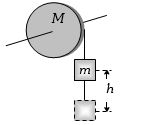
A massless string is wrapped round a disc of mass $M$ and radius $R$. Another end is tied to a mass $m$ which is initially at height $h$ from ground level as shown in the fig. If the mass is released then its velocity while touching the ground level will be
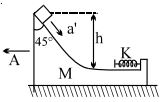
$A$ small block of mass $m$ is placed on $a$ wedge of mass $M$ as shown, which is initially at rest. All the surfaces are frictionless . The spring attached to the other end of wedge has force constant $k$. If $a'$ is the acceleration of $m$ relative to the wedge as it starts coming down and $A$ is the acceleration acquired by the wedge as the block starts coming down, then 
Which is not a physical quantity