The dimensions of four wires of the same material are given below. In which wire the increase in length will be maximum when the same tension is applied
Medium
Download our app for free and get started
(d)$Y = \frac{F}{A}\;\frac{L}{A} \Rightarrow l \propto \frac{L}{A} \propto \frac{L}{{\pi {d^2}}}$
$l \propto \frac{L}{{{d^2}}}$ [As F and Y are constant]
The ratio of $\frac{L}{{{d^2}}}$is maximum for case $(d)$

Download our appand get started for free
Experience the future of education. Simply download our apps or reach out to us for more information. Let's shape the future of learning together!No signup needed.*
Similar Questions
- 1Two steel wires having same length are suspended from a ceiling under the same load. If the ratio of their energy stored per unit volume is $1: 4,$ the ratio of their diameters isView Solution
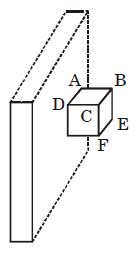
- 2A steel rod is projecting out of rigid wall. The shearing strength of steel is $345 \,\,MN/m^2.$ The dimensions $AB = 5\,\, cm,\,BC = BE = 2\,\, cm.$ The maximum load that can be put on the face $ABCD$ is .......... $kg$ (neglect bending of the rod) $(g = 10\,\, m/s^2)$View Solution
- 3If average depth of an ocean is $4000 \mathrm{~m}$ and the bulk modulus of water is $2 \times 10^9 \mathrm{Nm}^{-2}$, then fractional compression $\frac{\Delta V}{V}$ of water at the bottom of ocean is $\alpha \times 10^{-2}$. The value of $\alpha$ is ___________(Given, $\mathrm{g}=10 \mathrm{~ms}^{-2}, \rho=1000 \mathrm{~kg} \mathrm{~m}^{-3}$ )View Solution
- 4$A$ current of $(2.5 \pm 0.05)$ $A$ flows through a wire and develops a potential difference of $(10 \pm 0.1)$ $\mathrm{volt}.$ Resistance of the wire in $\mathrm{ohm},$ isView Solution
- 5The ratio of diameters of two wires of same material is $n : 1$. The length of wires are $4\, m$ each. On applying the same load, the increase in length of thin wire will beView Solution
- 6A steel wire $1.5\,m$ long and of radius $1\,mm$ is attached with a load $3\,kg$ at one end the other end of the wire is fixed it is whirled in a vertical circle with a frequency $2\,Hz$ . Find the elongation of the wire when the weight is at the lowest position $(Y = 2 \times 10^{11}\,N/m^2$ and $g = 10\,m/s^2)$View Solution
- 7Young’s moduli of two wires $A$ and $B$ are in the ratio $7 : 4$. Wire $A$ is $2\, m$ long and has radius $R$. Wire $A$ is $2\, m$ long and has radius $R$. Wire $B$ is $1.5\, m$ long and has radius $2\, mm$. If the two wires stretch by the same length for a given load, then the value of $R$ is close to ......... $mm$View Solution
- 8An elevator cable can have a maximum stress of $7 \times 10^7\,N/m^2$ for appropriate safety factors. Its maximum upward acceleration is $1.5\,m/s^2$ . If the cable has to support the total weight of $2000\,kg$ of a loaded elevator, the minimum area of crosssection of the cable should be ....... $cm^2$ $(g = 10\,m/s^2)$View Solution
- 9View SolutionThe modulus of elasticity is dimensionally equivalent to
- 10A string of area of cross-section $4\,mm ^{2}$ and length $0.5$ is connected with a rigid body of mass $2\,kg$. The body is rotated in a vertical circular path of radius $0.5\,m$. The body acquires a speed of $5\,m / s$ at the bottom of the circular path. Strain produced in the string when the body is at the bottom of the circle is $\ldots . . \times 10^{-5}$. (Use Young's modulus $10^{11}\,N / m ^{2}$ and $g =10\,m / s ^{2}$ )View Solution