MCQ
The dimensions of polarisation are:
- A[L A T]
- B[L-1 A -1 T]
- C[L A-1 T-1]
- D[L-2 A T]
Generate a complete, print-ready paper with questions like this in minutes — across 16+ boards, with answer keys.
Nucleus of an atom whose atomic mass is 24 consists of
|
(a) 11 electrons, 11 protons and 13 neutrons |
(b) 11 electrons, 13 protons and 11 neutrons |
|
(c) 11 protons and 13 neutrons |
(d) 11 protons and 13 electrons |
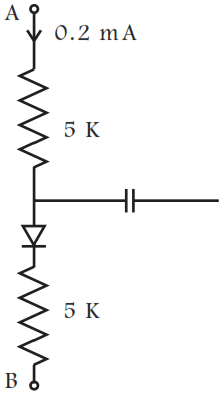
Threshold wavelength for photoelectric effect on sodium is 5000 Å. Its work function is
|
(a) 15 J |
(b) 16 |
(c) 4 |
(d) 4 |
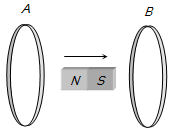
In the diagram shown if a bar magnet is moved along the common axis of two single turn coils A and B in the direction of arrow
|
(a) Current is induced only in A & not in B |
|
(b) Induced currents in A & B are in the same direction |
|
(c) Current is induced only in B and not in A |
|
(d) Induced currents in A & B are in opposite directions |
Correct statements are.
In Young's double slit experiment, if L is the distance between the slits and the screen upon which interference pattern is observed, x is the average distance between the adjacent fringes and d being the slit separation. The wavelength of light is given by
|
(a) |
(b) |
(c) |
(d) |


