MCQ
The dimensions of pressure is equal to
  • A
    Force per unit volume
  • Energy per unit volume
  • C
    Force
  • D
    Energy

Answer

Correct option: B.
Energy per unit volume
b
(b) $\frac{{{\rm{Energy}}}}{{{\rm{Volume}}}} = \frac{{M{L^2}{T^{ - 2}}}}{{{L^3}}} = [M{L^{ - 1}}{T^{ - 2}}]$= Pressure

Need a full question paper?

Generate a complete, print-ready paper with questions like this in minutes — across 16+ boards, with answer keys.

Start Generating Free

Similar questions

$K$ is the force constant of a spring. The work done in increasing its extension from ${l_1}$ to ${l_2}$ will be
An oscillator of mass $M$  is at rest in its equilibrium position in a potential $V\, = \,\frac{1}{2}\,k{(x - X)^2}.$ A particle of mass $m$  comes from right with speed $u$  and collides completely inelastically with $M$ and sticks to it . This process repeats every time the oscillator crosses its equilibrium position .The amplitude of oscillations after $13$  collisions is: $(M = 10,\, m = 5,\, u = 1,\, k = 1 ).$ 
Wind is blowing west to east along two parallel tracks. Two trains moving with same speed in opposite directions have the steam track of one double then other. The speed of each train is:
In one dimensional motion, instantaneous speed $v$ satisfies $0\le\text{v}<\text{v}_0.$
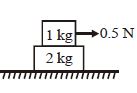
A force of $0.5\ N$ is applied on the upper block as shown in figure. The coefficient of static friction between the two blocks is $0.1$ and that between the lower block and the surface is zero. The work done by the lower block on the upper block for a displacement of $3\ m$ of the upper block is ...... $J$
Consider the motion of the tip of the second hand of a clock. In one minute (R be the length of second hand), its ......
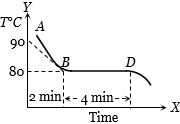
The figure given below shows the cooling curve of pure wax material after heating. It cools from $A$ to $B$ and solidifies along $BD$. If $L$ and $C$ are respective values of latent heat and the specific heat of the liquid wax, the ratio $L/C$ is
A planet moving along an elliptical orbit is closest to the sun at a distance $r_1$ and farthest away at a distance of $r_2$. If $v_1$ and $v_2$ are the linear velocities at these points respectively, then the ratio $\frac{v_1}{v_2}$ is
The dimensions of permittivity ${\varepsilon _0}$ are
A force applied by an engine of a train of mass $2.05 \times {10^6}\;kg$ changes its velocity from $5\;m/s$ to $25\;m/s$ in $5$ minutes. The power of the engine is ........... $MW$