Question
The dimensions of stress are equal to

Answer

(b) [Pressure] =[stress] = $[M{L^{ - 1}}{T^{ - 2}}]$

Need a full question paper?

Generate a complete, print-ready paper with questions like this in minutes — across 16+ boards, with answer keys.
Start Generating Free

Similar questions

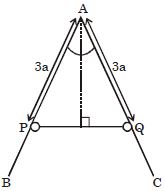
In the diagram, $BAC$ is a rigid fixed rough wire and angle $BAC$ is $60^o$. $P$ and $Q$ are two identical rings of mass $m$ connected by a light elastic string of natural length $2a$ and elastic constant $\frac{mg}{a}$. If $P$ and $Q$ are in equilibrium when $PA = AQ = 3a$ then the least coefficient of friction between the ring and the wire is $\mu$. Then value of $\mu + \sqrt 3 $ is :-
A silver sphere of radius $1\ cm$ and work function $4.7 \ eV$ is suspended from an insulating thread in free-space. It is under continuous illumination of $200 \ nm$ wavelength light. As photoelectrons are emitted, the sphere gets charged and acquires a potential. The maximum number of photoelectrons emitted from the sphere is $A \times 10^2$ (where $1 < A < 10$ ). The value of  $'Z '$ is
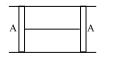
A cylindrical tube of cross-sectional area $A$ has two air tight frictionless pistons at its two ends. The pistons are tied with a straight two ends. The pistons are tied with a straight piece of metallic wire. The tube contains a gas at atmospheric pressure $P_0$ and temperature $T_0$. If temperature of the gas is doubled then the tension in the wire is
$A$ reversible engine converts one-sixth of the heat input into work. When the temperature of the sink is reduced by $ 62^oC$, the efficiency of the engine is doubled. The temperatures of the source and sink are
To obtain $P-$type $Si$ semiconductor, we need to dope pure $Si$ with
The terminal velocity of a copper ball of radius $5\,mm$ falling through a tank of oil at room temperature is $10\,cm\,s ^{-1}$. If the viscosity of oil at room temperature is $0.9\,kg\,m ^{-1} s ^{-1}$, the viscous drag force is :
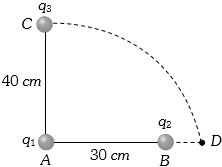
Two charges ${q_1}$ and ${q_2}$ are placed $30\,\,cm$ apart, shown in the figure. A third charge ${q_3}$ is moved along the arc of a circle of radius $40\,cm$ from $C$ to $D$. The change in the potential energy of the system is $\frac{{{q_3}}}{{4\pi {\varepsilon _0}}}k$, where $k$ is
A star moves away from earth at speed $0.8\, c$ while emitting light of frequency $6 \times 10^{14} \,Hz$. What frequency will be observed on the earth ? 
($c =$ speed of light)
A charged particle moves through a magnetic field perpendicular to its direction. Then
$1\,g$ of a liquid is converted to vapour at $3 \times 10^5\,Pa$ pressure. If $10 \%$ of the heat supplied is used for increasing the volume by $1600\,cm ^3$ during this phase change, then the increase in internal energy in the process will be $............\,J$