MCQ
The direction of electric field is from:
- APositive to negative plate.
- BNegative to positive plate.
- CBoth a and b.
- DNone.
Generate a complete, print-ready paper with questions like this in minutes — across 16+ boards, with answer keys.
Assertion : The force of repulsion between atomic nucleus and a-particle varies with distance according to inverse square law.
Reason : Rutherford did a-particle scattering experiment.
|
(a) If both assertion and reason are true and the reason is the correct explanation of the assertion. |
|
(b) If both assertion and reason are true but reason is not the correct explanation of the assertion. |
|
(c) If assertion is true but reason is false. |
|
(d) If the assertion and reason both are false. |
A rectangular loop carrying a current i is situated near a long straight wire such that the wire is parallel to the one of the sides of the loop and is in the plane of the loop. If a steady current I is established in wire as shown in figure, the loop will
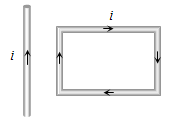
| (a) Rotate about an axis parallel to the wire |
| (b) Move away from the wire or towards right |
| (c) Move towards the wire |
| (d) Remain stationary |
The acceleration of an electron in an electric field of magnitude 50 V/cm, if e/m value of the electron is 1.76  is
is
|
(a) 8.8 |
(b) 6.2 |
(c) 5.4 |
(d) Zero |
A parallel plate condenser is connected with the terminals of a battery. The distance between the plates is 6mm. If a glass plate (dielectric constant K = 9) of 4.5 mm is introduced between them, then the capacity will become
|
(a) 2 times |
(b) The same |
(c) 3 times |
(d) 4 times |
During the nuclear fusion reaction
|
(a) A heavy nucleus breaks into two fragments by itself |
|
(b) A light nucleus bombarded by thermal neutrons breaks up |
|
(c) A heavy nucleus bombarded by thermal neutrons breaks up |
|
(d) Two light nuclei combine to give a heavier nucleus and possibly other products |


