The displacement of a particle is represented by the equation $y = sin^3\,\,\,\omega t$ . The motion is
Medium


Download our appand get started for free
Experience the future of education. Simply download our apps or reach out to us for more information. Let's shape the future of learning together!No signup needed.*
Similar Questions
- 1View SolutionWhat is constant in S.H.M.
- 2The maximum velocity of a body undergoing $S.H.M$. is $0.2\,m/s$ and its acceleration at $0.1\,m$ from the mean position is $0.4\,m/s^2$. The amplitude of the $S.H.M.$ is .... $m$View Solution
- 3The length of a seconds pendulum is .... $cm$View Solution
- 4A sphere of radius $r$ is kept on a concave mirror of radius of curvature $R$. The arrangement is kept on a horizontal table (the surface of concave mirror is frictionless and sliding not rolling). If the sphere is displaced from its equilibrium position and left, then it executes $S.H.M.$ The period of oscillation will beView Solution
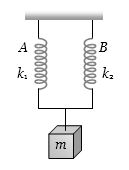
- 5A mass $m$ is suspended by means of two coiled spring which have the same length in unstretched condition as in figure. Their force constant are $k_1$ and $k_2$ respectively. When set into vertical vibrations, the period will beView Solution
- 6View SolutionWhich of the following equation does not represent a simple harmonic motion
- 7A particle of mass $m$ in a unidirectional potential field have potential energy $U(x)=\alpha+2 \beta x^2$, where $\alpha$ and $\beta$ are positive constants. Find its time period of oscillation.View Solution
- 8A mass $m$ is vertically suspended from a spring of negligible mass; the system oscillates with a frequency $n$. What will be the frequency of the system if a mass $4 m$ is suspended from the same springView Solution
- 9A body oscillates with $S.H.M.$ according to the equation $x=(5.0 \,m ) \cos \left[\left(2 \pi \,rad s ^{-1}\right) t+\pi / 4\right]$ At $t=1.5 \,s$, its acceleration is ....... $m / s ^2$View Solution
- 10The position co-ordinates of a particle moving in a $3-D$ coordinates system is given by $x = a\,cos\,\omega t$ , $y = a\,sin\,\omega t$ and $z = a\omega t$ The speed of the particle isView Solution