The maximum velocity of a body undergoing $S.H.M$. is $0.2\,m/s$ and its acceleration at $0.1\,m$ from the mean position is $0.4\,m/s^2$. The amplitude of the $S.H.M.$ is .... $m$
Medium


Download our appand get started for free
Experience the future of education. Simply download our apps or reach out to us for more information. Let's shape the future of learning together!No signup needed.*
Similar Questions
- 1A mass $m$ is vertically suspended from a spring of negligible mass; the system oscillates with a frequency $n$. What will be the frequency of the system if a mass $4 m$ is suspended from the same springView Solution
- 2$x$ and $y$ displacements of a particle are given as $x(t) = a\,sin\,\omega t$ and $y(t) = a\,sin\,2\omega t.$ Its trajectory will look likeView Solution
- 3The maximum velocity of a particle, executing simple harmonic motion with an amplitude $7\ mm$, is $4.4\ m/s$. The period of oscillation is .... $sec$View Solution
- 4Two pendulums have time periods $T$ and $\frac{{5T}}{4}.$They start $S.H.M.$ at the same time from the mean position. What will be the phase difference between them after the bigger pendulum has complete one oscillation ..... $^o$View Solution
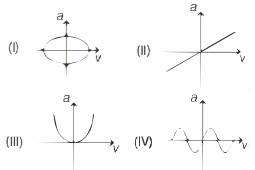
- 5If the speed $v$ of the bob in a simple pendulum is plotted against the tangential acceleration $a$, the correct graph will be represented byView Solution
- 6The period of oscillation of a simple pendulum of length $L$ suspended from the roof of a vehicle which moves without friction down an inclined plane of inclination $\alpha$, is given byView Solution
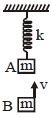
- 7Block $A$ is hanging from a vertical spring and it is at rest. Block $'B'$ strikes the block $'A'$ with velocity $v$ and stick to it. Then the velocity $v$ for which the spring just attains natural length is:View Solution
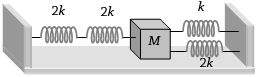
- 8Four massless springs whose force constants are $2k, 2k, k$ and $2k$ respectively are attached to a mass $M$ kept on a frictionless plane (as shown in figure). If the mass $M$ is displaced in the horizontal direction, then the frequency of oscillation of the system isView Solution
- 9A point object is kept in front of a plane mirror. The plane mirror is doing $SHM$ of amplitude $2\,cm$. The plane mirror moves along the $x-$ axis and $x-$ axis is normal to the mirror. The amplitude of the mirror is such that the object is always infront of the mirror. The amplitude of $SHM$ of the image is .... $cm$View Solution
- 10The ratio of frequencies of two pendulums are $2 : 3$, then their length are in ratioView Solution