Question
The displacement of two particles executing simple harmonic motion are represented by equations, $\text{y}=4\sin(10\text{t}+\theta)$ and $\text{y}=5\cos10\text{t}$ What is the phase difference between the velocities of these particles?

Answer

For 1st particle$\text{y}_1=4\sin(10\text{t}+\theta);$
Velocity $\frac{\text{dy}_1}{\text{dt}}$$=4\times10\cos(10\text{t}+\theta)$
$=40\cos(10\text{t}+\theta)$ For second particle $\text{y}_2=5\cos10\text{t}=5\sin(10\text{t}+\frac{\pi}{2})$
Velocity $\frac{\text{dy}_2}{\text{dt}}$$=5\cos\times10\cos(10\text{t}+\frac{\pi}{2})$
$=5\cos(10\text{t}+\frac{\pi}{2})$
Phase difference between velocities $=(10\text{t}+\theta)-(10\text{t}+\frac{\pi}{2})$
$=\Big(\theta-\frac{\pi}{2}\Big)$

Need a full question paper?

Generate a complete, print-ready paper with questions like this in minutes — across 16+ boards, with answer keys.
Start Generating Free

Similar questions

Obtain an expression for linear acceleration of a cylinder rolling down an inclined plane and hence find the condition for the cylinder to roll down the inclined plane without slipping.
Explain the shape of the surface of water and mercury in a glass tube.
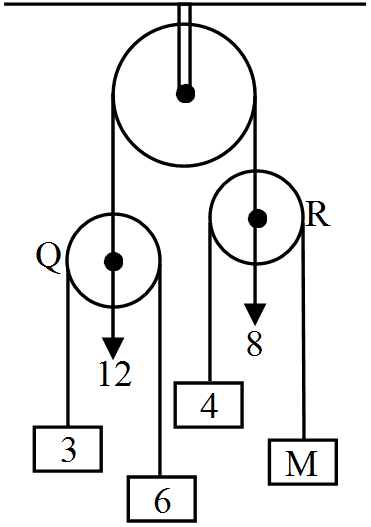
Two pulleys of masses $12kg$ and $8kg$ are connected by a fine string hanging over a fixed pulley as shown. Over the $8kg$ pulley is hung a fine string with masses $4kg$ and M. Over the $12kg$ pulley is hung another fine string with masses $3kg$ and $6kg$. Calculate M so that the string over the fixed pulley remains stationary.
A drunkard walking in a narrow lane takes 5 steps forward and 3 steps backward, followed again by 5 steps forward and 3 steps backward, and so on. Each step is 1m long and requires 1s. Plot the x-t graph of his motion. Determine graphically and otherwise how long the drunkard takes to fall in a pit 13m away from the start.
Write the rules for determining uncertainty in the results of arithmatic calculations.
The short-wavelength limit shifts by 26pm when the operating voltage in an X-ray tube is increased to 1.5 times the original value. What was the original value of the operating voltage?
An electric kettle used to prepare tea, takes $2$ minutes to boil $4$ cups of water ($1$ cup contains$ 200cc$ of water) if the room temperature is $25C$.
  1. If the cost of power consumption is $Rs.\ 1.00$ per unit ($1$ unit - $1000$ watt-hour), calculate the cost of boiling $4$ cups of water.
  2. What will be the corresponding cost if the room temperature drops to $5^\circ C$?
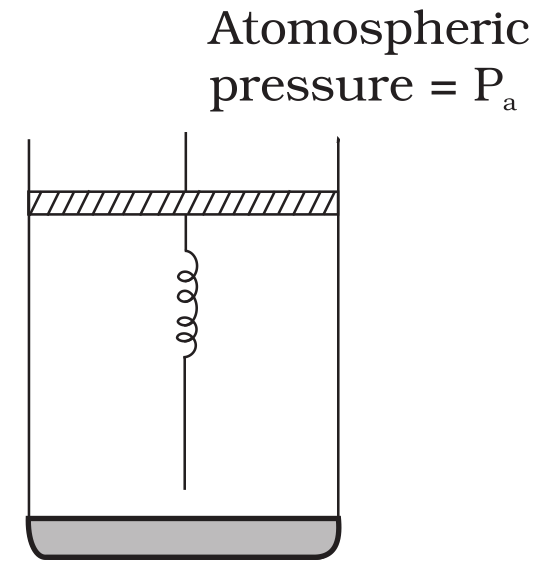
Consider one mole of perfect gas in a cylinder of unit cross section with a piston attached (Fig.) A spring (spring constant k) is attached (unstretched length L) to the piston and to the bottom of the cylinder. Initially the spring is unstretched and the gas is in equilibrium. A certain amount of heat Q is supplied to the gas causing an increase of volume from $V_o$ to $V_1$.
  1. What is the initial pressure of the system.
  2. What is the final pressure of the system.
  3. Uing the first law of thermodynamics, write down a relation between $Q, P_a, V, V_o$ and $k$.
A uniform ladder of length 10.0m and mass 16.0kg is resting against a vertical wall making an angle of 37° with it. The vertical wall is frictionless but the ground is rough. An electrician weighing 60.0kg climbs up the ladder. If he stays on the ladder at a point 8.00m from the lower end, what will be the normal force and the force of friction on the ladder by the ground? What should be the minimum coefficient of friction for the elctrician to work safely?
A diverging lens of focal length $20cm$ and a converging lens of focal length $30cm$ are placed $15cm$ apart with their principal axes coinciding. Where should an object be placed on the principal axis so that its image is formed at infinity?