Obtain an expression for linear acceleration of a cylinder rolling down an inclined plane and hence find the condition for the cylinder to roll down the inclined plane without slipping.
Download our app for free and get started
When a cylinder rolls down on an inclined plane, then forces involved are,
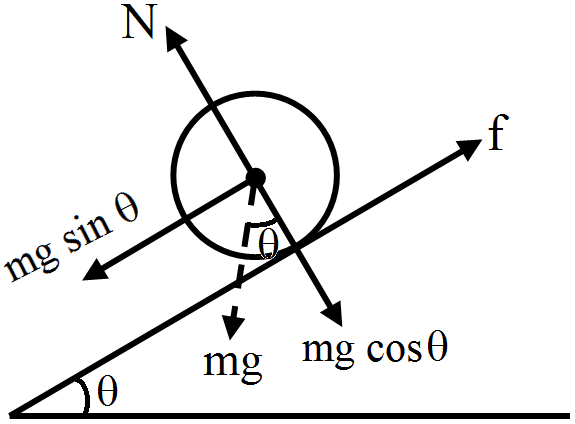
From free body diagram, $\text{N}-\text{mg}\cos\theta=0$ $\text{or }\text{N}-\text{mg}\cos\theta$ Also, if a = acceleration of centre of mass down the plane, then $\text{F}_{\text{net}}=\text{ma}=\text{mg}\sin\theta-\text{f}\dots(1)$ As friction produces torque necessary for rotation, $\tau=\text{I}\alpha=\text{f R}$ $\Rightarrow\text{f}=\frac{\text{I}\alpha}{\text{R}}=\frac{\text{Ia}}{\text{R}^2}\Big[\therefore\alpha=\frac{\text{a}}{\text{R}}\Big]$ Substituting for f in Eq. (i), we get $\text{ma}=\text{mg}\sin\theta-\frac{\text{Ia}}{\text{R}^2}$ $\Rightarrow\text{a}=\text{g}\sin\theta-\frac{\text{Ia}}{\text{mR}^2}$ For cylinder, $\text{I}=\frac{1}{2}\text{mR}^2$ $\therefore\text{a}=\text{g}\sin\theta-\frac{\text{a}}{2}$ $\Rightarrow\frac{3\text{a}}{2}=\text{g}\sin\theta$ $\Rightarrow\text{a}=\frac{2\text{g}\sin\theta}{3}$ and from Eq. (i), the value of friction is $\text{f}=\text{mg}\sin\theta-\text{ma}$ $=\text{mg}\sin\theta-\frac{2}{3}\text{mg}\sin\theta$ $=\frac{1}{3}\text{mg}\sin\theta$ $\text{If }\mu_{\text{s}}=$ coefficient of static friction, then $\mu_{\text{s}}=\frac{\text{f}}{\text{N}}\text{ or }\mu_{\text{s}}=\frac{1}{3}\tan\theta$ $\therefore$ For perfect rolling, $\mu_{\text{s}}\geq\frac{1}{3}\tan\theta$
- Weight mg.
- Normal reaction N.
- Friction f.
From free body diagram, $\text{N}-\text{mg}\cos\theta=0$ $\text{or }\text{N}-\text{mg}\cos\theta$ Also, if a = acceleration of centre of mass down the plane, then $\text{F}_{\text{net}}=\text{ma}=\text{mg}\sin\theta-\text{f}\dots(1)$ As friction produces torque necessary for rotation, $\tau=\text{I}\alpha=\text{f R}$ $\Rightarrow\text{f}=\frac{\text{I}\alpha}{\text{R}}=\frac{\text{Ia}}{\text{R}^2}\Big[\therefore\alpha=\frac{\text{a}}{\text{R}}\Big]$ Substituting for f in Eq. (i), we get $\text{ma}=\text{mg}\sin\theta-\frac{\text{Ia}}{\text{R}^2}$ $\Rightarrow\text{a}=\text{g}\sin\theta-\frac{\text{Ia}}{\text{mR}^2}$ For cylinder, $\text{I}=\frac{1}{2}\text{mR}^2$ $\therefore\text{a}=\text{g}\sin\theta-\frac{\text{a}}{2}$ $\Rightarrow\frac{3\text{a}}{2}=\text{g}\sin\theta$ $\Rightarrow\text{a}=\frac{2\text{g}\sin\theta}{3}$ and from Eq. (i), the value of friction is $\text{f}=\text{mg}\sin\theta-\text{ma}$ $=\text{mg}\sin\theta-\frac{2}{3}\text{mg}\sin\theta$ $=\frac{1}{3}\text{mg}\sin\theta$ $\text{If }\mu_{\text{s}}=$ coefficient of static friction, then $\mu_{\text{s}}=\frac{\text{f}}{\text{N}}\text{ or }\mu_{\text{s}}=\frac{1}{3}\tan\theta$ $\therefore$ For perfect rolling, $\mu_{\text{s}}\geq\frac{1}{3}\tan\theta$

Download our appand get started for free
Experience the future of education. Simply download our apps or reach out to us for more information. Let's shape the future of learning together!No signup needed.*
Similar Questions
- 1View SolutionA metal bar 70 cm long and 4.00 kg in mass supported on two knifeedges placed 10 cm from each end. A 6.00 kg load is suspended at 30 cm from one end. Find the reactions at the knife-edges. (Assume the bar to be of uniform cross section and homogeneous.)
- 2View SolutionA body is in translational equilibrium under the action of coplanar forces. If the torque of these forces is zero about a point, is it necessary that it will also be zero about any other point?
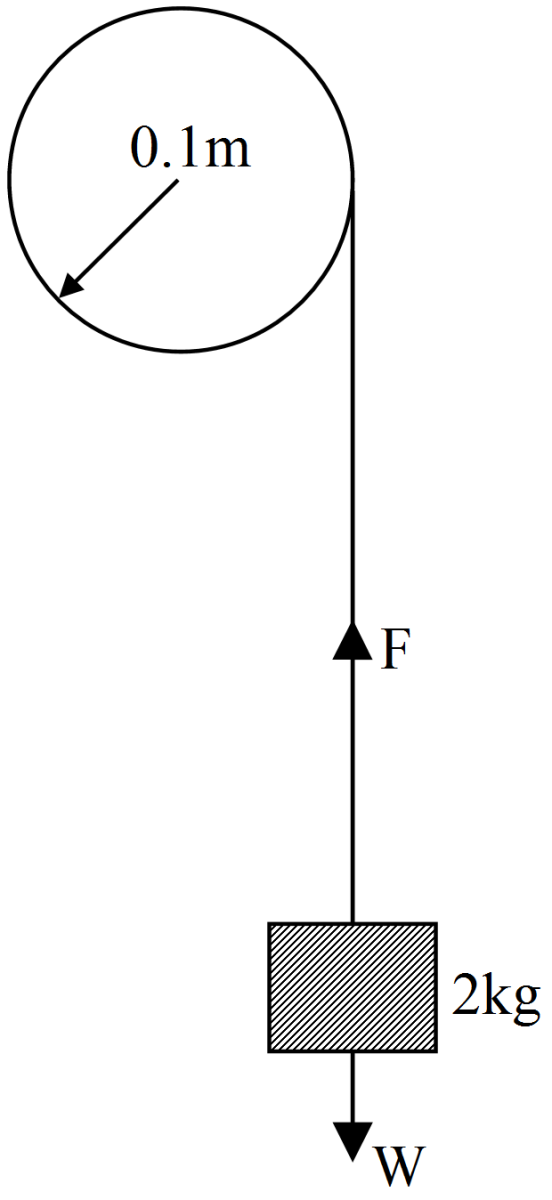
- 3The moment of inertia of a solid flywheel about its axis is $0.1kg-m^2$. A tangential force of $2kg/ wt$ is applied round the circumference of the flywheel with the help of a string and mass arrangement as shown in Fig. If the radius of the wheel is $0.1m$, find the acceleration of the mass.View Solution
- 4View SolutionExplain why friction is necessary to make the disc in roll in the direction indicated.
- Give the direction of frictional force at B, and the sense of frictional torque, before perfect rolling begins.
- What is the force of friction after perfect rolling begins?
- 5A car weighs $1800kg$. The distance between its front and back axles is $1.8m$. Its centre of gravity is $1.05m$ behind the front axle. Determine the force exerted by the level ground on each front wheel and each back wheel.View Solution
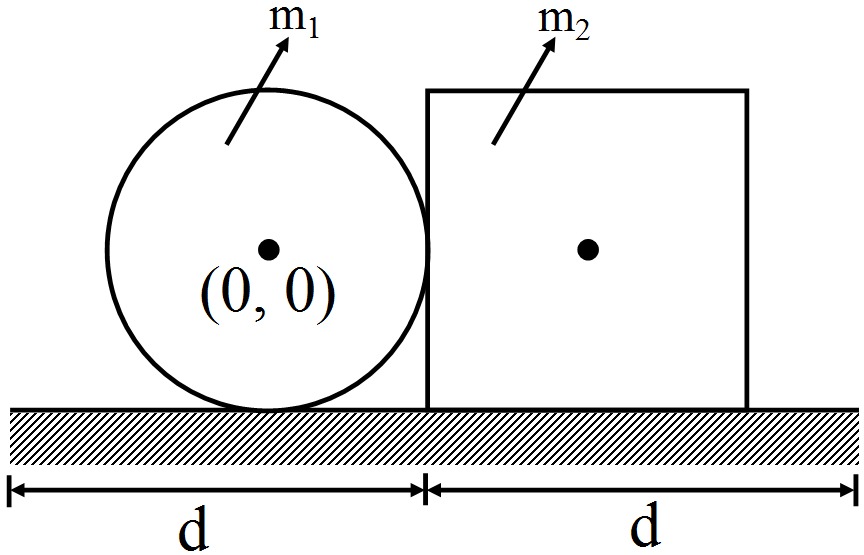
- 6View SolutionA square plate of edge d and a circular disc of diameter d are placed touching each other at the midpoint of an edge of the plate as shown in figure. Locate the centre of mass of the combination, assuming same mass per unit area for the two plates.
- 7What is Mechanical Advantage (M.A.) in the principle of moments for a lever? Find the reactions forces at knife edge as shown in the figure:View Solution
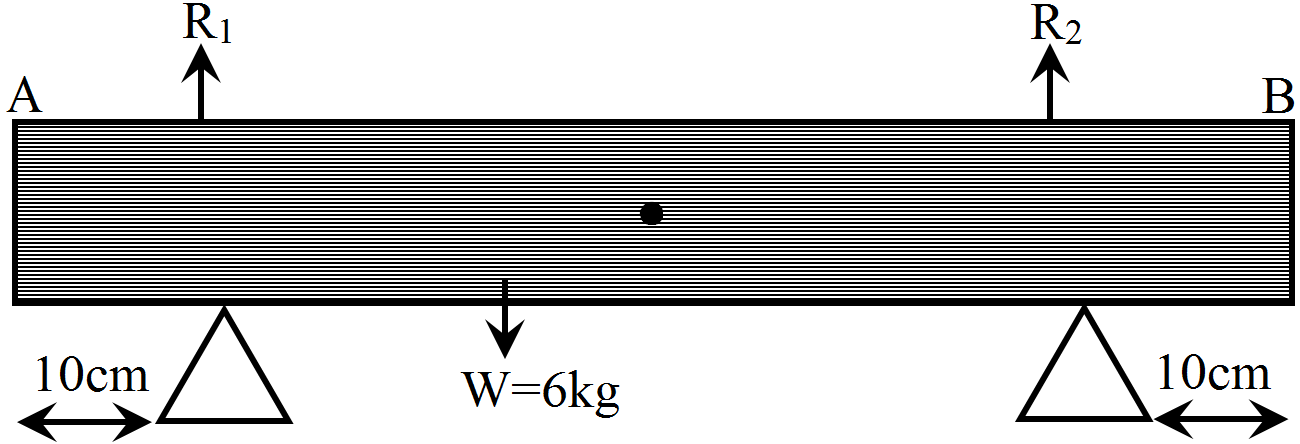
Where AB is a metal bar of $70cm$ length having mass $4kg$ and a $6kg$ load is suspended from $30cm$ from the end A. - 8Prove the result that the velocity v of translation of a rolling body (like a ring, disc, cylinder or sphere) at the bottom of an inclined plane of a height h is given by $\text{v}^2=\frac{2\text{gh}}{\Big(\frac{1+\text{k}^2}{\text{R}^2}\Big)}$ using dynamical consideration (i.e. by consideration of forces and torques).View Solution
Note: k is the radius of gyration of the body about its symmetry axis, and R is the radius of the body. The body starts from rest at the top of the plane. - 9The oxygen molecule has a mass of $5.30 \times 10^{-26}kg$ and a moment of inertia of $1.94 \times 10^{-46}kgm^2$ about an axis through its centre perpendicular to the lines joining the two atoms. Suppose the mean speed of such a molecule in a gas is 500m/s and that its kinetic energy of rotation is two thirds of its kinetic energy of translation. Find the average angular velocity of the molecule.View Solution
- 10View SolutionA uniform rod of length L lies on a smooth horizontal table. A particle moving on the table strikes the rod perpendicularly at an end and stops. Find the distance travelled by the centre of the rod by the time it turns through a right angle. Show that if the mass of the rod is four times that of the particle, the collision is elastic.