Questions · Page 1 of 2

5 Marks Questions

Take a timed test

50 questions · self-marked practice — reveal the answer and mark yourself.

Question 15 Marks
A mass attached to a spring is free to oscillate, with angular velocity $\omega,$ in a horizontal plane without friction or damping. It is pulled to a distance x0 and pushed towards the centre with a velocity $\upsilon_0$ at time t = 0. Determine the amplitude of the resulting oscillations in terms of the parameters $\omega,$ x0 and $\upsilon_0.$ [Hint: Start with the equation $\text{x}=\text{a}\cos(\omega\text{t}+\theta)$ and note that the initial velocity is negative.]
Answer
The displacement rquation for an oscillating mass is given by:

$\text{x}=\text{A}\cos(\omega\text{t}+\theta)$

where,

A is the amplitude

x is the displacement

$\theta$ is the phase constant

Velcoity, $\text{v}=\frac{\text{dx}}{\text{dt}}=-\text{A}\omega\sin(\omega\text{t}+\theta)$

At, t = 0, x = x0

$\text{x}_0=\text{A}\cos\theta=\text{x}_0\ .....(\text{i})$

and, $\frac{\text{dx}}{\text{dt}}=-v_0=\text{A}\omega\sin\theta$

$\text{A}\sin\theta=\frac{v_0}{\omega}\ ....(\text{ii})$

Squaring and adding equations (i) and (ii), we get:

$\text{A}^2(\cos^2\theta+\sin^2\theta)=\text{x}_0^2+\Big(\frac{v_0^2}{\omega^2}\Big)$

$\therefore\ \text{A}=\sqrt{\text{x}_0^2+\Big(\frac{v_0}{\omega}\Big)^2}$

Hence, the amplitude of the resulting oscillation is $\text{x}_0^2+\Big(\frac{v_0}{\omega}\Big)^2.$
View full question & answer
Question 25 Marks
Show that for a particle in linear SHM the average kinetic energy over a period of oscillation equals the average potential energy over the same period.
Answer
The equation of displacement of a particle executing SHM at an instant t is given as:

$\text{x}=\text{A}\sin\omega\text{t}$

where,

A = Amplitude of oscillation

$\omega=$ Angular frequency $=\sqrt{\frac{\text{k}}{\text{M}}}$

The velocity of the particle is: v = dx/dt $=\text{A}\omega\cos\omega\text{t}$

The kinetic energy of the particle is:

$\text{E}_\text{k}=\frac{1}{2}\text{Mv}^2=\frac{1}{2}\text{MA}^2\omega^2\cos^2\omega\text{t}$

The portential energy of the particle is:

$\text{E}_\text{p}=\frac{1}{2}\text{kx}^2=\frac{1}{2}\text{M}^2\omega^2\text{A}^2\sin^2\omega\text{t}$

For time period T, the average kinetic energy over a single cycle is given as:

$(\text{E}_\text{k})_\text{Avg}=\frac{1}{\text{T}}\int\limits_{0}^{\text{T}}\text{E}_\text{k}\text{dt}$

$=\frac{1}{\text{T}}\int\limits_{0}^{\text{T}}\frac{1}{2}\text{MA}^2\omega^2\cos^2\omega\text{t dt}$

$=\frac{1}{2\text{T}}\text{MA}^2\omega^2\int\limits_{0}^{\text{T}}\frac{(1+\cos2\omega\text{t})}{2}\text{dt}$

$=\frac{1}{4\text{T}}\text{MA}^2\omega^2\Big[\text{t}+\frac{\sin2\omega\text{t}}{2\omega}\Big]^{\text{T}}_{0}$

$=\frac{1}{4\text{T}}\text{MA}^2\omega^2(\text{T})$

$=\frac{1}{4}\text{MA}^2\omega^2\ ......(\text{i})$

And, average potential energy over one cycle is given as:

$(\text{E}_\text{p})_\text{Avg}=\frac{1}{\text{T}}\int\limits^{\text{T}}_{0}\text{E}_\text{p}\text{dt}$

$=\frac{1}{\text{T}}\int\limits_{0}^{\text{T}}\frac{1}{2}\text{MA}^2\omega^2\sin^2\omega\text{t dt}$

$=\frac{1}{2\text{T}}\text{MA}^2\omega^2\int\limits_{0}^{\text{T}}\frac{(1-\cos2\omega\text{t})}{2}\text{dt}$

$=\frac{1}{4\text{T}}\text{MA}^2\omega^2\Big[\text{t}-\frac{\sin2\omega\text{t}}{2\omega}\Big]^{\text{T}}_{0}$

$=\frac{1}{4\text{T}}\text{MA}^2\omega^2(\text{T})$

$=\frac{1}{4}\text{MA}^2\omega^2\ ......(\text{ii})$

It can be inferred from equations (i) and (ii) that the average kinetic energy for a given time period is equal to the average potential energy for the same time period.

View full question & answer
Question 35 Marks
The motion of a particle executing simple harmonic motion is described by the displacement function,

$\text{x(t)}=\text{A}\cos(\omega\text{t}+\phi).$

If the initial (t = 0) position of the particle is 1cm and its initial velocity is $\omega\text{ cm/s,}$ what are its amplitude and initial phase angle? The angular frequency of the particle is $\pi\text{s}^{-1}.$ If instead of the cosine function, we choose the sine function to describe the SHM: $\text{x}=\text{B}\sin(\omega\text{t}+\alpha),$ what are the amplitude and initial phase of the particle with the above initial conditions.

Answer
Initially, at t = 0:

Displacement, x = 1cm

Initial velocity, $\text{v}=\omega\text{ cm/sec.}$

Angular frequency, $\omega=\pi\text{ rad/s}^{-1}$

It is given that:

$\text{x(t)}=\text{A}\cos(\omega\text{t}+\phi)$

$1=\text{A}\cos(\omega\times0\times\phi)$

$\text{A}\cos\phi=1\ ........(1)$

$\text{Velocity, }\upsilon=\frac{\text{dx}}{\text{dt}}$

$\omega=-\text{A}\omega\sin(\omega\text{t}+\phi)$

$1=-\text{A}\sin(\omega\times0+\phi)=-\text{A}\sin\phi$

$\text{A}\sin\phi=-1\ ....(2)$

Squaring and adding equations (1) and (2), we get:

$\text{A}^2(\sin^2\phi+\cos^2\phi)=1+1$

$\text{A}^2=2$

$\therefore\ \text{A}=\sqrt{2}\ \text{cm}$

Dividing equation (2) by equation (1), we get:

$\tan\phi=-1$

$\therefore\ \phi=\frac{3\pi}{4},\frac{7\pi}{4},....$

SHM is given as:

$\text{x}=\text{B}\sin(\omega\text{t}+\alpha)$

Putting the given values in this equation, we get:

$1=\text{B}\sin[\omega\times0+\alpha]$

$\text{B}\sin\alpha=1\ .....(3)$

Velocity, $\upsilon=\omega\text{B}\cos(\omega\text{t}+\alpha)$

Substituting the given values, we get:

$\pi=\pi\text{B}\sin\alpha$

$\text{B}\sin\alpha=1\ .....(4)$

Squaring and adding equations (3) and (4), we get:

$\text{B}^2[\sin^2\alpha+\cos^2\alpha]=1+1$

$\text{B}^2=2$

$\therefore\ \text{B}=\sqrt{2}\text{ cm}$

Dividing equation (3) by equation (4), we get:

$\frac{\text{B}\sin\alpha}{\text{B}\cos\alpha}=\frac{1}{1}$

$\tan\alpha=1=\frac{\tan\alpha}{4}$

$\therefore\ \alpha=\frac{\pi}{4},\frac{5\pi}{4}, .....$

View full question & answer
Question 45 Marks
You are riding in an automobile of mass 3000kg. Assuming that you are examining the oscillation characteristics of its suspension system. The suspension sags 15cm when the entire automobile is placed on it. Also, the amplitude of oscillation decreases by 50% during one complete oscillation. Estimate the values of (a) the spring constant k and (b) the damping constant b for the spring and shock absorber system of one wheel, assuming that each wheel supports 750kg.
Answer
  1. Mass of the automobile, m = 3000kg

Displacement in the suspension system, x = 15cm = 0.15m

There are 4 springs in parallel to the support of the mass of the automobile.

The equation for the restoring force for the system:

F = –4kx = mg

Where, k is the spring constant of the suspension system

Time period, $\text{T}=2\pi\sqrt{\frac{\text{m}}{4\text{k}}}$

and k = mg/4x = 3000 × 10/4 × 0.15 = 5000 = 5 × 104Nm

Spring Constant, k = 5 × 104Nm

  1. Each wheel supports a mass, M = 3000/4 = 750kg

For damping factor b, the equation for displacement is written as

x = x0e-bt/2M

The amplitude of oscilliation decreases by 50%.

$\therefore$ x = x0/2

x0/2 = x0e-bt/2M

loge2 = bt/2M

$\therefore$ b = 2M loge2/t

where,

Time period, $\text{t}=2\pi\sqrt{\frac{\text{m}}{4\text{k}}}=2\pi\sqrt{\frac{3000}{4\times5\times10^4}}=0.7691\text{ s}$

$\therefore\ \text{b}=\frac{2\times750\times0.693}{0.7691}=1351.58\text{ kg/s}$

View full question & answer
Question 55 Marks
A cylindrical piece of cork of density of base area A and height h floats in a liquid of density $\rho_1.$ The cork is depressed slightly and then released. Show that the cork oscillates up and down simple harmonically with a period $\text{T}=2\pi\sqrt{\frac{\text{h}\rho}{\rho_1\text{g}}}$ where $\rho$ is the density of cork. (Ignore damping due to viscosity of the liquid).
Answer
Base area of the cork = A

Height of the cork = h

Density of the liquid = $\rho_1$

Density of the cork = $\rho$

In equilibrium:

Weight of the cork = Weight of the liquid displaced by the floating cork

Let the cork be depressed slightly by x. As a result, some extra water of a certain volume is displaced. Hence, an extra up-thrust acts upward and provides the restoring force to the cork.

Up-thrust = Restoring force, F = Weight of the extra water displaced

F = ­–(Volume × Density × g)

Volume = Area × Distance through which the cork is depressed

Volume = Ax

$\therefore\ \text{F}=-\text{Ax}\rho_1\text{g}\ .....(\text{i})$

Accroding to the force law:

F = kx

k = F/x

where, k is constant

$\text{k}=\frac{\text{F}}{\text{x}}=-\text{A}\rho_1\text{g}\ .....(\text{ii})$

The time period of the oscillations of the cork:

$\text{T}=2\pi\sqrt{\frac{\text{m}}{\text{k}}}\ .....(\text{iii})$

where,

m = Mass of the cork

= Volume of the cork × Density

= Base area of the cork × Height of the cork × Density of the cork

$=\text{Ah}\rho$

Hence, the expression for the time period becomes:

$\text{T}=2\pi\sqrt{\frac{\text{Ah}\rho}{\text{A}\rho_1\text{g}}}=2\pi\sqrt{\frac{\text{h}\rho}{\rho_1\text{g}}}$

View full question & answer
Question 65 Marks
One end of a U-tube containing mercury is connected to a suction pump and the other end to atmosphere. A small pressure difference is maintained between the two columns. Show that, when the suction pump is removed, the column of mercury in the U-tube executes simple harmonic motion.
Answer
Area of cross-section of the U-tube = A

Density of the mercury column = $\rho$

Acceleration due to gravity = g

Restoring force, F = Weight of the mercury column of a certain height

F = –(Volume × Density × g)

$\text{F}=-(\text{A}\times2\text{h}\times\rho\times\text{g})=-2\text{A}\rho\text{gh}$

= -k × Displacement in one of the arms (h)

Where,

2h is the height of the mercury column in the two arms

k is a constant, given by $\text{k}=-\frac{\text{F}}{\text{h}}=2\text{A}\rho\text{g}$

Time period, $\text{T}=2\pi\sqrt{\frac{\text{m}}{\text{k}}}=2\pi\sqrt{\frac{\text{m}}{2\text{A}\rho\text{g}}}$

Where,

m is the mass of the mercury column

Let l be the length of the total mercury in the U-tube.

Mass of mercury, m = Volume of mercury × Density of mercury

$=\text{Al}\rho$

$\therefore\ \text{T}=2\pi\sqrt{\frac{\text{Al}\rho}{2\text{A}\rho\text{g}}}=2\pi\sqrt{\frac{\text{l}}{2}}\text{g}$

Hence, the mercury column executes simple harmonic motion with time period $2\pi\sqrt{\frac{\text{l}}{2\text{g}}}$

View full question & answer
Question 75 Marks
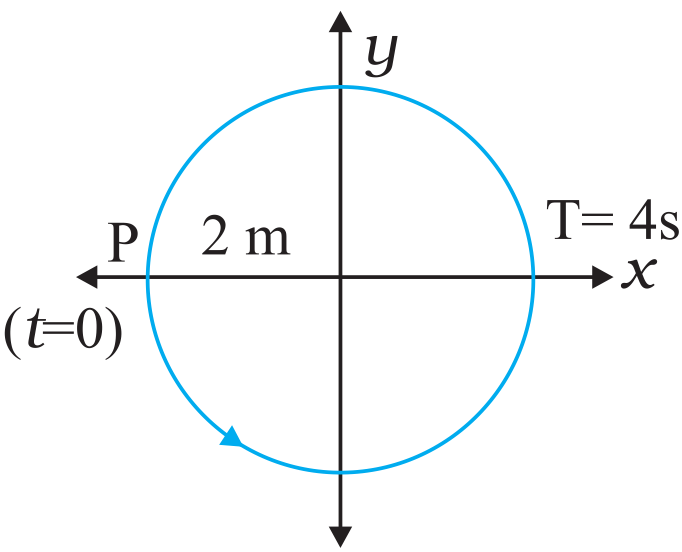
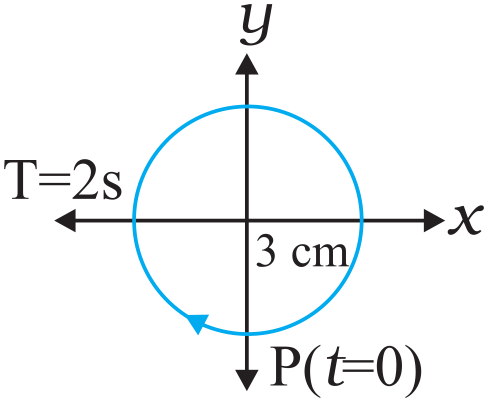
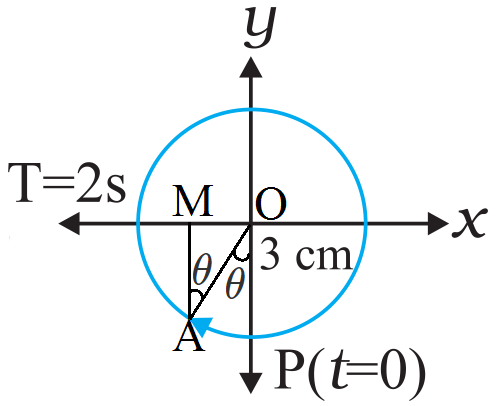
Figures correspond to two circular motions. The radius of the circle, the period of revolution, the initial position, and the sense of revolution (i.e. clockwise or anti-clockwise) are indicated on each figure.

Obtain the corresponding simple harmonic motions of the x-projection of the radius vector of the revolving particle P, in each case.
Answer
Let A be any point on the circle of reference of the figure From A, draw BN perpendicular on x-axis.
If $\angle\text{POA}=\theta,$ then
$\angle\text{OAM}=\theta=\omega\text{t}$
$\therefore$ In triangle OAM,
$\frac{\text{OM}}{\text{OA}}=\sin\theta$
$\therefore\ \frac{-\text{x}}{3}=\omega\text{t}=\frac{\sin(2\pi)}{\text{T}}\text{t}$
$\therefore\ \text{x}=-3\frac{\sin(2\pi)}{2}\text{t}$ or $\text{x}=-3\sin\pi\text{t}$ which is the equation of SHM.

View full question & answer
Question 85 Marks
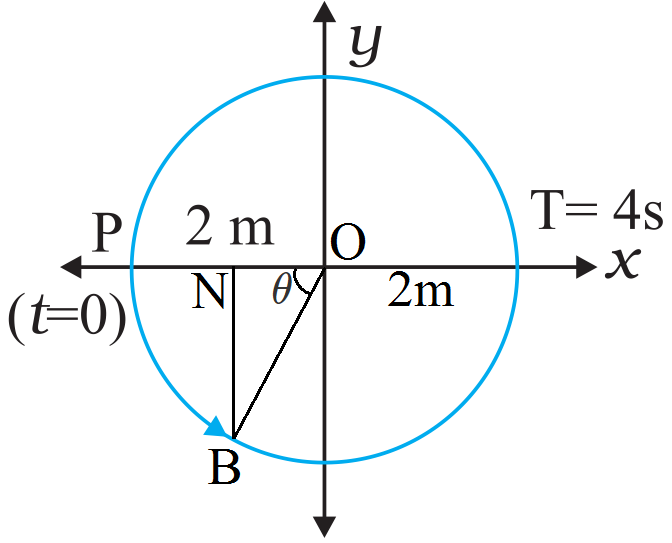
Figures correspond to two circular motions. The radius of the circle, the period of revolution, the initial position, and the sense of revolution (i.e. clockwise or anti-clockwise) are indicated on each figure.

Obtain the corresponding simple harmonic motions of the x-projection of the radius vector of the revolving particle P, in each case.

Answer
Let B be any point on the circle of reference of the figure. From B draw BN perpendicular on x-axis.

Then $\triangle\text{BON}=\theta=\omega\text{t}$

$\therefore$ In $\triangle\text{ONB},\ \cos\theta=\frac{\text{ON}}{\text{OB}}$

Or $\text{ON}=\text{OB}\cos\theta$

$\therefore\ -\text{x}=2\cos\omega\text{t}$

$\Rightarrow\ \text{x}=-2\frac{\cos(2\pi)}{\text{T}}\text{t}=-2\cos\frac{2\pi}{4}\text{t}$

$\therefore\ \text{x}=-2\cos\frac{\pi}{4}\text{t}$ which is equation of SHM

View full question & answer
Question 95 Marks
The acceleration due to gravity on the surface of moon is 1.7m s-2. What is the time period of a simple pendulum on the surface of moon if its time period on the surface of earth is 3.5 s? (g on the surface of earth is 9.8m s-2)
Answer
Acceleration due to gravity on the surface of moon, g' = 1.7m s–2

Acceleration due to gravity on the surface of earth, g = 9.8m s–2

Time period of a simple pendulum on earth, T = 3.5s

$\text{T}=2\pi\sqrt{\frac{\text{l}}{\text{g}}}$

Where l is the length of the pendulum

$\therefore\ \text{l}=\frac{\text{T}^2}{(2\pi)^2}\times\text{g}$

$=\frac{(3.5)^2}{4\times(3.14)^2}\times9.8\text{m}$

The length of the pendulum remains constant.

On moon's surface, time period, $\text{T}'=2\pi\sqrt{\frac{\text{l}}{\text{g}'}}$

$=2\pi\sqrt{\frac{\frac{(3.5)^2}{(4\times3.14)^2}\times9.8}{1.7}}=8.4\text{s}$

Hence, the time period of the simple pendulum on the surface of moon is 8.4s.

View full question & answer
Question 105 Marks
A spring balance has a scale that reads from 0 to 50kg. The length of the scale is 20cm. A body suspended from this balance, when displaced and released, oscillates with a period of 0.6s. What is the weight of the body?
Answer
Maximum mass that the scale can read, M = 50kg

Maximum displacement of the spring = Length of the scale, l = 20cm = 0.2m

Time period, T = 0.6s

Maximum force exerted on the spring, F = Mg

Where, g = acceleration due to gravity = 9.8m/s2

F = 50 × 9.8 = 490

$\therefore$ Spring constant, $\text{k}=\frac{\text{F}}{\text{l}}=\frac{490}{0.2}=2450\text{ Nm}^{-1}$

Mass m, is suspended from the balance.

Time period, $\text{T}=2\pi\sqrt{\frac{\text{m}}{\text{k}}}$

$\therefore\ \text{m}=\Big(\frac{\text{T}}{2\pi}\Big)^2\times\text{k}=\Big(\frac{0.6}{2\times3.14}\Big)^2\times2450$

= 22.36kg

$\therefore$ Weight of the body = mg = 22.36 × 9.8 = 219.167N

Hence, the weight of the body is about 219N.

View full question & answer
Question 115 Marks
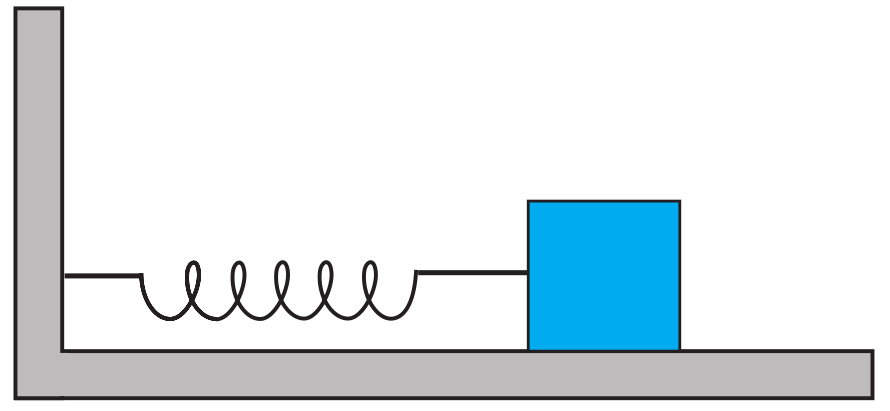
A spring having with a spring constant 1200N m-1 is mounted on a horizontal table as shown in Fig. A mass of 3kg is attached to the free end of the spring. The mass is then pulled sideways to a distance of 2.0cm and released.

Determine (i) the frequency of oscillations, (ii) maximum acceleration of the mass, and (iii) the maximum speed of the mass.

Answer
Spring constant, k = 1200N m-1

Mass, m = 3kg

Displacement, A = 2.0cm = 0.02cm

  1. Frequency of oscillation v, is given by the relation:

$\upsilon=\frac{1}{\text{T}}=\frac{1}{2\pi}\sqrt{\frac{\text{k}}{\text{m}}}$

where, T is time period

$\therefore\ \upsilon=\frac{1}{2\times3.14}\sqrt{\frac{1200}{3}}$

= 3.18m/s

Hence, the frequency of oscillations is 3.18 cycles per second.

  1. Maximum acceleration (a) is given by the relation:

$\text{a}=\omega^2\text{A}$

where,

$\omega=$ Angular frequency $=\sqrt{\frac{\text{k}}{\text{m}}}$

A = maximum displacement

$\therefore\ \text{a}=\frac{\text{k}}{\text{m}}\text{A}=\frac{1200\times0.02}{3}=8\text{ ms}^{-2}$

Hence, the maximum acceleration of the mass is 8.0m/s2.

Maximum velocity, $\text{v}_\text{max}=\text{A}\omega$

$=\text{A}\sqrt{\frac{\text{k}}{\text{m}}}=0.02\times\sqrt{\frac{1200}{3}}=0.4\text{ m/s}$

Hence, the maximum velocity of the mass is 0.4m/s.

View full question & answer
Question 125 Marks
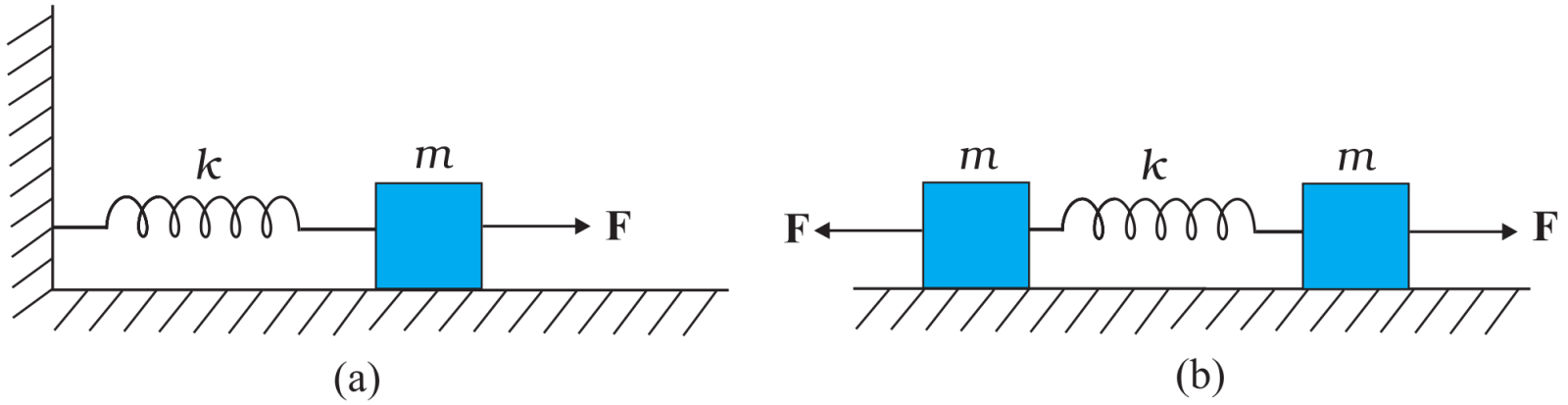
Figure (a) shows a spring of force constant k clamped rigidly at one end and a mass m attached to its free end. A force F applied at the free end stretches the spring. Figure (b) shows the same spring with both ends free and attached to a mass m at either end. Each end of the spring in Fig. (b) is stretched by the same force F.

If the mass in Fig. (a) and the two masses in Fig. (b) are released, what is the period of oscillation in each case?

Answer
In Fig. (a) if x is the extension in the spring, when mass m is returning to its mean position after being released free, then restoring force on the mass iss F = -kx, i.e., $\text{F}\propto\text{x}$
As, this F is directed towards mean position of the mass, hence the mass attached to the spring will execute SHM.
Spring factor = spring constant = k
inertia factor = mass of the given mass = m
As time period,
$\text{T}=2\pi\sqrt{\frac{\text{inertia factor}}{\text{spring factor}}}$
$\therefore\ \text{T}=2\pi\sqrt{\frac{\text{m}}{\text{k}}}$
In Fig. (b), we have a two body system of spring constant k and reduced mass, $\mu=\frac{\text{m}\times\text{m}}{\text{m+m}}=\frac{\text{m}}{2}$
Inertia factor = m/2
Spring factor = k
$\therefore$ Time period, $\text{T}=2\pi\sqrt{\frac{\frac{\text{m}}{2}}{\text{k}}}=2\pi\sqrt{\frac{\text{m}}{2\text{k}}}$
View full question & answer
Question 135 Marks
A circular disc of mass 10kg is suspended by a wire attached to its centre. The wire is twisted by rotating the disc and released. The period of torsional oscillations is found to be 1.5s. The radius of the disc is 15cm. Determine the torsional spring constant of the wire. (Torsional spring constant $\alpha$ is defined by the relation $\text{J}=-\alpha\theta,$ where J is the restoring couple and $\theta$ the angle of twist).
Answer
Mass of the circular disc, m = 10kg
Radius of the disc, r = 15cm = 0.15m
The torsional oscillations of the disc has a time period, T = 1.5s
The moment of inertia of the disc is:
$\text{l}=\frac{1}{2}\text{mr}^2$
$=\frac{1}{2}\times(10)\times(0.15)^2$
= 0.1125kg m2
Time period, $\text{T}=2\pi\sqrt{\frac{\text{l}}{\alpha}}$
$\alpha$ is the torsional constant.
$\alpha=\frac{4\pi^2\text{l}}{\text{T}^2}$
$=\frac{4\times(\pi)^2\times0.1125}{(1.5)^2}$
= 1.972Nm/rad
Hence, the torsional spring constant of the wire is 1.972Nm rad-1.
View full question & answer
Question 145 Marks
A body describes simple harmonic motion with an amplitude of 5cm and a period of 0.2s. Find the acceleration and velocity of the body when the displacement is (a) 5cm (b) 3cm (c) 0cm.
Answer
Amplitude, A = 5cm = 0.05m

Time period, T = 0.2s

For displacement, x = 5cm = 0.05m

Acceleration is given by:

$\text{a}=-\omega^2\text{x}$

$=-\Big(\frac{2\pi}{\text{T}}\Big)^2\text{x}$

$=-\Big(\frac{2\pi}{0.2}\Big)^2\times0.05$

$=-5\pi^2\text{ m/s}^2$

Velocity is given by:

$\text{v}=\omega\sqrt{\text{A}^2-\text{x}^2}$

$=\frac{2\pi}{\text{T}}\sqrt{(0.05)^2-(0.05)^2}$

= 0

When the displacement of the body is 5cm, its acceleration is $-5\pi^2\text{ m/s}^2$ and velocity is 0. 

For displacement, x = 3cm = 0.03m

$\text{a}=-\omega^2\text{x}$

$=-\Big(\frac{2\pi}{\text{T}}\Big)^2\text{x}$

$=-\Big(\frac{2\pi}{0.2}\Big)^20.03$

$=-3\pi^2\text{ m/s}^2$

Velocity is given by:

$\text{v}=\omega\sqrt{\text{A}^2-\text{x}^2}$

$=\frac{2\pi}{\text{T}}\sqrt{\text{A}^2-\text{x}^2}$

$=\frac{2\pi}{\text{T}}\sqrt{(0.05)^2-(0.03)^2}$

$=\frac{2\pi}{0.2}\times0.04$

$=0.4\pi\text{ m/s}$

When the displacement of the body is 3cm, its acceleration is $-3\pi\text{ m/s}^2$ and velocity is $0.4\pi\text{ m/s}.$

For displacement, x = 0

Acceleration is given by:

$\text{a}=-\omega^2\text{x}=0$

Velocity is given by:

$\text{v}=\omega\sqrt{\text{A}^2-\text{x}^2}$

$=\frac{2\pi}{\text{T}}\sqrt{\text{A}^2-\text{x}^2}$

$=\frac{2\pi}{0.2}\sqrt{(0.05)^2-0}$

$=0.5\pi\text{ m/s}$

When the displacement of the body is 0, its acceleration is 0 and velocity is $0.5\pi\text{ m/s}.$

View full question & answer
Question 155 Marks
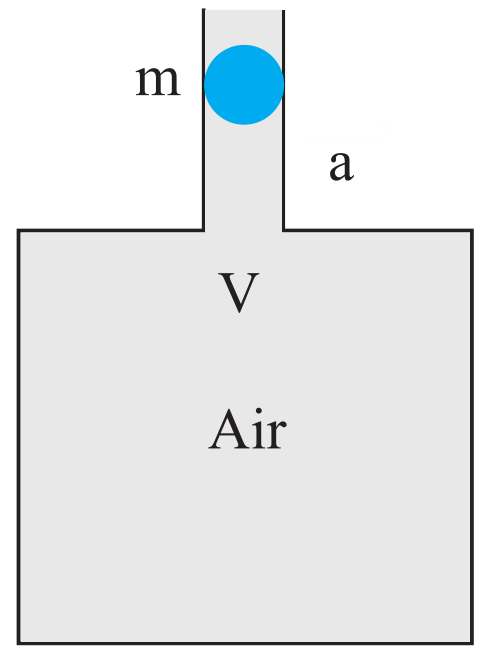
An air chamber of volume V has a neck area of cross section a into which a ball of mass m just fits and can move up and down without any friction (Fig.). Show that when the ball is pressed down a little and released , it executes SHM. Obtain an expression for the time period of oscillations assuming pressure-volume variations of air to be isothermal [see Fig.].

Answer
Volume of the air chamber = V

Area of cross-section of the neck = a

Mass of the ball = m

The pressure inside the chamber is equal to the atmospheric pressure. 

Let the ball be depressed by x units. As a result of this depression, there would be a decrease in the volume and an increase in the pressure inside the chamber

Decrease in the volume of the air chamber, ΔV = ax

Volumetric strain = Change in volume/Original volume

⇒ ΔV/V = ax/V

Bulk Modulus of air B = Stress/Strain = -p/ax/V

In this case, stress is the increase in pressure. The negative sign indicates that pressure increases with a decrease in volume.

$\text{p}=\frac{-\text{Bax}}{\text{V}}$

The restoring force acting on the ball,

$\text{F}=\text{p}\times\text{a}$

$=\frac{-\text{Bax}}{\text{V}}.\text{a}$

$=\frac{-\text{Ba}^2\text{x}}{\text{V}}\ ....(\text{i})$

In simple harmonic motion, the equation for restoring force is:

F = -kx ....(ii)

Where, k is the spring constant

Comparing equations (i) and (ii), we get:

$\text{k}=\frac{\text{Ba}^2}{\text{V}}$

Time period,

$\text{T}=2\pi\sqrt{\frac{\text{m}}{\text{k}}}$

$=2\pi\sqrt{\frac{\text{Vm}}{\text{Ba}^2}}$

View full question & answer
Question 165 Marks
A block whose mass is $1 kg$ is fastened to a spring. The spring has a spring constant of $50 N m ^{-1}$. The block is pulled to a distance $x=10 cm$ from its equilibrium position at $x=0$ on a frictionless surface from rest at $t=0$. Calculate the kinetic, potential and total energies of the block when it is $5 cm$ away from the mean position.
Answer
The block executes SHM, its angular frequency, as given by Eq. (13.14b), is
$
\begin{aligned}
\omega & =\sqrt{\frac{k}{m}} \\
& =\sqrt{\frac{50 N m ^{-1}}{1 kg }} \\
& =7.07 rad s ^{-1}
\end{aligned}
$

Its displacement at any time $t$ is then given by,
$
x(t)=0.1 \cos (7.07 t)
$

Therefore, when the particle is $5 cm$ away from the mean position, we have
$
0.05=0.1 \cos (7.07 t)
$

Or $\cos (7.07 t)=0.5$ and hence
$
\sin (7.07 t)=\frac{\sqrt{3}}{2}=0.866
$

Then, the velocity of the block at $x=5 cm$ is
$
\begin{array}{l}
=0.1 \times 7.07 \quad 0.866 m s ^{-1} \\
=0.61 m s ^{-1}
\end{array}
$

Hence the K.E. of the block,
$
\begin{array}{l}
=\frac{1}{2} m v^2 \\
=1 / 2\left[1 kg \times\left(0.6123 m s ^{-1}\right)^2\right] \\
=0.19 J
\end{array}
$

The P.E. of the block,
$
\begin{array}{l}
=\frac{1}{2} k x^2 \\
=1 / 2\left(50 N m ^{-1} \times 0.05 m \times 0.05 m \right) \\
=0.0625 J
\end{array}
$

The total energy of the block at $x=5 cm$,
$
\begin{array}{l}
=\text { K.E. + P.E. } \\
=0.25 J
\end{array}
$
we also know that at maximum displacement, K.E. is zero and hence the total energy of the system is equal to the P.E. Therefore, the total energy of the system,
$
\begin{aligned}
& =1 / 2\left(50 N m ^{-1} \times 0.1 m \times 0.1 m \right) \\
& =0.25 J
\end{aligned}
$
which is same as the sum of the two energies at a displacement of $5 cm$. This is in conformity with the principle of conservation of energy.
View full question & answer
Question 175 Marks
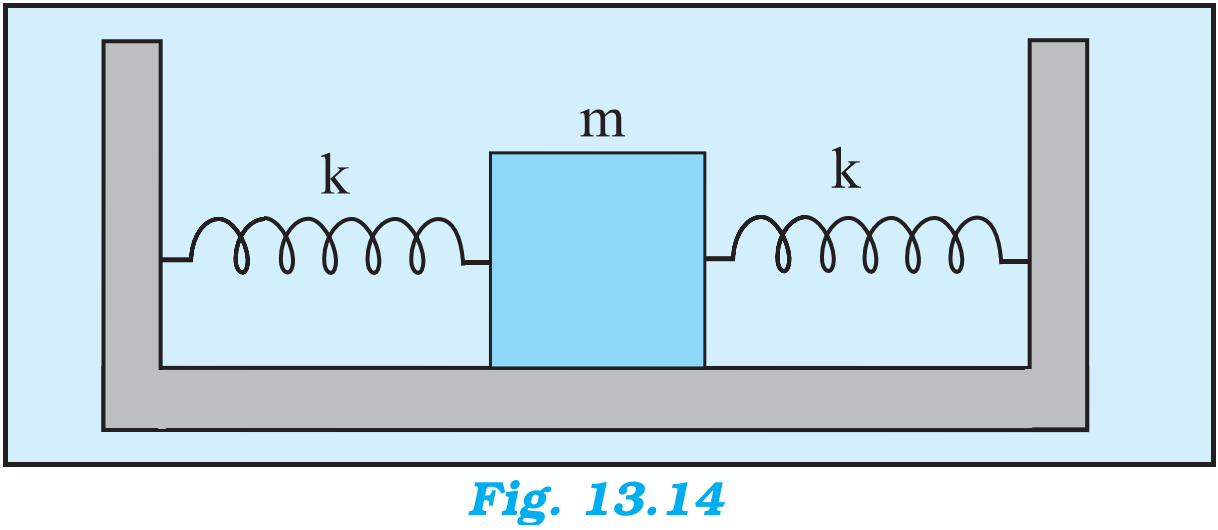
Two identical springs of spring constant k are attached to a block of mass m and to fixed supports as shown in Fig. 13.14. Show that when the mass is displaced from its equilibrium position on either side, it executes a simple harmonic motion. Find the period of oscillations.
Image
Answer
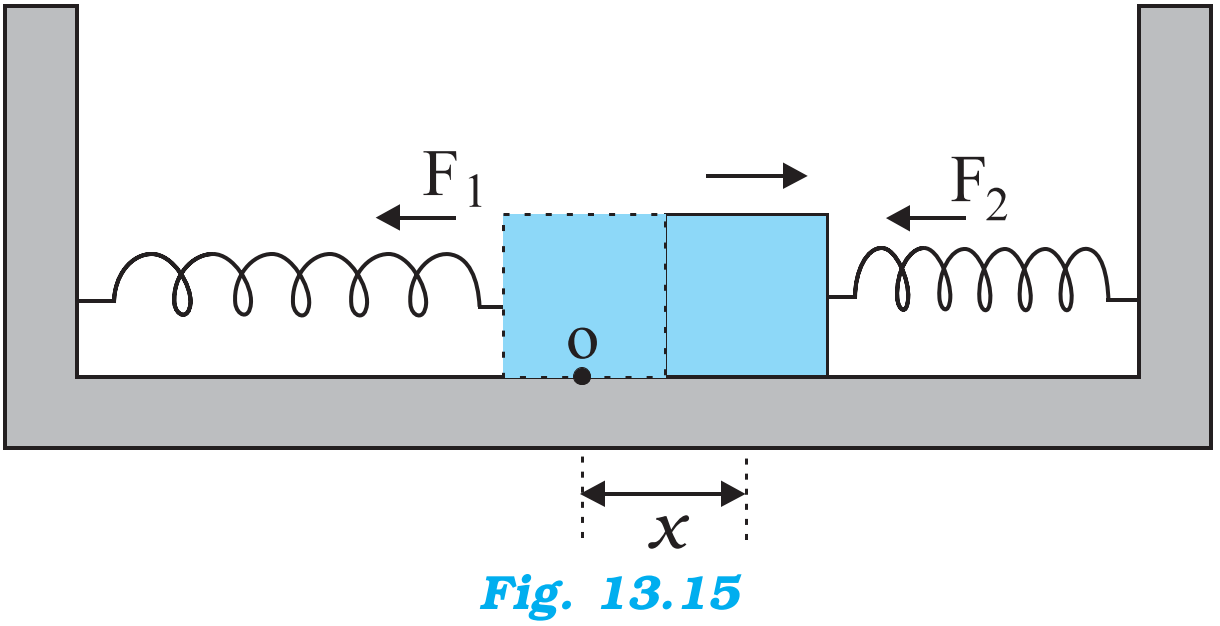
Let the mass be displaced by a small distance x to the right side of the equilibrium position, as shown in Fig. 13.15. Under this situation the spring on the left side gets
Image
elongated by a length equal to $x$ and that on the right side gets compressed by the same length. The forces acting on the mass are then,
$
\begin{array}{r}
F_1=-k x \text { (force exerted by the spring on } \\
\text { the left side, trying to pull the } \\
\text { mass towards the mean } \\
\text { position) } \\
F_2=-k x \text { (force exerted by the spring on } \\
\text { the right side, trying to push the } \\
\text { mass towards the mean } \\
\text { position) }
\end{array}
$

The net force, $F$, acting on the mass is then given by,
$
F=-2 k x
$

Hence the force acting on the mass is proportional to the displacement and is directed towards the mean position; therefore, the motion executed by the mass is simple harmonic. The time period of oscillations is,
$
T=2 \pi \sqrt{\frac{m}{2 k}}
$
View full question & answer
Question 185 Marks
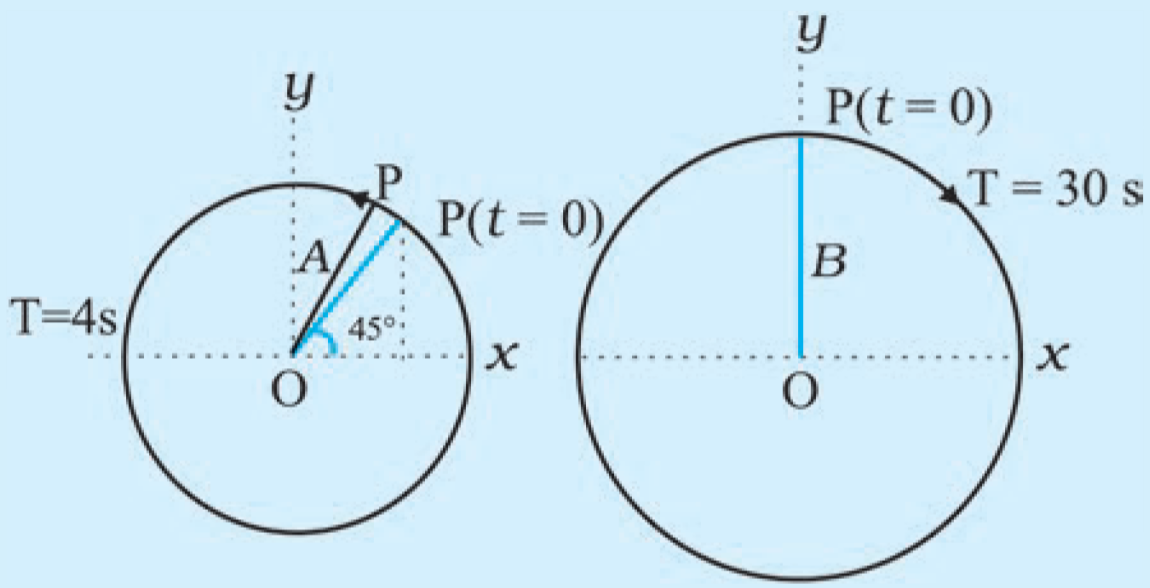
The figure given below depicts two circular motions. The radius of the circle, the period of revolution, the initial position and the sense of revolution are indicated in the figures. Obtain the simple harmonic motions of the x-projection of the radius vector of the rotating particle P in each case.
Image
Answer
(a) At $t=0$, OP makes an angle of $45^{\circ}=\pi / 4 rad$ with the (positive direction of) $x$-axis. After time $t$, it covers an angle $\frac{2 \pi}{T} t$ in the anticlockwise sense, and makes an angle of $\frac{2 \pi}{T} t+\frac{\pi}{4}$ with the $x$-axis.
The projection of OP on the $x$-axis at time $t$ is given by,
$
x(t)=A \cos \left(\frac{2 \pi}{T} t+\frac{\pi}{4}\right)
$
For $T=4 s$,
$
x(t)=A \cos \left(\frac{2 \pi}{4} t+\frac{\pi}{4}\right)
$
which is a SHM of amplitude $A$, period $4 s$, and an initial phase $*=\frac{\pi}{4}$.

(b) In this case at $t=0$, OP makes an angle of $90^{\circ}=\frac{\pi}{2}$ with the $x$-axis. After a time $t$, it covers an angle of $\frac{2 \pi}{T} t$ in the clockwise sense and makes an angle of $\left(\frac{\pi}{2}-\frac{2 \pi}{T} t\right)$ with the $x$-axis. The projection of OP on the $x$-axis at time $t$ is given by
$
\begin{array}{r}
x(t)=B \cos \left(\frac{\pi}{2}-\frac{2 \pi}{T} t\right) \\
=B \sin \left(\frac{2 \pi}{T} t\right)
\end{array}
$
For $T=30 s$,
$
x(t)=B \sin \left(\frac{\pi}{15} t\right)
$
Writing this as $x(t)=B \cos \left(\frac{\pi}{15} t-\frac{\pi}{2}\right)$, and comparing with Eq. (13.4). We find that this represents a SHM of amplitude $B$, period $30 s$, and an initial phase of $-\frac{\pi}{2}$.
View full question & answer
Question 195 Marks
Which of the following functions of time represent (a) periodic and (b) non-periodic motion? Give the period for each case of periodic motion [ $\omega$ is any positive constant].
(i) $\sin \omega t+\cos \omega t$
(ii) $\sin \omega t+\cos 2 \omega t+\sin 4 \omega t$
(iii) $e ^{-\omega t}$
(iv) $\log (\omega t)$
Answer
(i) $\sin \omega t+\cos \omega t$ is a periodic function, it can also be written as $\sqrt{2} \sin (\omega t+\pi / 4)$.
Now $\sqrt{2} \sin (\omega t+\pi / 4)=\sqrt{2} \sin (\omega t+\pi / 4+2 \pi)$ $=\sqrt{2} \sin [\omega(t+2 \pi / \omega)+\pi / 4]$
The periodic time of the function is $2 \pi / \omega$.
(ii) This is an example of a periodic motion. It can be noted that each term represents a periodic function with a different angular frequency. Since period is the least interval of time after which a function repeats its value, $\sin \omega t$ has a period $T_0=2 \pi / \omega ; \cos 2 \omega t$ has a period $\pi / \omega=T_o / 2$; and $\sin 4 \omega t$ has a period $2 \pi / 4 \omega=T_o / 4$. The period of the first term is a multiple of the periods of the last two terms. Therefore, the smallest interval of time after which the sum of the three terms repeats is $T_0$, and thus, the sum is a periodic function with a period $2 \pi / \omega$.
(iii) The function $e^{-\omega t}$ is not periodic, it decreases monotonically with increasing time and tends to zero as $t \rightarrow \infty$ and thus, never repeats its value.
(iv) The function $\log (\omega t)$ increases monotonically with time $t$. It, therefore, never repeats its value and is a nonperiodic function. It may be noted that as $t \rightarrow \infty, \log (\omega t)$ diverges to $\infty$. It, therefore, cannot represent any kind of physical displacement.
View full question & answer
Question 205 Marks
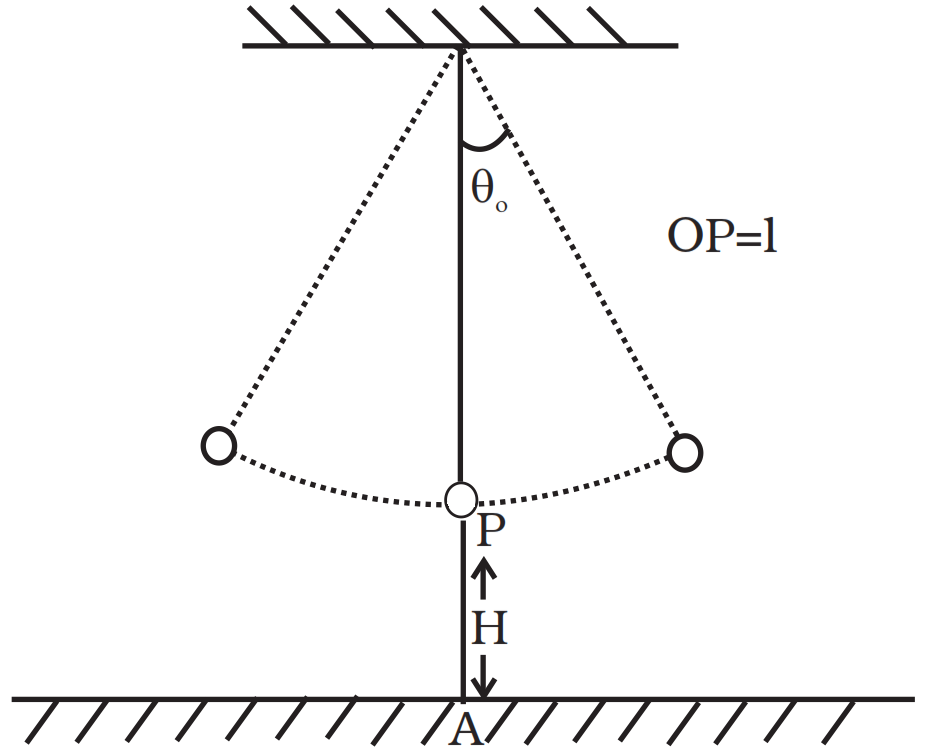
A simple pendulum of time period 1s and length l is hung from a fixed support at O, such that the bob is at adistance H vertically above A on the ground The amplitude is $\theta$ The string snaps at $\theta=\frac{\theta_0}{2}$ Find the time taken by the bob to hit the ground. Also find distance from A where bob hits the ground. Assume θ to be small so that $\sin\theta_0\ \text{and}\ \cos\theta_0=1.$

Answer
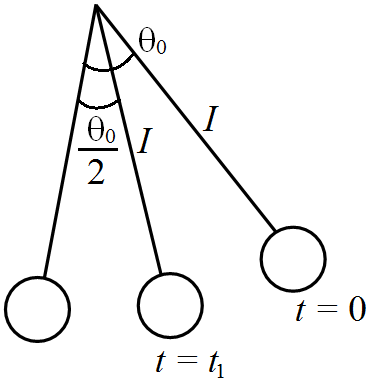
Consider the diagram at $\text{t}=0,\theta=\frac{\theta}{2}$

At $\text{t}=\text{t}_1\ \ \ \ \ \theta=\frac{\theta_0}{2}$

$\theta=\theta_0\cos\omega\text{t}$

$\text{t}=\text{t}_1,\theta=\frac{\theta_0}{2}$

$\therefore\frac{\theta_0}{2}=\theta_0\cos\frac{2\pi}{\text{T}}\text{t}_1$

$\text{T}=1\text{Sec}(\text{given})$

$\therefore\cos2\pi\text{t}_1=\frac{1}{2}=\cos\frac{\pi}{3}$

$2\pi\text{t}_1=\frac{\pi}{3}\ \text{or}\ \text{t}_1=\frac{1}{6}$

$\theta=\theta_0\cos2\pi\text{r}$

$\frac{\text{d}\theta}{\text{dt}}=-\theta_02\pi\sin2\pi\text{t}$

At $\text{t}=\frac{1}{6}\text{i.e,}\ \text{at}\ \theta=\frac{\theta_0}{2}$

$\frac{\text{d}\theta}{\text{dt}}=-\theta_02\pi\sin2\pi\frac{1}{6}$

$\frac{\text{d}\theta}{\text{dt}}=-\theta_02\pi\sin\frac{\pi}{3}$

$=-\theta_02\pi\frac{\sqrt{3}}{2}$

$\frac{\text{d}\theta}{\text{dt}}=-\theta_0\pi\sqrt{3}$

$\omega=-\theta_0\pi\sqrt{3}\Big(\because\frac{\text{d}\theta}{\text{dt}}=\omega\Big)$

$\frac{\text{v}}{\text{t}}=-\theta_0\pi\sqrt{3}$

$\text{v}=-\sqrt{3}\pi\theta_0\text{l}$

(-) ve shows that bob’s motion is towards left.

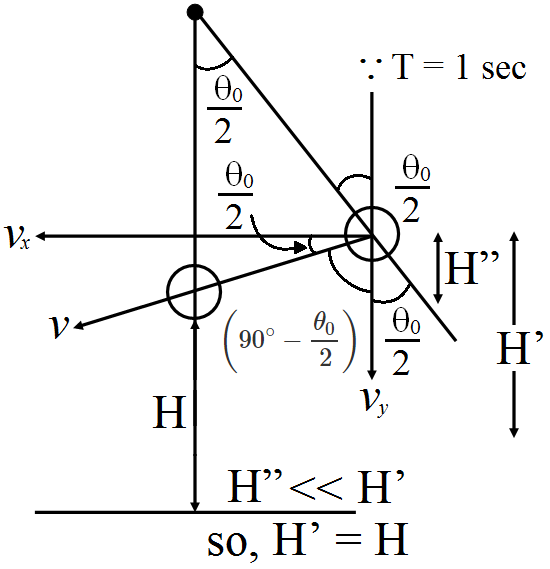
$\text{v}_\text{x}=\text{v}\cos\frac{\theta_0}{2}=-\sqrt{3\pi}\theta_0\text{l}\cos\frac{\theta_0}{2}$

$\text{v}_\text{y}=\text{v}\sin\frac{\theta_0}{2}=-\sqrt{3}\pi\theta_0\text{l}\sin\frac{\theta_0}{2}$

Let vertical distance covered by is H’ (downward)

$\text{s}=\text{ut}+\frac{1}{2}\text{gt}^2$

$\text{H}'=\text{v}_\text{y}\text{t}+\frac{1}{2}\text{gt}^2$

$\frac{1}{2}\text{gt}^2+\sqrt{3}\pi\theta_0\text{l}\sin\frac{\theta_0}{2}\times\text{t}-\text{H}'=0$

$\sin\frac{\theta_0}{2}=\frac{\theta_2}{2}$ (given)

$\therefore\frac{1}{2}\text{gt}^2+\sqrt{3}\pi\theta_0\text{l}\frac{\theta_0}{2}\text{t}-\text{H}=0$

By Quadratic formula $\text{t}=\frac{-\text{B}\pm\sqrt{\text{B}^2-4\text{Ac}}}{2\text{A}}$

$\text{t}=\frac{(-\sqrt{3}\pi\theta_0^2\text{l})/4\pm\sqrt{(3\pi^2\theta^4_0\text{l}^2)/4+4\frac{1}{2}\text{gH}}}{\text{2g/2}}$

As $\theta_0$ is very small so by neglecting $\theta^4_0$ and $\theta^2_0$

$\text{t}=\frac{+\sqrt{2\text{gH}'}}{\text{g}}\text{H}'=\text{H}+\text{H}''$

$\therefore\text{t}=\sqrt{\frac{2\text{H}}{\text{g}}}\text{H}''<<\text{H}$ as $\frac{\theta_0}{2}$ is very small

$\therefore\text{H}=\text{H}'$

Distance covered in horizontal = vxt

$\text{x}=\sqrt{3}\pi\theta_0\text{l}\cos\frac{\theta_0}{2}\sqrt{\frac{2\text{H}}{\text{g}}}$

$\therefore\text{x}=\sqrt{3}\pi\theta_0\text{l}\sqrt{\frac{2\text{H}}{\text{g}}}\cos\frac{\theta_0}{2}=1$

$\text{x}=\theta_0\text{l}\pi\sqrt{\frac{6\text{H}}{\text{g}}}$

At the time snapping, the bob was at distance $\text{l}\sin\frac{\theta_0}{2}=\text{l}\frac{\theta_0}{2}$ from A

Thus the distance of bob From A where it meet the ground is

$=\frac{\text{l}\theta_0}{2}-\text{x}=\frac{\text{l}\theta_0}{2}-\theta_0\text{l}\pi\sqrt{\frac{6\text{H}}{\text{g}}}$

$=\theta_0\text{l}\Big[\frac{1}{2}-\pi\sqrt{\frac{6\text{H}}{\text{g}}}\Big]$

View full question & answer
Question 215 Marks
The length of a second’s pendulum on the surface of Earth is 1m. What will be the length of a second’s pendulum on the moon?
Answer

A pendulam of time period (T) of 2sec is called secound penduluam.

$\text{T}_\text{e}=2\pi\sqrt{\frac{\text{l}_\text{e}}{\text{g}_\text{e}}}\Rightarrow\text{T}_\text{e}^2=4\pi^2\frac{\text{l}_\text{e}}{\text{g}_\text{e}}\ ...(1)$

$\text{T}_\text{m}=2\pi\sqrt{\frac{\text{l}_\text{m}}{\text{g}_\text{m}}}\because\text{g}_\text{m}=\frac{\text{g}_\text{e}}{6}$

$\therefore\text{T}_\text{m}^2=4\pi^2\frac{\text{i}_\text{m}\times6}{\text{g}_\text{e}}\ ...(2)$

For secound pendulum $\text{T}_\text{e}=\text{T}_\text{m}=2\text{sec}$

$4\pi^26\text{l}_\text{m}$

$\frac{\text{T}_\text{m}^2}{\text{T}^2_\text{e}}=\frac{\text{g}_\text{e}}{4\pi^2\frac{\text{l}_\text{e}}{\text{g}_\text{e}}}\ \text{or}\ \frac{(2)^2}{(2)^2}=\frac{6\text{l}_\text{m}}{\text{l}_\text{e}}\text{l}_\text{e}=1\text{m}$

$\frac{1}{1}=\frac{6\text{l}_\text{m}}{1\text{m}}\Rightarrow\text{l}_\text{m}=\frac{1}{6}\text{m}$

View full question & answer
Question 225 Marks
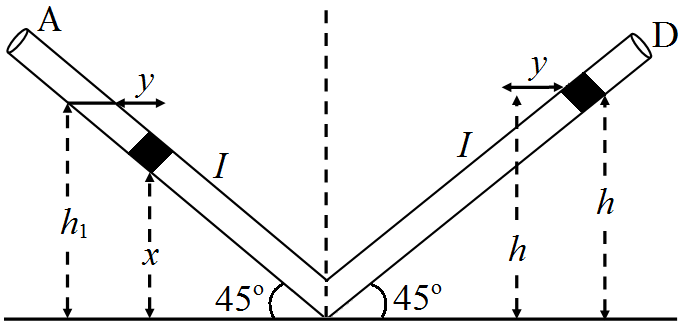
One end of a V-tube containing mercury is connected to a suction pump and the other end to atmosphere. The two arms of the tube are inclined to horizontal at an angle of 45 PHA° each. A small pressure difference is created between two columns when the suction pump is removed. Will the column of mercury in V-tube execute simple harmonic motion? Neglect capillary and viscous forces.Find the time period of oscillation.
Answer
Let the liquid column in both columns are at heights initial. Now due to pressure difference the liquid columns in A arm pressed by and in arm B lifts by (so difference in vertical height between two levels = Consider an element of liquid of height (in tube).

Then iy's mass $\text{dm}=\text{A}.\text{dx}\rho.$A = area of cross section of tube.

P.E. of the left dm element column = (dm)g h

P.E. of dm element in left column $\text{A}\rho\text{g x dx}$

Total P.E. in left column $=\int_{0}^{\text{h}}\text{A}\rho\text{gx dx}=\text{A}\rho\text{g}\Big[\frac{\text{x}^2}{2}\Big]^\text{h}_0$

$=\text{A}\rho\text{g}\frac{\text{h}_1^2}{2}$

from figure $\sin45^\circ=\frac{\text{h}_1}{\text{l}}$

$\text{h}_1=\text{h}_2=\text{l}\sin45^\circ=\frac{\text{l}}{\sqrt{2}}$

$\therefore\text{h}_1^2=\text{h}_2^2=\frac{\text{l}^2}{2}$

$\therefore$ P.E. in left column $=\text{A}\rho\text{g}\frac{\text{l}^2}{4}$

Similarly P.E. in right column $=\text{A}\rho\text{g}\frac{\text{l}^2}{4}$

$\therefore$ total potential energy $=\text{A}\rho\text{g}\ \frac{\text{l}^2}{4}+\text{A}\rho\text{g}\frac{\text{l}^2}{4}=\frac{\text{A}\rho\text{gl}^2}{2}$

Due to pressure difference, let element moves towards right side y is unit.

Then the liquid column is left arm = (l - y)

 And the liquid column is right arm = (l + y)

P.E. of liquid column in left arm $=\text{A}\rho\text{g}(\text{l}-\text{y})^2\sin^245^\circ$

P.E. of liquid column in right arm $=\text{A}\rho\text{g}(\text{l}+\text{y})^2\sin45^\circ$

$\therefore$ Total P.E. due liquid column $=\text{A}\rho\text{g}\Big(\frac{1}{\sqrt{2}}\Big)^2[(\text{l}-\text{y})^2+(\text{l}+\text{y})^2]$

Final P.E. due to different in liquid columns

$=\frac{\text{A}\rho\text{g}}{2}[\text{l}^2+\text{y}^2-2\text{ly}+\text{l}^2+\text{y}^2+2\text{ly}]$

Final P.E. $=\frac{\text{A}\rho\text{g}}{2}(2\text{l}^2+2\text{y}^2)$

Change P.E. = final P.E. - Initial P.E.

$=\frac{\text{A}\rho\text{g}}{2}(2\text{l}^2+2\text{y}^2)-\frac{\text{A}\rho\text{gl}^2}{2}$

$=\frac{\text{A}\rho\text{g}}{2}\ [2\text{l}^2+2\text{y}^2-\text{l}^2]$

Change in P.E. $=\frac{\text{A}\rho\text{g}}{2}\ (\text{l}^2+2\text{y}^2)$

If change in velocity (v) of total liquid column

$\Delta\text{KE}=\frac{1}{2}\text{mv}^2$

$\text{m}=(A.2\text{l})\rho$

$\Delta\text{kE}=\frac{1}{2}\ (\text{A}2\ \text{l}\rho)\text{v}^2=\text{A}\rho\text{lv}^2$

$\therefore$ Change in total energy $=\frac{\text{A}\rho\text{g}}{2}(\text{l}^2+2\text{y}^2)+-\text{A}\rho\text{lv}^2$

Total change in energy $\Delta\text{PE}+\Delta\text{KE}=0$

$\therefore\frac{\text{A}\rho\text{g}}{2}\ [\text{l}^2+2\text{y}^2]+\text{A}\rho\text{lv}^2=0$

$\frac{\text{A}\rho}{2}[\text{g}(\text{l}^2+2\text{y}^2)+2\text{lv}^2]=0$

$\frac{\text{A}\rho}{2}\neq0$

$\therefore\text{g}(\text{l}^2+2\text{y}^2)+2\text{lv}^2=0$

Differentiating W.R.T, $\text{g}\Big[0+2\times2\text{y}\ \frac{\text{dy}}{\text{dt}}\Big]+2\text{l}.2\text{v}.\frac{\text{dv}}{\text{dt}}=0$

$4\text{gy}\ \frac{\text{dy}}{\text{dt}}+4\text{vl}\ \frac{\text{d}^2\text{y}}{\text{dt}^2}=0$ $\Big[\because\text{A}=\frac{\text{dv}}{\text{dt}}=\frac{\text{d}^2\text{y}}{\text{dt}^2}\Big]$

$4\text{gy}.\text{v}+4\text{vl}\frac{\text{d}^2\text{y}}{\text{dt}^2}=0\Rightarrow4\text{v}\Big[\text{gy}+\text{l}.\frac{\text{d}^2\text{y}}{\text{dt}^2}\Big]=0$

$\frac{\text{d}^2\text{y}}{\text{dt}^2}+\frac{\text{g}}{\text{l}}\ \text{y}=0\ \because4\text{v}\neq0$

It is the equation of SHM oscillator and standard equation of SHM is $\frac{\text{d}^2\text{y}}{\text{dt}^2}+\omega^2\text{y}=0$

$\frac{2\pi}{\text{T}}=\sqrt{\frac{\text{g}}{\text{l}}}\Rightarrow\text{T}=2\pi\sqrt{\frac{\text{l}}{\text{g}}}$

View full question & answer
Question 235 Marks
A pendulum clock gives correct time. What is the error in time per day if the length increases by 0.05%?
Answer
$\text{T}=2\pi\sqrt{\frac{\text{L}}{\text{g}}}$ and $\text{T}'=2\pi\sqrt{\frac{\big(\text{L}+\frac{0.05}{100}\text{L}\big)}{\text{g}}}$

Dividing, $\frac{\text{T}'}{\text{T}}=\sqrt{\frac{\big(\text{L}+\frac{0.05}{100}\text{L}\big)}{\text{g}}}$

$=\Big[1+\frac{0.05}{100}\Big]^{\frac{1}2{}}$

Applying binomial theorem, and neglecting squares and higher powers, we get

$\frac{\text{T}'}{\text{T}}=1+\frac{1}{2}\times0.0005$

$\frac{\text{T}'}{\text{T}}-1=0.00025$

$\frac{\text{T}'-\text{T}}{\text{T}}=0.00025$

$\therefore$ Loss of time pre second $=0.00025\text{s}$

Loss of time per day

$=0.00025\times24\times60\times60\text{s}$

$=21.6\text{s}$

View full question & answer
Question 245 Marks
A body executing linear SHM has a velocity of 3cms-1 when its displacement is 4cm and a velocity of 4cms-1 when its displacement is 3cm.
  1. Find the amplitude and period of the oscillation.
  2. If the mass of the body is 50g, calculate the total energy of oscillation.
Answer
  1. In SHM, the velocity V at a displacement x is given by

$\text{V}=\omega(\text{A}^2-\text{x}^2)^\frac{1}{2}$

$\text{V}^2=\omega^2(\text{A}^2-\text{x}^2)$

V = 3cms-1 when x = 4cm. Therefore

$9=\omega^2(\text{A}^2-16) \cdots\text{(i)}$

V = 4cms-1 when x = 3cm. Therefore

$16=\omega^2(\text{A}^2-9) \cdots\text{(ii)}$

Simultaneous solution of eqns (i) and (ii) gives

Amplitude A = 5cm

Angular frequency, $\omega=1\text{ rad s}^{-1}$

Hence time period, $\text{T}=\frac{2\pi}{\omega}$

$=2\pi\text{ seconds}$

$=6.28\text{s}$

  1. $\text{m}=50\text{g}=50\times10^{-3}\text{kg}$

$\text{A}=5\text{cm}=5\times10^{-2}\text{m}$

$\omega=1\text{rad}\text{ s}^{-1}$

Total energy $=\frac{1}{2}\text{m}\text{A}^2\omega^2$

$=\frac{1}{2}\times(50\times10^{-3})\times5\times10^{-2})^2(1)^2$

$=6.25\times10^{-5}\text{J}$

View full question & answer
Question 255 Marks
A mass attached to a spring is free to oscillate, with angular velocity $\omega,$ in a horizontal plane without friction or damping. It is pulled to a distance x0 and pushed towards the centre with a velocity $\upsilon_0$ at time t = 0. Determine the amplitude of the resulting oscillations in terms of the parameters $\omega,$ x0 and $\upsilon_0.$ [Hint: Start with the equation $\text{x}=\text{a}\cos(\omega\text{t}+\theta)$ and note that the initial velocity is negative.]
Answer
The displacement rquation for an oscillating mass is given by:

$\text{x}=\text{A}\cos(\omega\text{t}+\theta)$

where,

A is the amplitude

x is the displacement

$\theta$ is the phase constant

Velcoity, $\text{v}=\frac{\text{dx}}{\text{dt}}=-\text{A}\omega\sin(\omega\text{t}+\theta)$

At, t = 0, x = x0

$\text{x}_0=\text{A}\cos\theta=\text{x}_0\ .....(\text{i})$

and, $\frac{\text{dx}}{\text{dt}}=-v_0=\text{A}\omega\sin\theta$

$\text{A}\sin\theta=\frac{v_0}{\omega}\ ....(\text{ii})$

Squaring and adding equations (i) and (ii), we get:

$\text{A}^2(\cos^2\theta+\sin^2\theta)=\text{x}_0^2+\Big(\frac{v_0^2}{\omega^2}\Big)$

$\therefore\ \text{A}=\sqrt{\text{x}_0^2+\Big(\frac{v_0}{\omega}\Big)^2}$

Hence, the amplitude of the resulting oscillation is $\text{x}_0^2+\Big(\frac{v_0}{\omega}\Big)^2.$
View full question & answer
Question 265 Marks
A particle executes S.H.M of time period 10s. The displacement at any instant is given by the relation $\text{x}=10\sin\omega\text{t}$ Find
  1. Velocity of the body 2s after it passes through the mean position and
  2. The acceleration 2s after it passes the mean position (Amplitude is given in cm).
Answer
  1.  Velocity at any instant t is given by  $\text{v}=\text{A}\omega\cos\text{t}$

Here A = 10cm

$\omega=\frac{2\pi}{\text{T}}=\frac{2\pi}{10}$

When t = 2s,

$\text{v}=10\times\frac{2\pi}{10}\cos\Big(\frac{2\pi}{10}\times2\Big)$

$=2\pi\cos(0.4\pi)$

$=1.942\text{cm/ s}$

  1. Accleration at any instant t is given by 

$\text{a}=-\text{A}\omega^2\sin\omega\text{t}$

$=-10\big(\frac{2\pi}{10}\big)^2\sin(0.4\pi)$

$=-3.755\text{cm/ s}^2$

Acceleration is numerically equal to 3.754cm/ s2 and is directed towards the mean position.

View full question & answer
Question 275 Marks
Two pendulums of lengths 100cm and 110.25cm start oscillating in phase simultaneously. After how many oscillations will they again be in phase together?
Answer
$\text{T}=2\pi\sqrt{\frac{\text{l}}{\text{g}}}$

$\text{l}_1=100\text{cm}$

$\text{l}_2=110.25\text{cm}$

For smaller pendulum, $\text{T}_1=2\pi\sqrt{\frac{100}{\text{g}}}\cdots\text{(i)}$

For larger pendulum, $\text{T}_2=2\pi\sqrt{\frac{110.25}{\text{g}}}\cdots\text{(ii)}$

Let these pendulums oscillate in phase again if larger pendulum completes 'n' oscillations. It means smaller pendulum must complete (n + 1) oscillations.

$\text{nT}_2=(\text{n}+1)\text{T}_1$

$\frac{\text{n}+1}{\text{n}}$

$\frac{\text{T}_2}{\text{T}_1}=\sqrt{\frac{110.25}{100}}$

$=1.05$

$=1+\frac{1}{\text{n}}$

$=1.05$

$=\frac{1}{\text{n}}=0.05$

$=\frac{5}{100}=\frac{1}{20}$

$\therefore\text{n}=20$

Hence both pendulums will again oscillate in phase after 20 oscillations of the larger or 21 oscillations of the smaller pendulum.

View full question & answer
Question 285 Marks
Given the example of the motion in the following cases:
  1. Where magnitude and direction of the acceleration of the particle changes.
  2. Where the magnitude and direction of acceleration of body remains constant.
  3. Where magnitude of acceleration changes but its direction remains constants.
  4. Where the magnitude of acceleration remains constant but its direction changes.
Answer
  1. In S.H.M., acceleration is always proportional to displacement but directed opposite to the displacement. So in this case, magnitude as well as direction of acceleration changes.
  2. A body falling under gravity near the surface of the earth.
  3. A body falling under gravity from a height comparable to the radius of the earth.
  4. A body revolving in a circular path with constant speed.
View full question & answer
Question 295 Marks
The motion of a particle executing simple harmonic motion is described by the displacement function,

$\text{x(t)}=\text{A}\cos(\omega\text{t}+\phi).$

If the initial (t = 0) position of the particle is 1cm and its initial velocity is $\omega\text{ cm/s,}$ what are its amplitude and initial phase angle? The angular frequency of the particle is $\pi\text{s}^{-1}.$ If instead of the cosine function, we choose the sine function to describe the SHM: $\text{x}=\text{B}\sin(\omega\text{t}+\alpha),$ what are the amplitude and initial phase of the particle with the above initial conditions.

Answer
Initially, at t = 0:

Displacement, x = 1cm

Initial velocity, $\text{v}=\omega\text{ cm/sec.}$

Angular frequency, $\omega=\pi\text{ rad/s}^{-1}$

It is given that:

$\text{x(t)}=\text{A}\cos(\omega\text{t}+\phi)$

$1=\text{A}\cos(\omega\times0\times\phi)$

$\text{A}\cos\phi=1\ ........(1)$

$\text{Velocity, }\upsilon=\frac{\text{dx}}{\text{dt}}$

$\omega=-\text{A}\omega\sin(\omega\text{t}+\phi)$

$1=-\text{A}\sin(\omega\times0+\phi)=-\text{A}\sin\phi$

$\text{A}\sin\phi=-1\ ....(2)$

Squaring and adding equations (1) and (2), we get:

$\text{A}^2(\sin^2\phi+\cos^2\phi)=1+1$

$\text{A}^2=2$

$\therefore\ \text{A}=\sqrt{2}\ \text{cm}$

Dividing equation (2) by equation (1), we get:

$\tan\phi=-1$

$\therefore\ \phi=\frac{3\pi}{4},\frac{7\pi}{4},....$

SHM is given as:

$\text{x}=\text{B}\sin(\omega\text{t}+\alpha)$

Putting the given values in this equation, we get:

$1=\text{B}\sin[\omega\times0+\alpha]$

$\text{B}\sin\alpha=1\ .....(3)$

Velocity, $\upsilon=\omega\text{B}\cos(\omega\text{t}+\alpha)$

Substituting the given values, we get:

$\pi=\pi\text{B}\sin\alpha$

$\text{B}\sin\alpha=1\ .....(4)$

Squaring and adding equations (3) and (4), we get:

$\text{B}^2[\sin^2\alpha+\cos^2\alpha]=1+1$

$\text{B}^2=2$

$\therefore\ \text{B}=\sqrt{2}\text{ cm}$

Dividing equation (3) by equation (4), we get:

$\frac{\text{B}\sin\alpha}{\text{B}\cos\alpha}=\frac{1}{1}$

$\tan\alpha=1=\frac{\tan\alpha}{4}$

$\therefore\ \alpha=\frac{\pi}{4},\frac{5\pi}{4}, .....$

View full question & answer
Question 305 Marks
  1. Derive expression for kinetic energy and potential energies of simple harmonic oscillator. Hence show that the total energy is conserved.
  2. What is the length of a simple pendulum which ticks in one second?
Answer
  1. P.E. with a S.H.M. $=\frac{1}{2}\text{kx}^2=\frac{1}{2}\text{m}\omega^2\text{x}^2$

K.E. with a S.H.M $=\frac{1}{2}\text{mv}^2=\frac{1}{2}\text{m}$

$\big[\omega\sqrt{\text{A}^2-\text{x}^2}\big]^2=\frac{1}{2}\text{m}\omega^2(\text{A}^2-\text{x}^2)$

where z is mass, A is amplitude, x is any position and $\omega$ is the angular frequency,

$\therefore\text{Total energy}=\frac{1}{2}\text{m}\omega^2\text{x}^2+\frac{1}{2}\text{m}\omega^2(\text{A}^2-\text{x}^2)$

$=\frac{1}{2}\text{m}\omega^2\text{A}^2$

  1. T = 1sec, l = ?

$\text{T}=2\pi\sqrt{\frac{\text{l}}{\text{g}}}$

$\text{l}=2\times3.14\sqrt{\frac{\text{l}}{9.8}}$

$\sqrt{\frac{\text{l}}{9.8}}=\frac{1}{6.28}$

Squaring both sides and solving,

$\text{l}=0.25\text{m}=25\text{cm}$

View full question & answer
Question 315 Marks
  1. Define SHM. What are its characteristics? At what distance from the mean position in SHM of amplitude r the energy is half kinetic and half potential?
  2. A spring having a force constant K is divided into three equal parts. What would be force constant for each individual parts?
Answer
  1. Simple harmonic motion is the projection of uniform circular motion on a diameter of a circle of reference.

Characteristics of SHM:

  1. Displacement: The displacement of a particle executing SHM at an instant is defined as the distance of a particle from the mean position at that instant.

  2. Amplitude: The maximum displacement on either side of the mean position is called the amplitude of the motion.

  3. Velocity: The velocity of the particle executing SHM at any instant, is defined as the time rate of change of its displacement at that instant.

  4. Acceleration: The acceleration of the particle executing SHM at any instant is defined as the time rate of change of its velocity at that instant.

P.E. with a S.H.M. $=\frac{1}{2}\text{Kx}^2=\frac{1}{3}\text{m}\omega^2\text{x}^2$

K.E. of the particle with a S.H.M. at any instant

$=\frac{1}{2}\text{mv}^2$

$=\frac{1}{2}\text{m}\big[\omega\sqrt{\text{r}^2-\text{x}^2}\big]^2$

$=\frac{1}{2}\text{m}\omega^2(\text{r}^2-\text{x}^2)$

Where z is mass, r is amplitude, x is any position and $\omega$ is the angular frequency.

$\text{P.E. = K.E.}$

$\frac{1}{2}\text{m}\omega^2\text{x}^2=\frac{1}{2}\text{m}\omega^2(\text{r}^2-\text{x}^2)$

$\text{x}=\pm\frac{\text{r}}{\sqrt{2}}$

  1. We know that force constaot ofa spring,

$\text{K}=\frac{\text{F}}{\text{y}}$

When the spring is cut into tfuee equal parts then the displacement for the same force will be reduced to $\frac{\text{y}}{3}$

$\therefore\text{K}'=\frac{\text{F}}{\text{y}^3}=\frac{\text{F}}{\text{y}}$

$\Rightarrow\text{K}'=3\text{K}$

View full question & answer
Question 325 Marks
You are riding in an automobile of mass 3000kg. Assuming that you are examining the oscillation characteristics of its suspension system. The suspension sags 15cm when the entire automobile is placed on it. Also, the amplitude of oscillation decreases by 50% during one complete oscillation. Estimate the values of (a) the spring constant k and (b) the damping constant b for the spring and shock absorber system of one wheel, assuming that each wheel supports 750kg.
Answer
  1. Mass of the automobile, m = 3000kg

Displacement in the suspension system, x = 15cm = 0.15m

There are 4 springs in parallel to the support of the mass of the automobile.

The equation for the restoring force for the system:

F = –4kx = mg

Where, k is the spring constant of the suspension system

Time period, $\text{T}=2\pi\sqrt{\frac{\text{m}}{4\text{k}}}$

and k = mg/4x = 3000 × 10/4 × 0.15 = 5000 = 5 × 104Nm

Spring Constant, k = 5 × 104Nm

  1. Each wheel supports a mass, M = 3000/4 = 750kg

For damping factor b, the equation for displacement is written as

x = x0e-bt/2M

The amplitude of oscilliation decreases by 50%.

$\therefore$ x = x0/2

x0/2 = x0e-bt/2M

loge2 = bt/2M

$\therefore$ b = 2M loge2/t

where,

Time period, $\text{t}=2\pi\sqrt{\frac{\text{m}}{4\text{k}}}=2\pi\sqrt{\frac{3000}{4\times5\times10^4}}=0.7691\text{ s}$

$\therefore\ \text{b}=\frac{2\times750\times0.693}{0.7691}=1351.58\text{ kg/s}$

View full question & answer
Question 335 Marks
A cylindrical piece of cork of density of base area A and height h floats in a liquid of density $\rho_1.$ The cork is depressed slightly and then released. Show that the cork oscillates up and down simple harmonically with a period $\text{T}=2\pi\sqrt{\frac{\text{h}\rho}{\rho_1\text{g}}}$ where $\rho$ is the density of cork. (Ignore damping due to viscosity of the liquid).
Answer
Base area of the cork = A

Height of the cork = h

Density of the liquid = $\rho_1$

Density of the cork = $\rho$

In equilibrium:

Weight of the cork = Weight of the liquid displaced by the floating cork

Let the cork be depressed slightly by x. As a result, some extra water of a certain volume is displaced. Hence, an extra up-thrust acts upward and provides the restoring force to the cork.

Up-thrust = Restoring force, F = Weight of the extra water displaced

F = ­–(Volume × Density × g)

Volume = Area × Distance through which the cork is depressed

Volume = Ax

$\therefore\ \text{F}=-\text{Ax}\rho_1\text{g}\ .....(\text{i})$

Accroding to the force law:

F = kx

k = F/x

where, k is constant

$\text{k}=\frac{\text{F}}{\text{x}}=-\text{A}\rho_1\text{g}\ .....(\text{ii})$

The time period of the oscillations of the cork:

$\text{T}=2\pi\sqrt{\frac{\text{m}}{\text{k}}}\ .....(\text{iii})$

where,

m = Mass of the cork

= Volume of the cork × Density

= Base area of the cork × Height of the cork × Density of the cork

$=\text{Ah}\rho$

Hence, the expression for the time period becomes:

$\text{T}=2\pi\sqrt{\frac{\text{Ah}\rho}{\text{A}\rho_1\text{g}}}=2\pi\sqrt{\frac{\text{h}\rho}{\rho_1\text{g}}}$

View full question & answer
Question 345 Marks
One end of a U-tube containing mercury is connected to a suction pump and the other end to atmosphere. A small pressure difference is maintained between the two columns. Show that, when the suction pump is removed, the column of mercury in the U-tube executes simple harmonic motion.
Answer
Area of cross-section of the U-tube = A

Density of the mercury column = $\rho$

Acceleration due to gravity = g

Restoring force, F = Weight of the mercury column of a certain height

F = –(Volume × Density × g)

$\text{F}=-(\text{A}\times2\text{h}\times\rho\times\text{g})=-2\text{A}\rho\text{gh}$

= -k × Displacement in one of the arms (h)

Where,

2h is the height of the mercury column in the two arms

k is a constant, given by $\text{k}=-\frac{\text{F}}{\text{h}}=2\text{A}\rho\text{g}$

Time period, $\text{T}=2\pi\sqrt{\frac{\text{m}}{\text{k}}}=2\pi\sqrt{\frac{\text{m}}{2\text{A}\rho\text{g}}}$

Where,

m is the mass of the mercury column

Let l be the length of the total mercury in the U-tube.

Mass of mercury, m = Volume of mercury × Density of mercury

$=\text{Al}\rho$

$\therefore\ \text{T}=2\pi\sqrt{\frac{\text{Al}\rho}{2\text{A}\rho\text{g}}}=2\pi\sqrt{\frac{\text{l}}{2}}\text{g}$

Hence, the mercury column executes simple harmonic motion with time period $2\pi\sqrt{\frac{\text{l}}{2\text{g}}}$

View full question & answer
Question 355 Marks
Two linear simple harmonic motions of equal amplitudes and frequencies $\omega$ and $2\omega$ are impressed on a particle along the axes of X and Y respectively. If the initial phase difference between them $\frac{\pi}{2}$ is find the resultant path followed by the particle.
Answer
Two simple harmonic motions of equal amplitudes (A) and frequencies o and 20 and initial phase difference of $\frac{\pi}{2}$ are represented by

$\text{x}=\text{A}\sin\omega\text{t}\cdots\text{(i)}$

$\text{y}=\text{A}\sin\Big(2\omega\text{t}+\frac{\pi}{2}\Big)$

$=\text{A}\cos2\omega\text{t}\cdots\text{(ii)}$

Since $\cos2\omega\text{t}=(1-2\sin^2\omega\text{t})$

$\therefore\text{y}=\text{A}[1-2\sin^2\omega\text{t}]\cdots\text{(iii)}$

From equ.(i), $\sin^2\omega\text{t}=\frac{\text{x}^2}{\text{A}^2}$

$\therefore\text{y}=\text{A}\Big[1-\frac{2\text{x}^2}{\text{A}^2}\Big]$

$=\text{A}-\frac{2\text{x}^2}{\text{A}}$

$\Rightarrow\frac{2\text{x}^2}{\text{A}}+\text{y}-\text{A}=0$

$=\text{x}^2+\frac{\text{Ay}}{2}-\frac{\text{A}^2}{2}=0$

Which is the equation of a parabola. Hence the resultant path followed by the particle is parabolic.

View full question & answer
Question 365 Marks
An object of mass 0.2kg executes simple harmonic oscillations along the x-axis with a frequency of $\frac{25}{\pi}$ Hertz. At the position x = 0.04m, the object has kinetic energy of 0.5J and potential energy of 0.4J. Find the amplitude of oscillations.
Answer
Given that, $\text{m}=0.2\text{kg},\text{v}=\frac{25}{\pi}\text{Hz}$

$\therefore\omega=2\pi\text{v}=2\pi\times\frac{25}{\pi}$

$=50\text{ rad s}^{-1}$

$\text{x}=0.04\text{m, E}_{\text{K}}=0.5\text{J},$

$\text{E}_{\text{p}}=0.4\text{J}$

We know,

$\text{E}_{\text{K}}=\frac{1}{2}\text{m}\omega^2(\text{a}^2-\text{x}^2)$

and $\text{E}_{\text{P}}=\frac{1}{2}\text{m}\omega^2\text{x}^2$

Dividing the two,

$\frac{\text{E}_{\text{K}}}{\text{E}_{\text{P}}}=\frac{\text{a}^2-\text{x}^2}{\text{x}^2}=\frac{\text{a}^2}{\text{x}^2}-1$

$\frac{\text{a}^2}{\text{x}^2}=\frac{\text{E}_{\text{K}}}{\text{E}_{\text{P}}}+1$

$\text{a}^2=\Big(\frac{\text{E}_{\text{K}}}{\text{E}_{\text{P}}}+1\Big)\text{x}^2$

$=\Big(\frac{0.5}{0.4}+1\Big)(0.04)^2$

$=\frac{9}{4}\times0.04\times0.04$

$=36\times10^{-4}\text{m}^2$

$\text{a}=\sqrt{36\times10^{-4}}\text{m}=6\times10^{-2}\text{m}$

View full question & answer
Question 375 Marks
A simple pendulum with a brass has a time period T. The bob is now immersed in a non-viscous liquid and oscillated. If the density of the liquid is $\frac{1}{9}$ that of brass, find the time period of the same pendulum.
Answer
Let V be the volume and P be the density of the brass bob. Mass of the bob $\text{m}=\text{V}\rho$ and weight of bob $\text{V}\rho\text{g}$

Buoyancy force of liquid on bob $=\text{V}\frac{\rho}{9}\text{g}$

$=\frac{\text{V}\rho\text{g}}{9}$

So the effective weight of bob in liquid $\text{V}\rho\text{g}-\frac{\text{V}\rho\text{g}}{9}$

$=8\frac{\text{V}\rho\text{g}}{9}$

$\therefore$ Acceleration $\text{g}'=\frac{\frac{8\text{V}\rho\text{g}}{9}}{\text{m}}$

$=\frac{\frac{8\text{V}\rho\text{g}}{9}}{\text{V}\rho}$

$=\frac{8\text{g}}{9}$

Time period of the bob $=2\pi\sqrt{\frac{\text{l}}{\text{g}}}$

$=2\pi\sqrt{\frac{\text{l}}{\frac{8\text{g}}{9}}}$

$=2\pi\sqrt{\frac{\text{l}}{\text{g}}}\times\frac{3}{\sqrt{8}}$

$=\frac{3\text{T}}{\sqrt{8}}$

View full question & answer
Question 385 Marks
A particle of mass 0.8kg is executing simple harmonic motion with amplitude of 1.0 metre and periodic time $\frac{11}{7}\text{sec}$. Calculate the velocity and the kinetic energy of the particle at the moment when its displacement is 0.6 metre.
Answer
We know that, $\text{v}=\omega\sqrt{(\text{a}^2-\text{y}^2)}$

Further $\omega=\frac{2\pi}{\text{T}}$

$\therefore\text{v}=\frac{2\pi}{\text{T}}\sqrt{(\text{a}^2-\text{y}^2)}$

$=\frac{2\times30.14}{\big(\frac{11}{7}\big)}\sqrt{[(1.0)^2-(0.6)^2]}$

$=3.2\text{m/ sec}$

Kinetic energy at displacement is given by

$\text{K}=\frac{1}{2}\text{mv}^2=\frac{1}{2}\times0.8\times(3.2)^2$

$=4.1\text{ joule}$.

View full question & answer
Question 395 Marks
A simple harmonic motion has an amplitude A and time period T. What is the time taken to travel from $\text{x}=\text{A}$ $\text{x}=\frac{\text{A}}{2}$?
Answer
Displacement from mean position.

$=\text{A}-\frac{\text{A}}{2}=\frac{\text{A}}{2}$

Now $\text{y}=\text{A}\cos\omega\text{t}$

$\frac{\text{A}}{2}=\text{A}\cos\frac{2\pi}{\text{T}}\text{t}$

$\cos\frac{2\pi}{\text{T}}\text{t}=\frac{1}{2}$

$\Rightarrow\cos\frac{2\pi}{\text{T}}\text{t}=\cos\frac{1}{3}$

$\frac{2\pi}{\text{T}}\text{t}=\cos\frac{1}{3}$

$\therefore\text{t}=\frac{\pi}{6}$

View full question & answer
Question 405 Marks
A particle is executing SHM. If v1 and v2 are the speeds of the particle at distance x1 and x2 from the equilibrium position, show that the frequency of oscillations is $\text{f}=\frac{1}{2\pi}\Big(\frac{\text{v}_1^2-\text{v}_2^2}{\text{x}_2^2-\text{x}_1^2}\Big)^\frac{1}{2}$
Answer
The displacement of a particle executing SHM is given by

$\text{x}=\text{A}^2\cos\omega\text{t}$

$\frac{\text{dx}}{\text{dt}}=-\omega\text{A}\sin\omega\text{t}$

$\therefore$ Velocity $\text{v}=\frac{\text{dx}}{\text{dt}}$

$\text{v}^2=\text{A}^2\omega^2\sin^2\omega\text{t}$

$=\text{A}^2\omega^2(1-\cos^2\omega\text{t})$

$=\omega^2(\text{A}^2-\text{x}^2)$

View full question & answer
Question 415 Marks
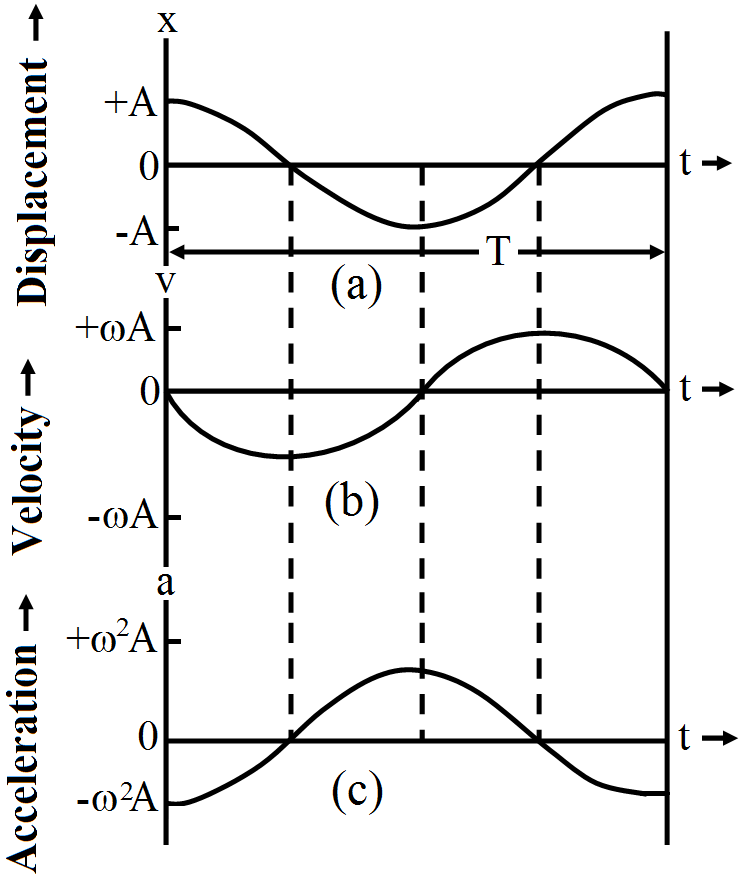
A SHM is expressed by the equation $\text{x}=\text{A}\cos(\omega\text{t}+\phi)$ and the phase angle $\phi=0$ . Draw graphs to show variation of displacement, velocity and acceleration for one complete cycle in SHM.
Answer
Let $\text{x}=\text{A}\cos(\omega\text{t}+\phi)$ and if phase $\phi$ is zero, then $\text{x}=\text{A}\cos\omega\text{t}+\phi$

$\therefore\text{v}=\frac{\text{dx}}{\text{dt}}$ $=-\text{A}\omega\sin\omega\text{t}$

$\text{a}\frac{\text{dv}}{\text{dt}}=-\text{A}\omega^2\cos\omega\text{t}$

$=-\omega\text{x}$

Thus, values of x ,v and a at different times, over one complete oscillation cycle are:

$\text{time}$ $0$ $\frac{\text{T}}{4}$ $\frac{\text{T}}{2}$ $\frac{3\text{T}}{4}$ $\text{T}$
$\omega\text{t}$ $0$ $\frac{\pi}{2}$ $\pi$ $\frac{3\pi}{2}$ $2\pi$
$\text{x}$ $\text{A}$ $0$ $-\text{A}$ $0$ $\text{A}$
$\text{v}$ $0$ $-\text{A}\omega$ $0$ $+\text{A}\omega$ $0$
$\text{a}$ $-\text{A}\omega^2$ $0$ $\text{A}\omega^2$ $0$ $-\text{A}\omega^2$
With the given data we plot x-t.v-t and a-t graphs. The grapha have beem shown in Fig. (a), (b) and (c).

View full question & answer
Question 425 Marks
A transverse harmonic wave travelling on a string is described by $\text{y(x, t})=3.0\sin\Big[(36\text{t}+0.018\text{x})+\frac{\pi}{4}\Big]$ where x and y are in cm and t in s. The positive direction of x is from left to right.
  1. What are the speed and direction of propagation of the wave?
  2. What are its amplitude and frequency?
  3. What is the initial phase at the origin?
  4. What is the least distance between two successive crests in the wave?
Answer
Given: $\text{y(x, t})=3.0\sin\Big[(36\text{t}+0.018\text{x})+\frac{\pi}{4}\Big]$

Comparing with a plane progressive wave going from right to left

$\text{y(x, t})=\text{r}\sin\Big[\frac{2\pi}{\lambda}(\omega\text{t}+\text{kx})+\phi_1\Big]$

  1. Speed $=\text{v}=\frac{\omega}{\text{k}}=\frac{36}{0.018}$

$=2000\text{cm/s}$

wave travelling from right to left, i.e. travels along the negative r-axis.

  1. Amplitude, $\text{r}=3.0\text{cm}$

$\Rightarrow\text{k}=\frac{2\pi}{\lambda}=\frac{2\pi}{\lambda}=0.018$

$\Rightarrow\lambda=\frac{2\pi}{0.018}\approx349\text{cm}$

and $\text{v}=\frac{\text{v}}{\lambda}=\frac{2000\text{cm/s}}{349\text{cm}}=5.73\text{s}^{-1}$

  1. $\phi_0=\frac{\pi}{4}$

Least distance between successive crest

$-\lambda-\frac{2\pi}{\text{k}}=\frac{2\pi}{0.018}-3.5\text{m}$

View full question & answer
Question 435 Marks
The displacement of two particles executing simple harmonic motion are represented by equations, $\text{y}=4\sin(10\text{t}+\theta)$ and $\text{y}=5\cos10\text{t}$ What is the phase difference between the velocities of these particles?
Answer
For 1st particle

$\text{y}_1=4\sin(10\text{t}+\theta);$

Velocity $\frac{\text{dy}_1}{\text{dt}}$

$=4\times10\cos(10\text{t}+\theta)$

$=40\cos(10\text{t}+\theta)$

For second particle 

$\text{y}_2=5\cos10\text{t}=5\sin(10\text{t}+\frac{\pi}{2})$

Velocity $\frac{\text{dy}_2}{\text{dt}}$

$=5\cos\times10\cos(10\text{t}+\frac{\pi}{2})$

$=5\cos(10\text{t}+\frac{\pi}{2})$

Phase difference between velocities 

$=(10\text{t}+\theta)-(10\text{t}+\frac{\pi}{2})$

$=\Big(\theta-\frac{\pi}{2}\Big)$

View full question & answer
Question 445 Marks
A circular disc of mass 10kg is suspended by a wire attached to its centre. The wire is twisted by rotating the disc and released. The period of torsional oscillations is found to be 1.5s. The radius of the disc is 15cm. Determine the torsional spring constant of the wire. (Torsional spring constant $\alpha$ is defined by the relation $\text{J}=-\alpha\theta,$ where J is the restoring couple and $\theta$ the angle of twist).
Answer
Mass of the circular disc, m = 10kg

Radius of the disc, r = 15cm = 0.15m

The torsional oscillations of the disc has a time period, T = 1.5s

The moment of inertia of the disc is:

$\text{l}=\frac{1}{2}\text{mr}^2$

$=\frac{1}{2}\times(10)\times(0.15)^2$

= 0.1125kg m2

Time period, $\text{T}=2\pi\sqrt{\frac{\text{l}}{\alpha}}$

$\alpha$ is the torsional constant.

$\alpha=\frac{4\pi^2\text{l}}{\text{T}^2}$

$=\frac{4\times(\pi)^2\times0.1125}{(1.5)^2}$

= 1.972Nm/rad

Hence, the torsional spring constant of the wire is 1.972Nm rad-1.

View full question & answer
Question 455 Marks
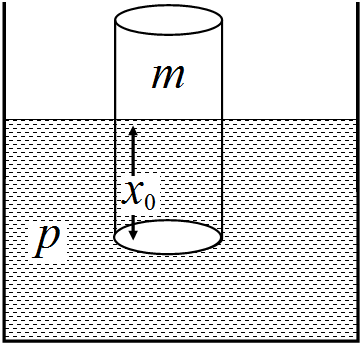
A cylindrical log of wood of height h and area of cross-section A floats in water. It is pressed and then released. Show that the log would execute S.H.M. with a time period.

$\text{T}=2\pi\sqrt{\frac{\text{m}}{\text{A}\rho\text{g}}}$

where m is mass of the body and ρ is density of the liquid.

Answer
when log is pressed downward into the liquid then and upward Buoyant force (B.F.) action it which oves the block upward and due to inertia it moves upward from its mean position due to inertia and then again come down due to gravity. So net restoring force on

block = Buoyant force – mg

V = volume of liquid displaced by blocks

Let when floats then

$\text{mg}=\text{B.f}\ \text{or}\ \text{mg}=\text{V}\rho\text{g}$

A = area of cross section

x = Height of blocks liquid

Let x height again dip in liquid when pressed into water total height of block in water

$=(\text{x}+\text{x}_0)$

So net restoring force $[\text{A}(\text{x}+\text{x}_0)]\rho\text{g}-\text{mg}$

$\text{F}_\text{restoring}=\text{A}\text{x}_0\rho\text{g}+\text{Ax}\rho\text{g}-\text{A}\text{x}_0\rho\text{g}$

$\text{F}_\text{Restoring}=-\text{Ax}\rho\text{g}$

(as Buoyant force is upward and x is downward)

$\text{F}_\text{restoring}\propto-\text{x}$

So motion is SHM here k $\text{A}\rho\text{g}$

$\text{a}=-\omega^2\text{x}\omega^2=\frac{\text{k}}{\text{m}}\Rightarrow\text{T}=2\pi\sqrt{\frac{\text{m}}{\text{k}}}$

$\text{F}_\text{restoring}=-\text{A}\rho\text{gx}$

$\text{ma}=-\text{A}\rho\text{gx}$

$\text{a}=\frac{-\text{A}\rho\text{gx}}{\text{m}}\Rightarrow-\omega^2\text{x}=\frac{-\text{A}\rho\text{gx}}{\text{m}}$

$\omega^2=\frac{\text{A}\rho\text{g}}{\text{m}}$

$\text{k}=\text{A}\rho\text{g}$

$\Big(\frac{2\pi}{\text{T}}\Big)^2=\frac{\text{A}\rho\text{g}}{\text{m}}\Rightarrow\frac{\text{T}}{2\pi}=\sqrt{\frac{\text{m}}{\text{A}\rho\text{g}}}\Rightarrow\text{T}=2\pi\sqrt{\frac{\text{m}}{\text{A}\rho\text{g}}}$

View full question & answer
Question 465 Marks
A simple pendulum with a brass bob has a time period T. The bob is now immersed in a non-viscous liquid and oscillated. If the density of the liquid is $\frac{1}{9}$ that of brass, find the time of the same pendulum.
Answer
Let V be the volume and $\rho$ be the density of the brass bob. Mass of the bob $\text{m}=\text{V}\rho$ and weight of bob $=\text{V}\rho\text{g}.$ Buoyancy force of liquid on bob $=\text{V}\Big(\frac{\rho}{9}\Big)\text{g}=\frac{\text{V}\rho\text{g}}{9}.$

So, the effective weight of bob in liquid $=\text{V}\rho\text{g}-\frac{\text{V}\rho\text{g}}{9}=\frac{8\text{V}\rho\text{g}}{9},$

$\therefore\text{Acceleration g}'=\frac{\frac{8\text{V}\rho\text{g}}{9}}{\text{m}}$

$=\frac{\frac{8\text{V}\rho\text{g}}{9}}{\text{V}\rho}=\frac{8\text{g}}{9}$

Time period of the bob

$-2\pi\sqrt{\frac{\text{l}}{\text{g}}}=2\pi\sqrt{\frac{\text{l}}{\big(\frac{8\text{g}}{9}\big)}}$

$=2\pi\sqrt{\frac{\text{l}}{\text{g}}}\times\frac{3}{\sqrt{8}}=\frac{3\text{T}}{\sqrt{8}}$ $\Big(\because\text{T}=2\pi\sqrt{\frac{\text{l}}{\text{g}}}\Big)$

View full question & answer
Question 475 Marks
The displacement x (in cm) of an oscillating particle varies with time t (in seconds) according to the equation. $\text{x}=2\cos(0.5\pi\text{t}+\frac{\pi}{3})$ Find 
  1. Amplitude of oscillation.
  2. The time period of oscillation.
  3. The maximum velocity of the particle.
  4. The maximum acceleration of the particle.
Answer
The displacement of the particle is given by $\text{x}=2\cos(0.5\pi\text{t}+\frac{\pi}{3})\text{cm}$ To find the amplitude and time period of the oscillation, we compare this equation with $\text{x}=\text{A}\cos(\omega\text{t}+\delta)$

  1. Amplitude A = 2cm
  2. Angular frequency $\omega=0.5\pi\text{ rad}\text{ s}^{-1}$

$\text{T}=\frac{2\pi}{\omega}=\frac{2\pi}{0.5\pi}=4\text{s}$

  1. Maximum acceleration $\text{a}_\text{max}=|\text{A}\omega|$

$=2\times0.5\pi=\pi\text{cm}\text{s}^{-1}=3.142\text{cms}^{-1}$

  1. Maximum acceleration $\text{a}_\text{max}=|-\omega^2\text{A}|$

$=\omega^2\text{A}=(0.5\pi)^2\times2$

$=\frac{\pi}{2}\text{cms}^{-2}=4.935\text{cms}^{-2}$

View full question & answer
Question 485 Marks
A particle of mass m is executing simple harmonic oscillations of amplitude A. At $\text{x}=\frac{\text{A}}{2}$ what fraction of its energy is potential? What fraction is kinetic?
Answer
We know that total energy of a harmonic oscillator 

$\text{E}=\frac{1}{2}\text{m}\omega^2\text{A}^2$

 At $\text{x}=\frac{\text{A}}{2}$, the potential energy of oscillator,

$\text{U}=\frac{1}{2}\text{m}\omega^2\text{x}^2$

$\frac{1}{2}\text{m}\omega^2.\big(\frac{\text{A}}{2}\big)^2$

$=\frac{1}{8}\text{m}\omega^2\text{A}^2$

$\therefore\frac{\text{U}}{\text{E}}=\frac{\frac{1}{8}\text{m}\omega^2\text{A}^2}{\frac{1}{2}\text{m}\omega^2\text{A}^2}$

$=\frac{1}{4}=\frac{1}{4}\times100\%$

$=25\%$

$\text{x}=\frac{\text{A}}{2}$ the Kinetic energy 

$\text{K}=\frac{1}{2}\text{m}\omega^2(\text{A}^2-\text{x}^2)$

$=\frac{1}{2}\text{m}\omega^2\bigg[\text{A}^2-\big(\frac{\text{A}}{2}\big)^2\bigg]$

$=\frac{3}{8}\text{m}\omega^2\text{A}^2$

$\therefore\frac{\text{K}}{\text{E}}=\frac{\frac{3}{8}\text{m}\omega^2\text{A}^2}{\frac{1}{2}\text{m}\omega^2\text{A}^2}$

$=\frac{3}{4}=\frac{3}{4}\times100\%$

$=75\%$

View full question & answer
Question 495 Marks
Show that for a particle in linear SHM the average kinetic energy over a period of oscillation equals the average potential energy over the same period.
Answer
The equation of displacement of a particle executing SHM at an instant t is given as:

$\text{x}=\text{A}\sin\omega\text{t}$

where,

A = Amplitude of oscillation

$\omega=$ Angular frequency $=\sqrt{\frac{\text{k}}{\text{M}}}$

The velocity of the particle is: v = dx/dt $=\text{A}\omega\cos\omega\text{t}$

The kinetic energy of the particle is:

$\text{E}_\text{k}=\frac{1}{2}\text{Mv}^2=\frac{1}{2}\text{MA}^2\omega^2\cos^2\omega\text{t}$

The portential energy of the particle is:

$\text{E}_\text{p}=\frac{1}{2}\text{kx}^2=\frac{1}{2}\text{M}^2\omega^2\text{A}^2\sin^2\omega\text{t}$

For time period T, the average kinetic energy over a single cycle is given as:

$(\text{E}_\text{k})_\text{Avg}=\frac{1}{\text{T}}\int\limits_{0}^{\text{T}}\text{E}_\text{k}\text{dt}$

$=\frac{1}{\text{T}}\int\limits_{0}^{\text{T}}\frac{1}{2}\text{MA}^2\omega^2\cos^2\omega\text{t dt}$

$=\frac{1}{2\text{T}}\text{MA}^2\omega^2\int\limits_{0}^{\text{T}}\frac{(1+\cos2\omega\text{t})}{2}\text{dt}$

$=\frac{1}{4\text{T}}\text{MA}^2\omega^2\Big[\text{t}+\frac{\sin2\omega\text{t}}{2\omega}\Big]^{\text{T}}_{0}$

$=\frac{1}{4\text{T}}\text{MA}^2\omega^2(\text{T})$

$=\frac{1}{4}\text{MA}^2\omega^2\ ......(\text{i})$

And, average potential energy over one cycle is given as:

$(\text{E}_\text{p})_\text{Avg}=\frac{1}{\text{T}}\int\limits^{\text{T}}_{0}\text{E}_\text{p}\text{dt}$

$=\frac{1}{\text{T}}\int\limits_{0}^{\text{T}}\frac{1}{2}\text{MA}^2\omega^2\sin^2\omega\text{t dt}$

$=\frac{1}{2\text{T}}\text{MA}^2\omega^2\int\limits_{0}^{\text{T}}\frac{(1-\cos2\omega\text{t})}{2}\text{dt}$

$=\frac{1}{4\text{T}}\text{MA}^2\omega^2\Big[\text{t}-\frac{\sin2\omega\text{t}}{2\omega}\Big]^{\text{T}}_{0}$

$=\frac{1}{4\text{T}}\text{MA}^2\omega^2(\text{T})$

$=\frac{1}{4}\text{MA}^2\omega^2\ ......(\text{ii})$

It can be inferred from equations (i) and (ii) that the average kinetic energy for a given time period is equal to the average potential energy for the same time period.

View full question & answer
Question 505 Marks
A point particle of mass 0.1kg is executing S.H.M. of amplitude of 0.1m. When the particle passes through the mean position, its kinetic energy is 8 × 10⁻³ joule. Obtain the equation of motion of this particle if the initial phase of oscillation is 45°
Answer
The displacement of a particle in S.H.M is given by

$\text{y}=\text{a}\sin(\omega\text{t}+\phi)$

Velocity $=\frac{\text{dy}}{\text{dt}}=\omega\text{a}\cos(\omega\text{t}+\phi)$

The velocity is maximum when the particle passes through the mean position i.e.

$=\Big(\frac{\text{dy}}{\text{dt}}\Big)_\text{max}=\omega\text{a}$

The kinetic energy at this instant is given by

$=\frac{1}{2}\text{m}\Big(\frac{\text{dy}}{\text{dt}}\Big)^2$

$=\frac{1}{2}\text{m}\times\omega^2\text{a}^2$

$=8\times10^{-3}\text{ joule}$

$\frac{1}{2}\times(0.1)\omega^2\times(0.1)^2$

$=8\times10^{-3}\text{ joule}$

Solving we get $\omega=\pm4$

Substituting the values of a $\omega$ and $\phi$ in the equation of SHM., we get

$\text{y}=0.1\sin(\pm4\text{t}+\frac{\pi}{4})\text{ metre}$

View full question & answer
5 Marks Questions - Physics STD 11 Science Questions - Vidyadip