MCQ
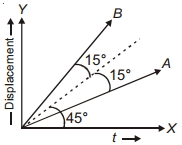
The displacement-time graph for two particles $A$ and $B$ is as follows. The ratio $\frac{v_A}{v_B}$ is
  • A
    $1: 2$
  • B
    $1: \sqrt{3}$
  • C
    $\sqrt{3}: 1$
  • $1: 3$

Answer

Correct option: D.
$1: 3$
d
(d)

The slope of line $A$ is $\tan 30^{\circ}$ and $B=\tan 60^{\circ}$

$\frac{v_A}{v_B}=\frac{\tan 30^{\circ}}{\tan 60^{\circ}}=\frac{\frac{1}{\sqrt{3}}}{\sqrt{3}}=\frac{1}{3} \Rightarrow v_A: v_B=1: 3$
Need a full question paper?

Generate a complete, print-ready paper with questions like this in minutes — across 16+ boards, with answer keys.
Start Generating Free

Similar questions

The displacement of a particle varies with time as $x = 12\sin \omega t - 16{\sin ^3}\omega t$ (in $cm$). If its motion is $S.H.M.$, then its maximum acceleration is
Consider the following two statements:
$A.$ Linear momentum of the system remains constant.
$B.$ Centre of mass of the system remains at rest.
The diameter of a wire is measured to be $0.0205 \times 10^{-4} \,m$. The number of significant figures in the measurement is
The kinetic energy per gm mol for a diatomic gas at room temperature is
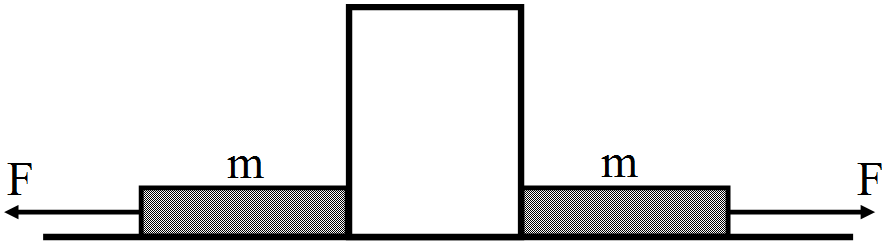
Figure shows a heavy block kept on a frictionless surface and being pulled by two ropes of equal mass $m.$ At $t = 0$, the force on the left rope is withdrawn but the
force on the right end continues to act. Let $F_1$ and $F_2$ be the magnitudes of the forces by the right rope and the left rope on the block respectively:
$20\, gm$ of boiling water is poured into an ice-cold brass vessel (specific heat $0.1\, cal/gm-\,^oC$) of mass $100\, gm$. The resulting temperature is ........ $^oC$
Path length does not depend on $...........$
Which of the diagrams shown in figure represents variation of total mechanical energy of a pendulum oscillating in water as function of time?
A long horizontal rod has a bead which can slide along its length, and initially placed at a distance $L$ from one end $A$ of the rod. The rod is set in angular motion about $A$ with constant angular acceleration $\alpha$. If the coefficient of friction between the rod and the bead is $\mu$, and gravity is neglected, then the time after which the bead starts slipping is
A student sitting at the top of a tree has $............$ than the student who is sitting on the ground.