MCQ
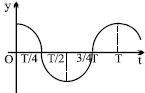
The displacement-time graph of a particle executing $SHM$ is shown. Which of the following statements is/are true ?
  • A
    The potential energy equals the oscillation energy at $t = T/2.$
  • B
    The acceleration is maximum at $t = T$
  • C
    The force is zero at $t = 3T/4$
  • all of the above

Answer

Correct option: D.
all of the above
d
$v=0$ at $t=T / 2$

a is maximum at extremes

$F=0$ at $t=\frac{3 T}{4}$

$\mathrm{K.E.}=0$ at $\mathrm{t}=\mathrm{T} / 2$

Need a full question paper?

Generate a complete, print-ready paper with questions like this in minutes — across 16+ boards, with answer keys.

Start Generating Free

Similar questions

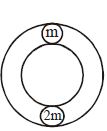
A particle of mass $m$ moving with a speed $v$ hits elastically another stationary particle of mass $2\ m$ in a fixed smooth horizontal circular tube of radius $R$. Find the time when the next collision will take place?
A satellite revolves around the earth in an elliptical orbit. Its speed
A uniform rod of length $L$ has a mass per unit length $\lambda$ and area of cross-section $A$. If the Young's modulus of the rod is $Y$. Then elongation in the rod due to its own weight is ...........
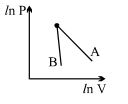
The figure, shows the graph of logarithmic reading of pressure and volume for two ideal gases $A$ and $B$ undergoing adiabatic process. From figure it can be concluded that
A body of mass $m$ is accelerated uniformly from rest to a speed $v$ in a time $T$ . The instantaneous power delivered to the body as a function of time is given by
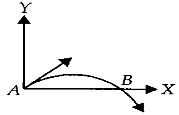
The velocity of projectile at the intial point $A$ is $\left( {2\hat i + 3\hat j} \right)$ $m/s $ . It's velocity (in $m/s$) at point $B$ is
The mean square speed of the molecules of a gas at absolute temperature T is proportional to:
Which of the following particles will have minimum frequency of revolution when projected with the same velocity perpendicular to a magnetic field?
The ends of a metal bas of constant cross-sectional area are maintained at temperatures $T_1$ and $T_2$ which are both higher than the temperature of the surroundings. If the bar is unlagged, which one of the following sketches best represents the variation of temperature with distance along the bar?
A force of $750 \,N$ is applied to a block of mass $102\, kg$ to prevent it from sliding on a plane with an inclination angle $30°$ with the horizontal. If the coefficients of static friction and kinetic friction between the block and the plane are $0.4 $ and $0.3$ respectively, then the frictional force acting on the block is...... $N$