The displacement $x$ (in metre) of a particle in, simple harmonic motion is related to time t (in seconds) as
$x = 0.01\cos \left( {\pi \,t + \frac{\pi }{4}} \right)$
The frequency of the motion will be
Easy
Download our app for free and get started
(a) Comparing given equation with standard equation, $x = a\cos \,(\omega t + \phi )$
we get, $a = 0.01$ and $\omega = \pi $
$ \Rightarrow 2\pi n = \pi \Rightarrow n = 0.5\,Hz$

Download our appand get started for free
Experience the future of education. Simply download our apps or reach out to us for more information. Let's shape the future of learning together!No signup needed.*
Similar Questions
- 1A $S.H.M.$ is represented by $x = 5\sqrt 2 (\sin 2\pi t + \cos 2\pi t).$ The amplitude of the $S.H.M.$ is .... $cm$View Solution
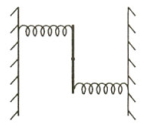
- 2A uniform rod of length $L$ and mass $M$ is pivoted at the centre. Its two ends are attached to two springs of equal spring constants $k$. The springs are fixed to rigid supports as shown in the figure, and the rod is free to oscillate in the horizontal plane. The rod is gently pushed through a small angle $\theta$ in one direction and released. The frequency of oscillation isView Solution
- 3A mass of $0.2\,kg$ is attached to the lower end of a massless spring of force-constant $200\, N/m,$ the upper end of which is fixed to a rigid support. Which of the following statements is/are true ?View Solution
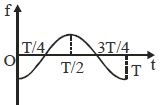
- 4A body is performing simple harmonic motion with amplitude a and time period $T$. Variation of its acceleration $(f)$ with time $(t)$ is shown in figure. If at time $t$, velocity of the body is $v$, which of the following graphs is correctView Solution
- 5In an elevator, a spring clock of time period $T_S$ (mass attached to a spring) and a pendulum clock of time period $T_P$ are kept. If the elevator accelerates upwardsView Solution
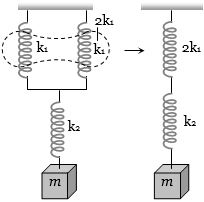
- 6View SolutionWhat will be the force constant of the spring system shown in the figure
- 7View SolutionTo make the frequency double of a spring oscillator, we have to
- 8The kinetic energy of a particle executing $S.H.M.$ is $16\, J$ when it is at its mean position. If the mass of the particle is $0.32 \,kg$, then what is the maximum velocity of the particle ..... $m/s$View Solution
- 9The potential energy of a particle of mass $1\, kg$ in motion along the $x-$ axis is given by $U = 4\,(1 -cos\,2x)$, where $x$ is in $metres$ . The period of small oscillation (in $second$ ) isView Solution
- 10A particle doing simple harmonic motion, amplitude $= 4\, cm$, time period $= 12\, sec$. The ratio between time taken by it in going from its mean position to $2 \,cm$ and from $2\, cm$ to extreme position isView Solution