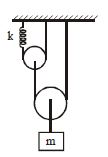
The kinetic energy of a particle executing $S.H.M.$ is $16\, J$ when it is at its mean position. If the mass of the particle is $0.32 \,kg$, then what is the maximum velocity of the particle ..... $m/s$
Medium
Download our app for free and get started
(c) Kinetic energy at mean position, ${K_{\max }} = \frac{1}{2}mv_{\max }^2.$
$\Rightarrow {v_{\max }} = \sqrt {\frac{{2\,{K_{\max }}}}{m}} $ $ = \sqrt {\frac{{2 \times 16}}{{0.32}}} $
$ = \sqrt {100} $
$ = 10\,m/s.$

Download our appand get started for free
Experience the future of education. Simply download our apps or reach out to us for more information. Let's shape the future of learning together!No signup needed.*
Similar Questions
- 1A particle executes linear simple harmonic motion with an ampilitude of $3\,cm$ . When the particle is at $2\,cm$ from the mean position , the magnitude of its velocity is equal to that of its acceleration. Then its time period in seconds isView Solution
- 2Time period of a particle executing $SHM$ is $8\, sec.$ At $t = 0$ it is at the mean position. The ratio of the distance covered by the particle in the $1^{st}$ second to the $2^{nd}$ second is :View Solution
- 3Two particles $P$ and $Q$ start from origin and execute Simple Harmonic Motion along $X-$axis with same amplitude but with periods $3$ seconds and $6$ seconds respectively. The ratio of the velocities of $ P$ and $Q$ when they meet isView Solution
- 4The displacement $y(t) = A\,\sin \,(\omega t + \phi )$ of a pendulum for $\phi = \frac {2\pi }{3}$ is correctly represented byView Solution
- 5The acceleration due to gravity at a place is ${\pi ^2}\,m/se{c^2}$. Then the time period of a simple pendulum of length one metre isView Solution
- 6A particle is performing simple harmonic motion along $x-$axis with amplitude $4 \,cm$ and time period $1.2\, sec$. The minimum time taken by the particle to move from $x =2 ,cm$ to $ x = + 4\, cm$ and back again is given by .... $\sec$View Solution
- 7A bob of mass $'m'$ suspended by a thread of length $l$ undergoes simple harmonic oscillations with time period ${T}$. If the bob is immersed in a liquid that has density $\frac{1}{4}$ times that of the bob and the length of the thread is increased by $1 / 3^{\text {rd }}$ of the original length, then the time period of the simple harmonic oscillations will be :-View Solution
- 8Two particles are executing $SHM$ of the same amplitude $A$ and frequency $\omega $ along the $x-$ axis. Their mean position is separated by $X_0$ (where $X_0 > A$ ). If maximum separation between them is $X_0 + 2A$ , then the phase difference between their motion isView Solution
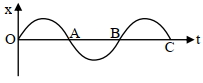
- 9The variation of displacement with time of a particle executing free simple harmonic motion is shown in the figure. The potential energy ${U}({x})$ versus time $({t})$ plot of the particle is correctly shown in figure:View Solution
- 10What is the period of small oscillations of the block of mass $m$ if the springs are ideal and pulleys are massless ?View Solution