The kinetic energy and the potential energy of a particle executing $S.H.M.$ are equal. The ratio of its displacement and amplitude will be
Medium


Download our appand get started for free
Experience the future of education. Simply download our apps or reach out to us for more information. Let's shape the future of learning together!No signup needed.*
Similar Questions
- 1A particle moving along the $X-$axis executes simple harmonic motion, then the force acting on it is given byView Solution
Where $A$ and $K$ are positive constants
- 2Consider the following statements. The total energy of a particle executing simple harmonic motion depends on itsView Solution
$(1)$ Amplitude $(2) $ Period $(3)$ Displacement
Of these statements
- 3A particle moves in space according to equationView Solution
$\vec r = (\sin \,t\,\hat i\, + \,\cos \,t\,\hat j\, + \,t\,\hat k)m$
Find time $'t'$ when position vector and acceleration vector are perpendicular to each other
- 4The amplitude of a particle executing $SHM$ about $O$ is $10\, cm.$ Then :View Solution
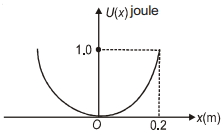
- 5A particle of mass $4 \,kg$ moves simple harmonically such that its $P E(U)$ varies with position $x$, as shown. The period of oscillations is ............View Solution
- 6View SolutionTo make the frequency double of a spring oscillator, we have to
- 7A sphere of radius $r$ is kept on a concave mirror of radius of curvature $R$. The arrangement is kept on a horizontal table (the surface of concave mirror is frictionless and sliding not rolling). If the sphere is displaced from its equilibrium position and left, then it executes $S.H.M.$ The period of oscillation will beView Solution
- 8The force constants of two springs are ${K_1}$ and ${K_2}$. Both are stretched till their elastic energies are equal. If the stretching forces are ${F_1}$ and ${F_2}$, then ${F_1}:{F_2}$ isView Solution
- 9A circular disc of mass $10 \;kg$ is suspended by a wire attached to its centre. The wire is twisted by rotating the disc and released. The period of torsional oscillations is found to be $1.5 \;s$. The radius of the disc is $15\; cm .$ Determine the torsional spring constant of the wire in $N\;m\;rad^{-1}$. (Torsional spring constant $\alpha$ is defined by the relation $J=-\alpha \theta,$ where $J$ is the restoring couple and $\theta$ the angle of twist).View Solution
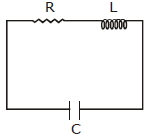
- 10An $LCR$ circuit is equivalent to a damped pendulum. In an $LCR$ circuit the capacitor is charged to $Q_0$ and then connected to the $L$ and $R$ as shown below.View Solution
If a student plots graphs of the square of maximum charge $( Q_{Max} ^2 )$ on the capacitor with time$(t)$ for two different values $L_1$ and $L_2 (L_1 > L_2)$ of $L$ then which of the following represents this graph correctly? (plots are schematic and not drawn to scale)