The distance between charges $+\mathrm{q}$ and $-\mathrm{q}$ is $2 l$ and between $+2 \mathrm{q}$ and $-2 \mathrm{q}$ is $4 l$. The electrostatic potential at point $P$ at a distance $r$ from centre $O$ is $-\alpha\left[\frac{q l}{r^2}\right] \times 10^9 \mathrm{~V}$, where the value of $\alpha$ is____. (Use $\left.\frac{1}{4 \pi \varepsilon_0}=9 \times 10^9 \mathrm{Nm}^2 \mathrm{C}^{-2}\right)$
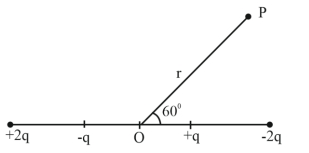
JEE MAIN 2024, Diffcult
Download our app for free and get started
$\mathrm{V}=\frac{\mathrm{K} \dot{\mathrm{p}} \cdot \overrightarrow{\mathrm{r}}}{\mathrm{r}^3}=\frac{9 \times 10^9(6 \mathrm{q} \ell)}{\mathrm{r}^2} \cos \left(120^{\circ}\right)$
$=-(27)\left(\frac{\mathrm{q} \ell}{\mathrm{r}^2}\right) \times 10^9 \mathrm{Nm}^2 \mathrm{c}^{-2}$
$\Rightarrow \alpha=27$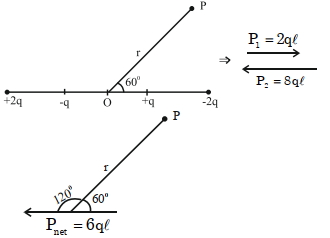

Download our appand get started for free
Experience the future of education. Simply download our apps or reach out to us for more information. Let's shape the future of learning together!No signup needed.*
Similar Questions
- 1Two small equal point charges of magnitude $q$ are suspended from a common point on the ceiling by insulating mass less strings of equal lengths. They come to equilibrium with each string making angle $\theta $ from the vertical. If the mass of each charge is $m,$ then the electrostatic potential at the centre of line joining them will be $\left( {\frac{1}{{4\pi { \in _0}}} = k} \right).$View Solution
- 2View SolutionWhen one electron is taken towards the other electron, then the electric potential energy of the system
- 3Two condensers of capacities $1\,\mu F$ and $2\,\mu F$ are connected in series and the system is charged to $120\;volts$. Then the $P.D.$ on $1\,\mu F$ capacitor (in $volts$) will beView Solution
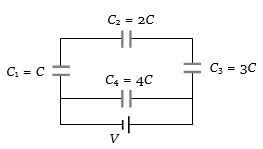
- 4A network of four capacitors of capacity equal to ${C_1} = C,\,\,{C_2} = 2C,\,{C_3} = 3C$ and ${C_4} = 4C$ are conducted in a battery as shown in the figure. The ratio of the charges on ${C_2}$ and ${C_4}$ isView Solution
- 5A particle of mass $m$ and charge $q$ is kept at the top of a fixed frictionless sphere. $A$ uniform horizontal electric field $E$ is switched on. The particle looses contact with the sphere, when the line joining the center of the sphere and the particle makes an angle $45^o$ with the vertical. The ratio $\frac{qE}{mg}$ is :-View Solution
- 6This question contains Statement$-1$ and Statement$-2$. Of the four choices given after the statements, choose the one that best describes the two statements.View Solution
Statement$-1$ : For a charged particle moving from point $P$ to point $Q$, the net work done by an electrostatic field on the particle is independent of the path connecting point $P$ to point $Q$.
Statement$-2$ : The net work done by a conservative force on an object moving along a closed loop is zero. - 7View SolutionA parallel plate capacitor is charged to a certain potential and the charging battery is then disconnected. Now, if the plates of the capacitor are moved apart then:
- 8Consider the combination of $2$ capacitors $C _{1}$ and $C _{2},$ with $C _{2}> C _{1},$ when connected in parallel, the equivalent capacitance is $\frac{15}{4}$ time the equivalent capacitance of the same connected in series. Calculate the ratio of capacitors, $\frac{ C _{2}}{ C _{1}}$View Solution
- 9A series combination of three capacitors of capacities $1\,\mu \,F,\,2\,\mu \,F$ and $8\,\mu \,F$ is connected to a battery of $e.m.f.$ $13\, volt$. The potential difference across the plates of $2\,\mu \,F$ capacitor will be.....$V$View Solution
- 10Three charges, each $+q,$ are placed at the comers of an isosceles triangle $ABC$ of sides $BC$ and $AC, 2a.$ $D$ and $E$ are the mid-points of $BC$ and $CA.$ The work done in taking a charge $Q$ from $D$ to $E$ isView Solution