Two condensers of capacities $1\,\mu F$ and $2\,\mu F$ are connected in series and the system is charged to $120\;volts$. Then the $P.D.$ on $1\,\mu F$ capacitor (in $volts$) will be
Medium


Download our appand get started for free
Experience the future of education. Simply download our apps or reach out to us for more information. Let's shape the future of learning together!No signup needed.*
Similar Questions
- 1View SolutionWhen a parallel plates capacitor is connected to a source of constant potential difference,
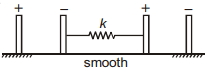
- 2Two charged capacitors have their outer plates fixed and inner plates connected by a spring of force constant ' $k$ '. The charge on each capacitor is q. Find the extension in the spring at equilibriumView Solution
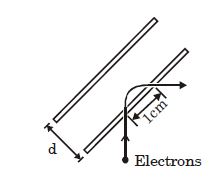
- 3A problem of practical interest is to make a beam of electrons turn at $90^o$ corner. This can be done with the electric field present between the parallel plates as shown in the figure. An electron with kinetic energy $8.0 × 10^{-17}\ J$ enters through a small hole in the bottom plate. The strength of electric field that is needed if the electron is to emerge from an exit hole $1.0\ cm$ away from the entrance hole, traveling at right angles to its original direction is $y × 10^5\ N/C$ . The value of $y$ isView Solution
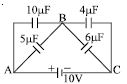
- 4View SolutionIn the circuit shown in figure, four capacitors are connected to a battery. A capacitor is connected to a battery. The force of attraction between the plates when the separation between them is halved
- 5At distance of $5$ $cm$ and $10$ $cm $ outwards from the surface of a uniformly charged solid sphere, the potentials are $100$ $V$ and $75$ $V$ respectively . ThenView Solution
- 6A condenser of capacity ${C_1}$ is charged to a potential ${V_0}$. The electrostatic energy stored in it is ${U_0}$. It is connected to another uncharged condenser of capacity ${C_2}$ in parallel. The energy dissipated in the process isView Solution
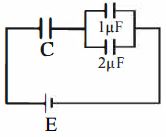
- 7In the given circuit, charge $Q_2$ on the $2\ μF$ capacitor changes as $C$ is varied from $1\ μF$ to $3\ μF$. $Q_2$ as a function of '$C$' is given properly by: (figures are drawn schematically and are not to scale)View Solution
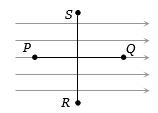
- 8View SolutionThepoints resembling equal potentials are
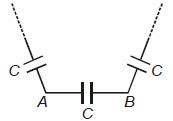
- 9On each side of a polygon of $n$ sides a capacitor of capacitance $C$ is placed as shown in figure. Equivalent capacitance across $A$ and $B$ isView Solution
- 10The electrostatic potential inside a charged spherical ball is given by : $V = b -ar^2$, where $r$ is the distance from the centre ; $a$ and $b$ are constants. Then, the charge density inside the ball is :View Solution