Question
The drift current in a p-ri junction is:

Answer

  1. From the n-side to the p-side.
Explanation:
After the diffusion of majority charge carriers across a p‒n junction, an electric field is set up because of the accumulation of immobile ions at the junction. These further oppose the motion of majority charge carriers across the junction. As a result, electrons from the p region start moving to the n region and holes from the n region start moving to the p region. This constitutes the drift current. As the direction of the current is opposite to the direction of the motion of the electrons, the direction of the drift current is from the n side to the p side.
In forward biasing, there is no movement of electrons from the p region to the n region and of holes from the n region to the p region. Hence, there is not drift current.

Need a full question paper?

Generate a complete, print-ready paper with questions like this in minutes — across 16+ boards, with answer keys.
Start Generating Free

Similar questions

Eight drops of mercury of equal radii possessing equal charges combine to form a big drop. Then the capacitance of bigger drop compared to each individual small drop is(a) 8 times(b) 4 times(c) 2 times(d) 32 times
       
For a glass prism, the angle of minimum deviation will be smallest for the light of:
A radio transmitter radiates $1\ kW$ power at a wavelength $198.6$ metres. How many photons does it emit per second
For one electron vacancy,
In an AC circuit containing only capacitance, the current:
A strip of copper and another of germanium are cooled from room temperature to 80K. The resistance of:
The molar heat capacity of oxygen gas at STP is nearly 2.5R. As the temperature is increased, it gradually increases and approaches 3.5R. The most appropriate reason for this behaviour is that at high temperatures:
  1. Oxygen does not behave as an ideal gas.
  2. Oxygen molecules dissociate in atoms.
  3. The molecules collide more frequently.
  4. Molecular vibrations gradually become effective.
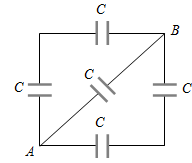
In the figure shown, the effective capacitance between the points $A$ and $B,$ if  each has capacitance $C,$ is
By properly combining two prisms made of different materials, it is possible to:
A table tennis ball which has been covered with conducting paint is suspended by a silk thread so that it hang between two plates, out of which one is earthed and other is connected to a high voltage generator. This ball (a) Is attracted towards high voltage plate and stays there(b) Hangs without moving(c) Swing backward and forward hitting each plate in turn (d) Is attracted to earthed plate and stays there