MCQ
The drift velocity does not depend upon
  • A
    Cross-section of the wire
  • Length of the wire
  • C
    Number of free electrons
  • D
    Magnitude of the current

Answer

Correct option: B.
Length of the wire
b
The drift velocity does not depend on the length or the cross sectional area of the wire, when dealing with a macroscopic (ordinary, everyday life) wire. However, if the wire is, say, too short, e.g. comparable to the average distance a charge carrier travels before undergoing a collision, then it might begin to depend on the wire length, but for all practical intents and purposes a wire won't be that short.And we also know that,$v _{ d }=\frac{ I }{ eNA }$ where $I =$ current, $e =$ charge on electron, $N =$ no. of electrons,$A=$ area of cross-section.

Need a full question paper?

Generate a complete, print-ready paper with questions like this in minutes — across 16+ boards, with answer keys.
Start Generating Free

Similar questions

The de Broglie wavelength $\lambda$ associated with a proton increases by $25 \%$, if its momentum is decreased by $p_0$. The initial momentum was
When two resistance $R_1$ and $R_2$ connected in series and introduced into the left gap of a meter bridge and a resistance of $10 \Omega$ is introduced into the right gap, a null point is found at $60 cm$ from left side. When $R_1$ and $R_2$ are connected in parallel and introduced into the left gap, a resistance of $3 \Omega$ is introduced into the right-gap to get null point at 40 cm from left end. The product of $R_1 R_2$ is $.............\Omega$
A particle is moving in a uniform magnetic field, then
An electron is travelling along the x-direction. It encounters a magnetic field in the y-direction. Its subsequent motion will be
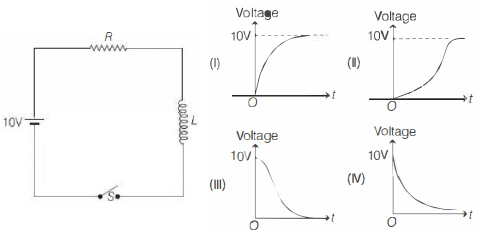
In the circuit shown below, the switch is closed at time $t=0$. Which of the graphs shown below best represents the voltage across the inductor, as seen on an oscilloscope?
Three concentric spherical metallic shells $X , Y$ and $Z$ of radius $a , b$ and c respectively $[ a < b < c ]$ have surface charge densities $\sigma,-\sigma$ and $\sigma$, respectively. The shells $X$ and $Z$ are at same potential. If the radii of $X$ and $Y$ are $2\,cm$ and $3\,cm$, respectively.The radius of shell $Z$ is $......cm$.
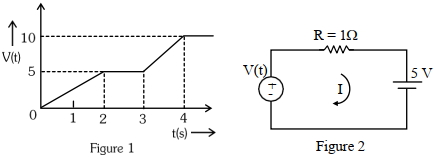
For the circuit shown, the value of current at time ${t}=3.2\, {s}$ will be ...... ${A}$.

[Voltage distribution $V(t)$ is shown by Fig. $(1)$ and the circuit is shown in Fig. $(2)$]
If the energy of a hydrogen atom in $n$th orbit is $E _{ n }$, then energy in the $n$th orbit of a singley ionized helium atom will be
A proton and an a-particle are accelerated through a potential difference of 100 V. The ratio of the wavelength associated with the proton to that associated with an a-particle is
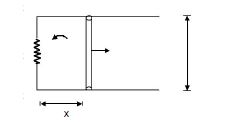
Two long parallel horizontal rails, a distance $l$ apart and each has a resistance $\lambda$ per  unit length are joined at one end by a resistance $R$. A perfectly conducting rod $MN$ of mass  $m$ is free to slide along the rails without friction. There is a uniform magnetic field of  induction $B$ normal to the plane of paper and directed into the paper. A variable force $F$ is applied to the rod $MN$ such that, as the rod moves, a constant current $i$ flows through $P$. The applied force $F$ as function of distance $x$ of the rod from $R$ is