MCQ
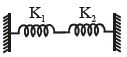
The effective spring constant of two spring system as shown in figure will be 
  • $K_1 + K_2$
  • B
    $K_1K_2/(K_1 + K_2)$
  • C
    $K_1 -K_2$
  • D
    $K_1K_2/(K_1 -K_2)$

Answer

Correct option: A.
$K_1 + K_2$
a
For Parallel combination $ K = K_1 + K_2$

Need a full question paper?

Generate a complete, print-ready paper with questions like this in minutes — across 16+ boards, with answer keys.

Start Generating Free

Similar questions

Dimensions of the following three quantities are the same
You lift a suitcase from the floor and keep it on the table. The work done by you on the suitcase depends on:
The speed of light $(c)$, gravitational constant $(G)$ and planck's constant $(h)$ are taken as fundamental units in a system. The dimensions of time in this new system should be
A vector is of magnitude $10\sqrt{3}$ units and making equal angles with the positive direction of $x, y$ and $z$ axis is:
Two trains $A$ and $B$ are running in the same direction on parallel rails such that $A$ is faster than $B$ . Packets of equal weight are transferred between them. What will happen due to this
$\mathrm{C}_{\mathrm{v}}$ and $\mathrm{C}_{\mathrm{p}}$ denote the molar specific heat capacities of a gas at constant volume and constant pressure, respectively. Then

$(A)$ $\mathrm{C}_{\mathrm{p}}-\mathrm{C}_{\mathrm{v}}$ is larger for a diatomic ideal gas than for a monoatomic ideal gas

$(B)$ $\mathrm{C}_{\mathrm{p}}+\mathrm{C}_{\mathrm{v}}$ is larger for a diatomic ideal gas than for a monoatomic ideal gas

$(C)$ $\mathrm{C}_{\mathrm{p}} / \mathrm{C}_{\mathrm{v}}$ is larger for a diatomic ideal gas than for a monoatomic ideal gas

$(D)$ $\mathrm{C}_{\mathrm{p}} \cdot \mathrm{C}_v$ is larger for a diatomic ideal gas than for a monoatomic ideal gas
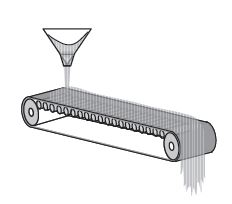
Sand is deposited at a uniform rate of $20\ kg/s$ and with negligible kinetic energy on an empty conveyor belt moving horizontally at a constant speed of $10$ meters per minute. Find the force required to maintain constant velocity of the conveyor belt.
One end of a massless spring of spring constant $k$ and natural length $l_{0}$ is fixed while the other end is connected to a small object of mass $m$ lying on a frictionless table. The spring remains horizontal on the table. If the object is made to rotate at an angular velocity $\omega$ about an axis passing through fixed end, then the elongation of the spring will be
The second overtone of an open organ pipe has the same frequency as the first overtone of a closed pipe $L$ metre long. The length of the open pipe will be 
The mass of air inside a room of dimension $(3 \times 4 \times 6)m^3$ can be compared to the mass of: