MCQ
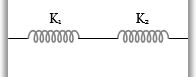
The effective spring constant of two spring system as shown in figure will be
- ✓${K_1} + {K_2}$
- B${K_1}{K_2}/{K_1} + {K_2}$
- C${K_1} - {K_2}$
- D${K_1}{K_2}/{K_1} - {K_2}$
i.e. $F = {F_1} + {F_2}$
==> $ - \,kx = - \,{k_1}x - {k_2}x$
$\Rightarrow $$k = {k_1} + {k_2}$
Generate a complete, print-ready paper with questions like this in minutes — across 16+ boards, with answer keys.
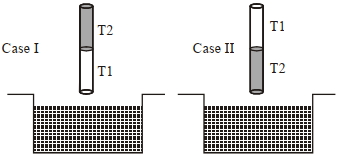
(Surface tension of water $=0.075 N / m$, density of water $=1000 kg / m ^3$, take $g =10 m / s ^2$ )
$(1)$ The correction in the height of water column raised in the tube, due to weight of water contained in the meniscus, will be different for both cases.
$(2)$ For case I, if the capillary joint is $5 cm$ above the water surface, the height of water column raised in the tube will be more than $8.75 cm$. (Neglect the weight of the water in the meniscus)
$(3)$ For case $I$, if the joint is kept at $8 cm$ above the water surface, the height of water column in the tube will be $7.5 cm$. (Neglect the weight of the water in the meniscus)
$(4)$ For case II, if the capillary joint is $5 cm$ above the water surface, the height of water column raised in the tube will be $3.75 cm$. (Neglect the weight of the water in the meniscus)