MCQ
The efficiency of an engine working between temperatures $T _1$ and $T _2$ is :
  • A
    $\left(1-\frac{T_1}{T_2}\right)$
  • $\left(1-\frac{T_2}{T_1}\right)$
  • C
    $\left(\frac{T_1}{T_2}-1\right)$
  • D
    $\left(\frac{T_1-T_2}{T_2}\right)$

Answer

Correct option: B.
$\left(1-\frac{T_2}{T_1}\right)$
B

Need a full question paper?

Generate a complete, print-ready paper with questions like this in minutes — across 16+ boards, with answer keys.

Start Generating Free

Similar questions

The equation of motion of a projectile are given by $ x = 36 t\,metre$ and $2y = 96 t -9.8 t^2\, metre$. The angle of projection is
Surface tension of a liquid is found to be influenced by
A boy is sitting on the horizontal platform of a joy wheel at a distance of $5 \,m$ from the center. The wheel begins to rotate and when the angular speed exceeds $1 \,rad / s$, the boy just slips. The coefficient of friction between the boy and the wheel is $\left(g=10 \,m / s ^2\right)$
A trolley of mass $300 \;kg$ carrying a sandbag of $25 \;kg$ is moving uniformly with a speed of $27\; km / h$ on a frictionless track. After a while, sand starts leaking out of a hole on the floor of the trolley at the rate of $0.05 \;kg s ^{-1} .$ What is the speed (in $km/h$) of the trolley after the entire sand bag is empty?
A particle is projected from ground with speed $80 \,m / s$ at angle $30^{\circ}$ with horizontal from ground. The magnitude of average velocity of particle in time interval $t=2 \,s$ to $t=6 \,s$ is ....... $m / s$ [Take $g=10 \,m / s ^2$ ]
The ratio of specific heat of a mixture of one mole of helium and one mole of hydrogen gas will be
If a gymnast sitting on a rotating stool with his arms outstretched, suddenly lowers his hands:
A $3\ kg$ sphere dropped through air has a terminal speed of $25\ m/s$. (Assume that the drag force is $-bv$.) Now suppose the sphere is attached to a spring of force constant $k = 300\ N/m$, and that it oscillates with an initial amplitude of $20\ cm$. What is the angular frequencu of its damped $SHM$? ..... $rad/s$
The acceleration of a particle is increasing linearly with time $t$ as $bt$. The particle starts from the origin with an initial velocity ${v_0}$. The distance travelled by the particle in time $t$ will be
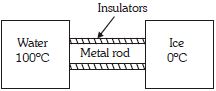
An insulated container is filled with ice at $0\,^oC$ , and another container is filled with water that is continuously boiling at $100\,^oC$ . In series of experiments, the containers are connected by various thick metal rods that pass through the walls of container as shown in the figure

In the experiment $I$ : a copper rod is used and all ice melts in $20$ minutes.

In the experiment $II$ : a steel rod of identical dimensions is used and all ice melts in $80$ minutes.

In the experiment $III$ : both the rods are used in series and all ice melts in $t_{10}$ minutes.

In the experiment $IV$ : both rods are used in parallel and all ice melts in $t_{20}$ minutes.