MCQ
The elastic limit for a gas
  • Exists
  • B
    Exists only at absolute zero
  • C
    Exists for a perfect gas
  • D
    Does not exist

Answer

Correct option: A.
Exists
a
(a)

Need a full question paper?

Generate a complete, print-ready paper with questions like this in minutes — across 16+ boards, with answer keys.

Start Generating Free

Similar questions

According to Newton, the viscous force acting between liquid layers of area $A$ and velocity gradient $\frac{\Delta v}{\Delta x}$ is given by $F=-\eta A \frac{\Delta v}{\Delta x}$, where $\eta$ is constant called coefficient of viscosity. The dimensional formula of $\eta$ is
A beaker is completely filled with water at $4°C$. It will overflow if
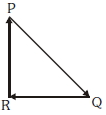
A particle moving with velocity $\overrightarrow{\mathrm{V}}$ is acted by three forces shown by the vector triangle $PQR$. The velocity of the particle will 
A ball of mass $m$ is thrown vertically upward. Another ball of mass $2\,m$ is thrown an angle $\theta$ with the vertical. Both the balls stay in air for the same period of time. The ratio of the heights attained by the two balls respectively is $\frac{1}{x}$. The value of $x$ is $.....$
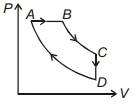
For $P-V$ diagram of a thermodynamic cycle as shown in figure, process $B C$ and $D A$ are isothermal. Which of the corresponding graphs is correct?
A body of mass ' ${m}$ ' dropped from a height ' ${h}$ ' reaches the ground with a speed of $0.8 \sqrt{{gh}}$. The value of workdone by the air-friction is $.....\,{mgh}$
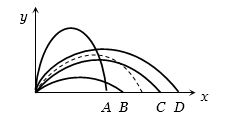
The path of a projectile in the absence of air drag is shown in the figure by dotted line. If the air resistance is not ignored then which one of the path shown in the figure is appropriate for the projectile
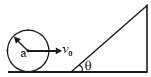
A sphere of radius $'a'$ and mass $'m'$ rolls along a horizontal plane with constant speed $v_{0}$. It encounters an inclined plane at angle $\theta$ and climbs upward. Assuming that it rolls without slipping, how far up the sphere will travel?
Consider a capacitor$-$charging circuit. Let $Q_1$ be the charge given to the capacitor in a time interval of $10 ms$ and $Q_2$ be the charge given in the next time interval of $10 ms$ . Let $10 mC$ charge be deposited in time interval $\mathrm{t}_1$ and another $10 mC$ charge be deposited in the next time interval $\mathrm{t}_2$.
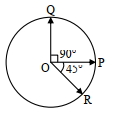
Three vectors $\overrightarrow{\mathrm{OP}}, \overrightarrow{\mathrm{OQ}}$ and $\overrightarrow{\mathrm{OR}}$ each of magnitude $A$ are acting as shown in figure. The resultant of the three vectors is $A \sqrt{x}$. The value of $x$ is. . . . . . . . .