A threaded rod with 12turns/ cm and diameter 1.18cm is mounted horizontally. A bar with a threaded hole to match the rod is screwed onto the rod. The bar spins at 216rev/ min. How long will it take for the bar to move 1.50cm along the rod?
Download our app for free and get started
Here, distance between two consecutive threads = pitch $=\frac{1}{12}\text{cm.}$ Total distance to be moved = 1.5m $\therefore$ No. of rotations $=\frac{1.5}{\frac{1}{12}}=18$ Total angle of turing, $\theta=18\times2\pi=36\pi$ radian angular speed, $\omega=2\pi\text{n}=2\pi\times\frac{216}{60}=7.2\pi\text{rad/s}$ $\therefore$ time taken, $\text{t}=\frac{\theta}{\omega}=\frac{36\pi}{7.2\pi}5\text{s}.$

Download our appand get started for free
Experience the future of education. Simply download our apps or reach out to us for more information. Let's shape the future of learning together!No signup needed.*
Similar Questions
- 1A solid sphere of mass 0.50kg is kept on a horizontal surface. The coefficient of static friction between the surfaces in contact is $\frac{2}{7}.$ What maximum force can be applied at the highest point in the horizontal direction so that the sphere does not slip on the surface?View Solution
- 2View SolutionA sphere of a radius 10cm weighs 1kg, calculate the moment of inertia.
- About the diameter.
- About the tangent.
- 3View Solution
- Prove the theorem of perpendicular axes.
- Prove the theorem of parallel axes.
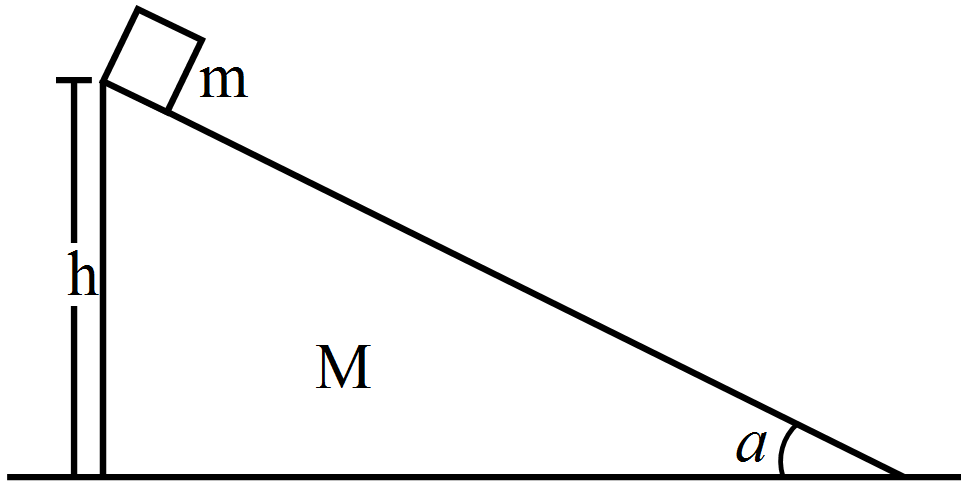
- 4View SolutionA block of mass m is placed on a triangular block of mass M, which in turn is placed on a horizontal surface as shown in figure. Assuming frictionless surfaces find the velocity of the triangular block when the smaller block reaches the bottom end.
- 5A car weighs $1800kg$. The distance between its front and back axles is $1.8m$. Its centre of gravity is $1.05m$ behind the front axle. Determine the force exerted by the level ground on each front wheel and each back wheel.View Solution
- 6View Solution
- Prove the theorem of perpendicular axes.
- Prove the theorem of parallel axes.
- 7View SolutionA uniform rod of length L lies on a smooth horizontal table. A particle moving on the table strikes the rod perpendicularly at an end and stops. Find the distance travelled by the centre of the rod by the time it turns through a right angle. Show that if the mass of the rod is four times that of the particle, the collision is elastic.
- 8A uniform wheel of radius R is set into rotation about its axis at an angular speed $\omega.$ This rotating wheel is now placed on a rough horizontal surface with its axis horizontal. Because of friction at the contact, the wheel accelerates forward and its rotation decelerates till the wheel starts pure rolling on the surface. Find the linear speed of the wheel after it starts pure rolling.View Solution
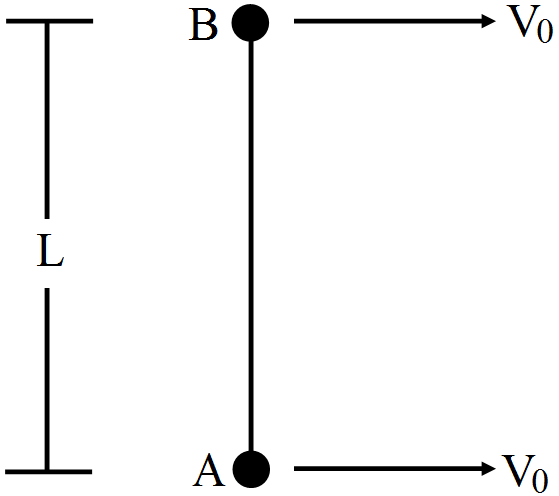
- 9View SolutionTwo small balls A and B, each of mass m, are joined rigidly to the ends of a light rod of lengh L (figure). The system translates on a frictionless horizontal surface with a velocity vo in a direction perpendicular to the rod. A particle P of mass m kept at rest on the surface sticks to the ball A as the ball collides with it. Find:
- The linear speeds of the balls A and B after the collision.
- The velocity of the centre of mass C of the system A + B + P.
- The angular speed of the system about C after the collision.
- 10View Solution
- Obtain an expression for moment of inertia of uniform circular disc about an axis perpendicular to the plane of disc and passing through its centre.
- Three point masses of 1kg, 2kg and 3kg lie at (1, 2), (0, -1) and (2, -3) respectively. Calculate the co-ordinates of centre of mass of the system.