MCQ
The electric field inside a conductor.
- AMust be zero.
- BMay be non-zero.
- CMust be non-zero.
- D(a) and (c) are correct.
Generate a complete, print-ready paper with questions like this in minutes — across 16+ boards, with answer keys.
The condition for observing Fraunhofer diffraction from a single slit is that the light wavefront incident on the slit should be
|
(a) Spherical |
(b) Cylindrical |
(c) Plane |
(d) Elliptical |
An a-particle of 5 MeV energy strikes with a nucleus of uranium at stationary at an scattering angle of 180o. The nearest distance upto which a-particle reaches the nucleus will be of the order of
|
(a) 1 Å |
(b) |
(c) |
(d) |
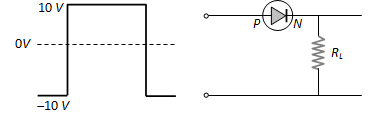
If the following input signal is sent through a PN-junction diode, then the output signal across RL will be
(a)
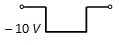
|
(b)
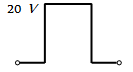
|
(c)
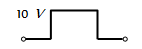
|
(d)
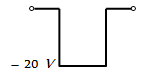
|
In the above question, the power lost in the cable during transmission is
|
(a) 12.5 kW |
(b) 6.25 kW |
(c) 25 kW |
(d) 3.15 kW |
$\text{v}=\frac{\text{v}_1+\text{v}_2}{2}$
$\text{v}=\sqrt{\text{v}_1\text{v}_2}$
$\frac{2}{\text{v}}=\frac{1}{\text{v}_1}+\frac{1}{\text{v}_2}$
$\frac{1}{\text{v}}=\frac{1}{\text{v}_1}+\frac{1}{\text{v}_2}$
The mass of an a-particle is
|
(a) Less than the sum of masses of two protons and two neutrons |
|
(b) Equal to mass of four protons |
|
(c) Equal to mass of four neutrons |
|
(d) Equal to sum of masses of two protons and two neutrons |
The Lyman series of hydrogen spectrum lies in the region
|
(a) Infrared |
(b) Visible |
(c) Ultraviolet |
(d) Of X - rays |


