MCQ
The electric field lines are crowded where electric field is:
- AStrong.
- BWeak.
- CModerate.
- DNone.
Generate a complete, print-ready paper with questions like this in minutes — across 16+ boards, with answer keys.
In Milikan's oil drop experiment, a charged drop falls with terminal velocity V. If an electric field E is applied in vertically upward direction then it starts moving in upward direction with terminal velocity 2V. If magnitude of electric field is decreased to  , then terminal velocity will become
|
(a) |
(b) V |
(c) |
(d) 2V |
The variation of the intensity of magnetisation (I) with respect to the magnetising field (H) in a diamagnetic substance is described by the graph
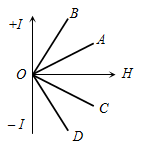
|
(a) OD |
(b) OC |
(c) OB |
(d) OA |
Let V and H be the vertical and horizontal components of earth's magnetic field at any point on earth. Near the north pole
|
(a) V >> H |
(b) V << H |
(c) V = H |
(d) V = H = 0 |
The amplification factor of a triode is 50. If the grid potential is decreased by 0.20 V, what increase in plate potential will keep the plate current unchanged
|
(a) 5 V |
(b) 10 V |
(c) 0.2 V |
(d) 50 V |
The bob of a simple pendulum is replaced by a magnet. The oscillations are set along the length of the magnet. A copper coil is added so that one pole of the magnet passes in and out of the coil. The coil is short-circuited. Then which one of the following happens
| (a) Period decreases | (b) Period does not change |
| (c) Oscillations are damped | (d) Amplitude increases |
Select the right option in the following
|
(a) Christian Huygens a contemporary of Newton established the wave theory of light by assuming that light waves were transverse |
|
(b) Maxwell provided the compelling theoretical evidence that light is transverse wave |
|
(c) Thomas Young experimentally proved the wave behaviour of light and Huygens assumption |
|
(d) All the statements give above, correctly answers the question “what is light” |
In the figure a potential of + 1200 V is given to point A and point B is earthed, what is the potential at the point P

|
(a) 100 V |
(b) 200 V |
(c) 400 V |
(d) 600 V |

