MCQ
Two parallel wires carrying currents in the same direction attract each other because of:
- APotential difference between them.
- BMutual inductance between them.
- CElectric forces between them.
- DMagnetic forces between them.
Generate a complete, print-ready paper with questions like this in minutes — across 16+ boards, with answer keys.
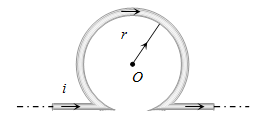
An infinitely long straight conductor is bent into the shape as shown in the figure. It carries a current of i ampere and the radius of the circular loop is r metre. Then the magnetic induction at its centre will be
(a)  
|
(b) 
|
(c) Zero |
(d) Infinite |
Infinite charges of magnitude q each are lying at x =1, 2, 4, 8... meter on X-axis. The value of intensity of electric field at point x = 0 due to these charges will be
|
(a) 12 ×109q N/C |
(b) Zero |
(c) 6 × 10⁹q N/C |
(d) 4 × 10⁹q N/C |
Express which of the following setups can be used to verify Ohm’s law
|
(a)
|
(b)
|
(c)
|
(d)
|
A point charge is kept at the centre of a metallic insulated spherical shell. Then
|
(a) Electric field out side the sphere is zero |
(b) Electric field inside the sphere is zero |
|
(c) Net induced charge on the sphere is zero |
(d) Electric potential inside the sphere is zero |
$\text{3V}\cos\theta$
$2\text{V}\cos\theta$
$\frac{3}{2}\text{V}\cos\theta$
$\text{V}\cos\theta$


