MCQ
The electric fields of two plane electromagnetic plane waves in vacuum are given by

$\overrightarrow{\mathrm{E}}_{1}=\mathrm{E}_{0} \hat{\mathrm{j}} \cos (\omega \mathrm{t}-\mathrm{kx})$ and

$\overrightarrow{\mathrm{E}}_{2}=\mathrm{E}_{0} \hat{\mathrm{k}} \cos (\omega \mathrm{t}-\mathrm{ky})$

At $t=0,$ a particle of charge $q$ is at origin with a velocity $\overrightarrow{\mathrm{v}}=0.8 \mathrm{c} \hat{\mathrm{j}}$ ($c$ is the speed of light in vacuum). The instantaneous force experienced by the particle is 

  • A
    $\mathrm{E}_{0} \mathrm{q}(-0.8 \hat{\mathrm{i}}+\hat{\mathrm{j}}+\hat{\mathrm{k}})$
  • B
    $\mathrm{E}_{0} \mathrm{q}(0.8 \hat{\mathrm{i}}-\hat{\mathrm{j}}+0.4 \hat{\mathrm{k}})$
  • $\mathrm{E}_{0} \mathrm{q}(0.8 \hat{\mathrm{i}}+\hat{\mathrm{j}}+0.2 \hat{\mathrm{k}})$
  • D
    $\mathrm{E}_{0} \mathrm{q}(0.4 \hat{\mathrm{i}}-3 \hat{\mathrm{j}}+0.8 \hat{\mathrm{k}})$
Answer

Correct option: C.
$\mathrm{E}_{0} \mathrm{q}(0.8 \hat{\mathrm{i}}+\hat{\mathrm{j}}+0.2 \hat{\mathrm{k}})$
c
$\overrightarrow{\mathrm{E}}_{1}=\mathrm{E}_{0} \mathrm{j} \cos (\omega \mathrm{t}-\mathrm{kx})$

Its corresponding magnetic field will be

$\overrightarrow{\mathrm{B}}_{1}=\frac{\mathrm{E}_{0}}{\mathrm{c}} \hat{\mathrm{k}} \cos (\omega \mathrm{t}-\mathrm{kx})$

$\overrightarrow{\mathrm{E}}_{2}=\mathrm{E}_{0} \hat{\mathrm{k}} \cos (\omega \mathrm{t}-\mathrm{ky})$

$\overrightarrow{\mathrm{B}}_{2}=\frac{\mathrm{E}_{0}}{\mathrm{c}} \hat{\mathrm{i}} \cos (\omega \mathrm{t}-\mathrm{ky})$

Net force on charge particle

$=\mathrm{q} \overrightarrow{\mathrm{E}}_{1}+\mathrm{q} \overrightarrow{\mathrm{E}}_{2}+\mathrm{q} \overrightarrow{\mathrm{v}} \times \mathrm{B}_{1}+\mathrm{q} \overrightarrow{\mathrm{v}} \times \overrightarrow{\mathrm{B}}_{2}$

$=\mathrm{q} \mathrm{E}_{0} \hat{\mathrm{j}}+\mathrm{q} \mathrm{E}_{0} \hat{\mathrm{k}}+\mathrm{q}(0.8 \mathrm{c} \hat{\mathrm{j}}) \times\left(\frac{\mathrm{E}_{0}}{\mathrm{c}} \hat{\mathrm{k}}\right)+\mathrm{q}(0.8 \mathrm{c} \hat{\mathrm{j}}) \times\left(\frac{\mathrm{E}_{0}}{\mathrm{c}} \hat{\mathrm{i}}\right)$

$=\mathrm{q} \mathrm{E}_{0} \hat{\mathrm{j}}+\mathrm{q} \mathrm{E}_{0} \hat{\mathrm{k}}+0.8 \mathrm{q} \mathrm{E}_{0} \hat{\mathrm{i}}-0.8 \mathrm{q} \mathrm{E}_{0} \hat{\mathrm{k}}$

$\overrightarrow{\mathrm{F}}=\mathrm{q} \mathrm{E}_{0}[0.8 \hat{\mathrm{i}}+1 \hat{\mathrm{j}}+0.2 \hat{\mathrm{k}}]$

Need a full question paper?

Generate a complete, print-ready paper with questions like this in minutes — across 16+ boards, with answer keys.

Start Generating Free

Similar questions

For a colour of light the wavelength for air is $6000 Å$ and in water the wavelength is $4500 Å.$ Then the speed of light in water will be
The two thin coaxial rings, each of radius $'a'$ and having charges $+{Q}$ and $-{Q}$ respectively are separated by a distance of $'s'.$ The potential difference between the centres of the two rings is :
Which reaction is not part of proton-proton cycle
A particle of mass $m$ having negative charge $q$ move along an ellipse around a fixed positive charge $Q$ so that its maximum and minimum distances from fixed charge are equal to $r_1$ and $r_2$ respectively. The angular momentum $L$ of this particle is
A man of height $170\,cm$ wants to see his complete image in a plane mirror (while standing). This eyes are at a height of $160 \,cm$ from the ground.

$(a)$ Minimum length of mirror is $80\,cm$

$(b)$ Minimum length of mirror is $85\,cm$.

$(c)$ Bottom of the mirror should be at a height $80\,cm$

$(d)$ Bottom of the mirror should be at a height $85\,cm.$

Energy per unit volume for a capacitor having area $A$ and separation $d$ kept at potential difference $V$ is given by
A beam of natural light falls on a system of $6$ polaroids, which are arranged in succession such that each polaroid is turned through $30^o $ with respect to the preceding one. The percentage of incident intensity that passes through the system will be....$\%$
A photon and an electron have equal energy $E$. ${\lambda_{{\rm{photon}}}}/{\lambda _{{\rm{electron}}}}$ is proportional to
A block of mass $m$ is lying on an inclined plane. The coefficient of friction between the  plane and the block is $\mu$. The force $(F_1)$ required to move the block up the  inclined plane will be
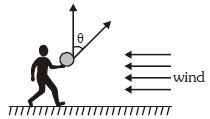
A body throws a ball upwards with velocity $v_0 = 20\, m/s$ . The wind imparts a horizontal acceleration of $4\, m/s^2$ to the ball. The angle $\theta $ from vertical at which the ball must be thrown so that the ball returns to the boy's hand is $(g = 10\, m/s^2)$