MCQ
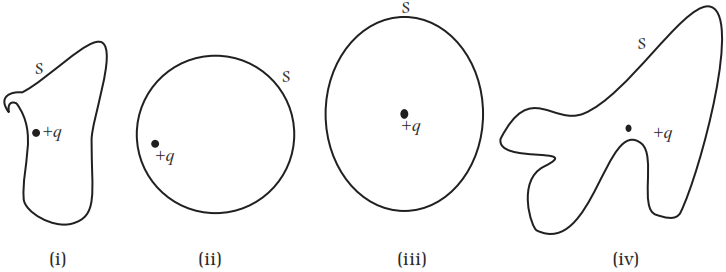
The Electric flux through the surface:
  • A
    In Fig. $1.3 (iv)$ is the largest.
  • B
    In Fig. $1.3 (iii)$ is the least.
  • C
    In Fig. $1.3 (ii)$ is same as Fig. $1.3 (iii)$ but is smaller than Fig. $1.3 (iv)$
  • Is the same for all the figures.

Answer

Correct option: D.
Is the same for all the figures.
Key concept: According to Gauss' law of electrostatics, the total electric flux out of a closed surface is equal to the charge enclosed divided by the permittivity,
$\text{i.e.,}\phi=\frac{\text{Q}_\text{enclosed}}{\in_0}$
Thus, electric flux through a surface doesn't depend on the shape, size or area of a surface but it depends on the amount of charge enclosed by the surface.
In given figures the charge enclosed are same that means the electric flux through all the surfaces should be the same. Hence option $(d)$ is correct.

Need a full question paper?

Generate a complete, print-ready paper with questions like this in minutes — across 16+ boards, with answer keys.
Start Generating Free

Similar questions

All of the following statements are true except
 A wire of resistance $4 \,\Omega$ is stretched to twice its original length. The resistance of stretched wire would be ........... $\Omega$
Calculate the amount of charge on capacitor of $4\, \mu\, {F}$. The internal resistance of battery is $1\, \Omega$ : (in $\mu {C}$)
The figure, shows a transparent sphere of radius $R$ and refractive index $\mu$ . An object $O$ is placed at a distance $x$ from the pole of the first surface so that a real image is formed at the pole of the exactly opposite surface. In previous problem, if the refractive index of the sphere is varied, then the position $x$ of the object and its image from the respective poles will also vary. Identify the correct statement.
A square loop $\mathrm{PQRS}$ having $10$ turns, area $3.6 \times$ $10^{-3} \mathrm{~m}^2$ and resistance $100 \Omega$ is slowly and uniformly being pulled out of a uniform magnetic field of magnitude $\mathrm{B}=0.5 \mathrm{~T}$ as shown. Work done in pulling the loop out of the field in $1.0 \mathrm{~s}$ is. . . . . $\times 10^{-6} \mathrm{~J}$.
The voltage of domestic ac is $220$ $ volt$. What does this represent
Energy required for the electron excitation in $Li++$ from the first to the third Bohr orbit is:
Electromagnetic waves
Carbon, silicon and germanium have four valence electrons each. At room temperature which one of the following statements is most appropriate ?
Which of the following is correct for light diverging from a point source?