MCQ
The electrical resistance of depletion layer is large because
  • It has no charge carriers
  • B
    It has a large number of charge carriers
  • C
    It contains electrons as charge carriers
  • D
    It has holes as charge carriers

Answer

Correct option: A.
It has no charge carriers
a
(a)Depletion layer consist of mainly stationary ions.

Need a full question paper?

Generate a complete, print-ready paper with questions like this in minutes — across 16+ boards, with answer keys.
Start Generating Free

Similar questions

Two capacitors of capacities $C_1$ and $C_2$ are charged to voltages $V_1$ and $V_2$ respectively. There will be no exchange of energy in connecting them in parallel, if
Which waves are used by artificial satellites for communication?
The Young's experiment is performed with the lights of blue $4360 \;\mathring A$ and green colour $5460 \;\mathring A$, If the distance of the 4th fringe from the centre is $x$, then
In a Young’s double slit experiment, the slits are placed $0.320\,mm$ apart. Light of wavelength $\lambda = 500\,nm$ is incident on the slits. The total number of bright fringes that are observed in the angular range $ - {30^o} \le \theta  \le {30^o}$ is
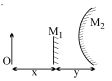
An object $O$ is placed in front of a small plane mirror $M_1$ and $a$ large convex mirror $M_2$ of focal length $f$. The distance between $O$ and $M_1$ is $x$, and the distance between $M_1$ and $M_2$ is $y$. The images of $O$ formed by $M_1$ and $M_2$ coincide. The magnitude of $f$ is
If six identical cells each having an e.m.f. of 6V are connected in parallel, the e.m.f. of the combination is
Figure shows four situations in which an electron is moving in electric/magnetic field. In which case the de Broglie wavelength of electron is increasing?
When two light nuclei fuse to form a relatively heavier nucleus, the specific binding energy of the product nucleus is:
An electron (charge =$1.6 \times {10^{ - 19}}C$) is accelerated through a potential of $ 100,000 V$. The energy acquired by the electron is
A primary cell has an e.m.f. of 1.5 volts, when short-circuited it gives a current of 3 amperes. The internal resistance of the cell is